Australian students went scuba diving to rebuild an oyster reef; 28 underwater structures quickly attracted oysters and marine life
Australian high school students have taken part in an underwater experiment aimed at bringing native oyster reefs back to Coffin Bay in South Australia.
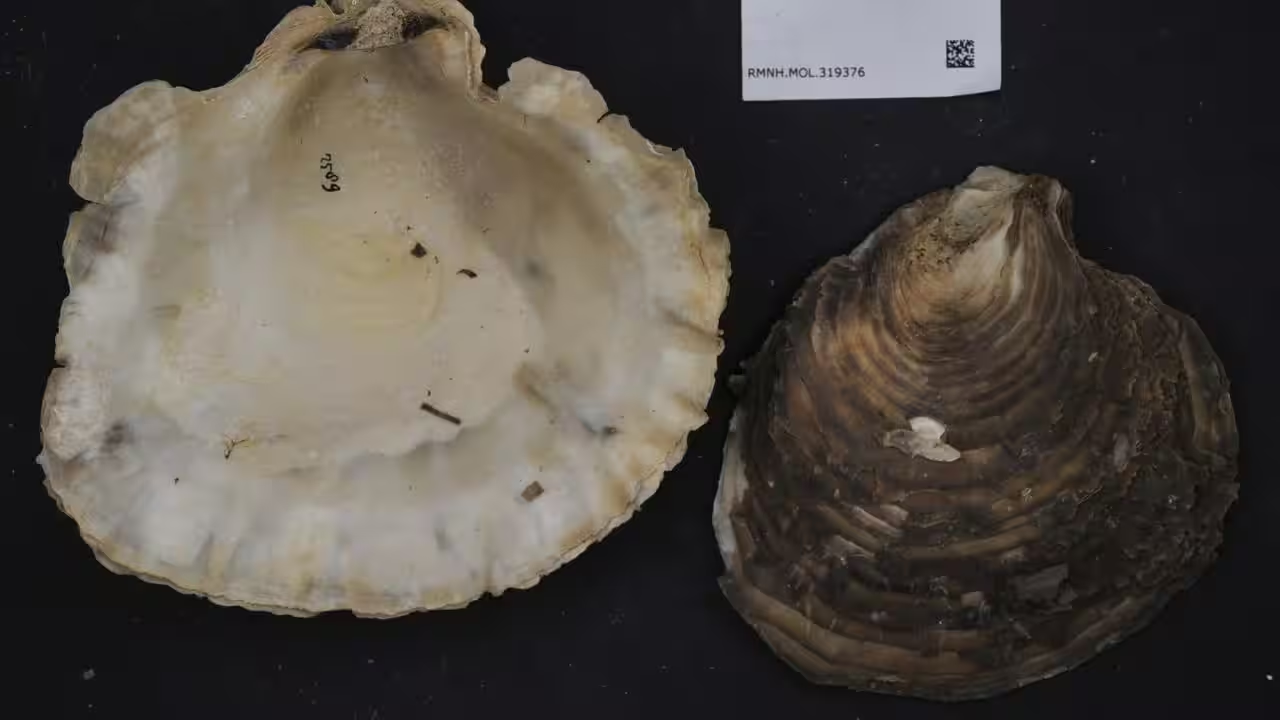
Australian high school students have taken part in an underwater experiment aimed at bringing native oyster reefs back to Coffin Bay in South Australia. After receiving SCUBA training, the students helped place 28 restoration units across different sites in the bay. The structures were made from old oyster shells inside mesh crates, creating a base where young oysters and other marine organisms could settle. When researchers returned three months later, every unit had attracted oysters, while hundreds of other marine organisms had also colonised the structures, according to a 2026 study published in People and Nature.Australian students learned scuba diving to rebuild the oyster reefThe project brought local teenagers directly into marine restoration rather than keeping the research work on land. The study involved 10 students aged about 15 to 17 from 2 regional high schools, who worked with diving professionals to prepare and deploy the experiment.Before entering the water, the students completed SCUBA training and received PADI Open Water Diver certification. The training was provided without cost to their families through funding from an Environmental Citizen Science Small Grant from the South Australian Government.The students also helped collect old oyster shells from historical reef locations. These shells had been buried beneath sediment and were carefully excavated by hand while diving. After organisms were removed, the shells were cleaned, dried and sterilised before being used in the experiment.Why were oysters being restored in Coffin BayCoffin Bay once had some of South Australia's largest native oyster reefs. The study explains that the native oyster Ostrea angasi was historically an important part of the seafloor, and the first colonial settlement in the area was even called Oyster Town because of the productive oyster dredge fishery.That fishery did not last. Decades of overharvesting drove native oysters to functional extinction in the area, while dredging also removed the shells that young oysters need to settle and build new reefs. Sediment runoff later covered much of the remaining shell material, leaving little natural recovery after dredging ended.The bay still has an oyster industry based on introduced Pacific oysters, but the researchers were interested in whether native oysters could once again establish themselves using suitable habitat.What did the 28 underwater structures containThe researchers placed 28 restoration units across 8 sites in Coffin Bay. Four of the locations were inside no-fishing Sanctuary Zones, while four nearby sites were used as control areas.Each unit contained 100 clean native oyster shells inside a plastic mesh crate measuring 40 by 20 by 15 centimetres. The open structure allowed water and small animals to move through the shells while providing a hard surface for young oysters to settle.Two concrete settlement panels were also attached to each unit. The experiment was deployed during the oyster recruitment season, from January to April, and all 28 units went into the water on the same day.Three months later, the students returned with researchers to retrieve the structures. The team examined the oysters and other organisms found inside them, with smaller creatures later identified in the laboratory.Analysing the underwater structures after 3 monthsThe underwater units quickly became occupied. Oysters recruited to every restoration unit, although the number varied substantially between locations.Across the sites, individual units contained between 26 to 2,388 oysters. Dutton Bay recorded the highest average recruitment, with about 1,257 oysters per unit, compared with 348 at Kellidie Bay and 160 at Yangie Bay.The settlement panels also recorded large numbers of young oysters, ranging from 44 to 20,065 oysters per square metre. The researchers found that recruitment differed between locations, showing that some parts of Coffin Bay may provide more favourable conditions for rebuilding reefs than others.The structures were not used only by oysters. After three months, 3,342 organisms representing 68 faunal species had colonised the restoration units. The researchers also recorded new occurrence and distribution information for several species in the region, including two fish species.The study found that marine life differed between locations and between Sanctuary and control areas. Sanctuary areas also showed higher measures of species diversity, although the effects varied depending on the site.What did the students hope to gain from the projectThe underwater work was not simply a science exercise for the teenagers. Researchers examined why the students wanted to participate by analysing their application essays.They identified 23 different motivations, which appeared 297 times across the 10 essays. Personal benefits accounted for 36% of the motivations, while environmental benefits and community or social opportunities each accounted for 32%.Students described gaining experience, learning about marine science, developing possible career skills and spending time in the ocean. Environmental reasons included protecting local biodiversity and helping nature. Others were motivated by their connection to Coffin Bay and the chance to contribute to their own community.Half of the students specifically recognised the project as a potential career-building experience, including opportunities connected with conservation and environmental work.Importance of this oyster experiment for future restorationFor the researchers, the experiment provided two kinds of information at once. It showed that native oysters could still recruit in large numbers in Coffin Bay, while also giving local students and residents direct experience with restoration.The findings suggested that restoring the lost reefs could be feasible using natural oyster recruitment. Recruitment varied between sites, but oysters appeared on every restoration unit, including areas where the historical reef ecosystem had been heavily degraded.The researchers said the knowledge generated by the project subsequently enabled the first oyster reef restoration on South Australia's Eyre Peninsula, with the work continuing through community participation.You use AI every day. Now get your AI Quotient. Take the AIQ test.
Topics in this story
Gathered from external sources. Rights to this text belong to whoever originally published it.