In 1998, Israel closed the Hiriya landfill after decades of waste had formed a 60-metre mound; years later, methane wells, trees and trails helped transform the site into the centrepiece of a 2,000-acre park
Rest of World News: Discover how the former Hiriya landfill in Israel evolved into the lush Ariel Sharon Park, a prime example of urban reclamation and sustainable design, transforming environmental hazards into a thriving green space.
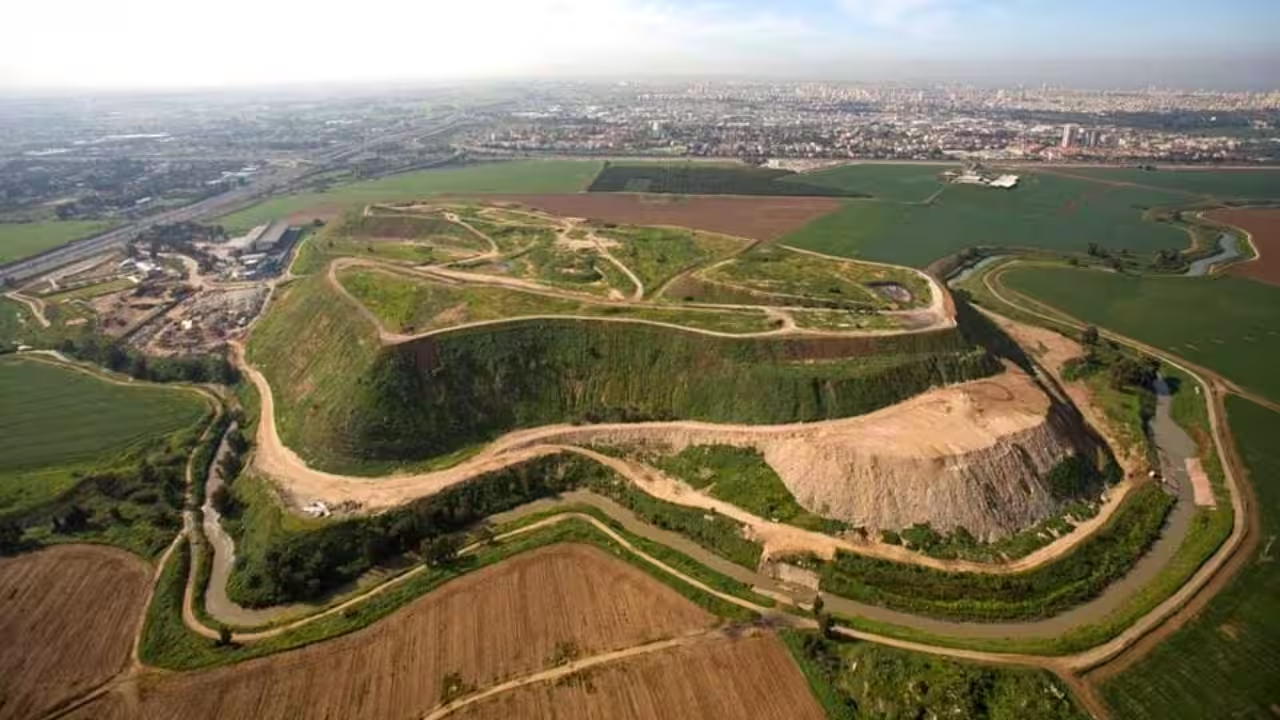
In August 1998, Israel closed the Hiriya landfill after almost five decades of receiving waste from the Dan Region. By then, the site had grown into a garbage hill of roughly 60 metres high. This huge landfill footprint accounted for an estimated 25 million tons of accumulated waste, a figure supported by a 2006 peer-reviewed study that calculated the physical volume of the buried material at approximately 16 million cubic metres. The landfillâs closure, however, did not remove the mountain; instead, it began a long process of engineering, gas management and landscape rehabilitation that eventually led to the former dump becoming the centrepiece of Ariel Sharon Park, a planned metropolitan park covering about 2,000 acres.An accumulating waste mountain turns into an environmental hazardHiriya opened in 1952 and became the principal waste-disposal ground for most of the Dan Region. According to O. Ayalon, N. Becker and E. Shaniâs 2006 study published in Waste Management, the landfill operated until 1998 and developed into a major environmental hazard. When the site closed, approximately 16 million cubic metres of waste were estimated to remain buried there. The study also identified several problems requiring rehabilitation, including greenhouse gas emissions, unstable slopes and leachate formation.The moundâs location made things even more complicated, with the landfillâs proximity to Ben Gurion Airport and the birds attracted by decomposing waste. Contemporary accounts identified those birds as an aviation hazard because of their proximity to aircraft during takeoff and landing. However, the bird problem was only one part of a larger environmental challenge that included leachate, landfill gas, instability and the sheer scale of the waste mound.The 2006 study pointed out that closing the landfill did not mean simply walking away from it. While emergency interim measures were deployed immediately in 1998 to manage urgent bird hazards and slope stability, comprehensive, long-term rehabilitation efforts began in 2001, including site investigations, engineering and scientific evaluations and planning for the landscapeâs eventual use. The conclusion notes that engineering rehabilitation was necessary to make a public park possible, while converting the site into a park provided the strongest justification for the wider reclamation attempt.Methane wells help stabilise the waste mountainOne of the most persistent problems faced by the authorities was the landfill gas. Organic material buried in the mountain continued to decompose after the landfill stopped accepting waste, producing methane. As per Hiriyaâs current account of its biogas project, to address this, an engineered gas-extraction system was developed to draw methane from the mass of waste, eventually expanding to comprise approximately 100 wells divided into nine clusters. These wells were drilled to depths of about 12 to 27 metres, depending on local leachate levels.Hiriyaâs records indicate that the gas project was already developing before the park became a public landscape. An agreement giving Ayalon Biogas the extraction rights was signed in 2005, and by capturing the methane and piping it to a nearby textile factory to replace fossil fuels, the project successfully mitigated greenhouse gas emissions. As a result, in 2006, the initiative received formal registration under the UN Clean Development Mechanism.Meanwhile, planners were still contemplating what the enormous waste mound could be transformed into. In 2004, an international competition was held to find a way to rehabilitate Hiriya and give the former landfill a new identity. Fourteen proposals were submitted, and German landscape architect Peter Latz and his team won the competition. A 2023 peer-reviewed study of the competition describes the winning proposal as turning the waste mountain into a prominent landscape monument while addressing the siteâs polluted past. The park was conceived on a scale much larger than the landfill itself, that is, about 2,000 acres that included the former waste mountain and its surrounding site.Trees and trails replaced the old landscapeThe physical transformation required that the waste mountain be treated as an engineered landform rather than an ordinary hill. Landscape plans called for its surface to be protected with engineered layers and clean soil so vegetation could grow without coming directly in contact with the waste beneath it. This approach allowed trees, grasses and other plants to become a part of the new landscape while the former wasteland continued to be monitored and managed underneath.By the early 2010s, the summit of the past landfill had already acquired landscaped paths and an overlook, while additional cycling and recreation facilities were being developed across the wider park. The Times of Israel reported that the larger park project had been officially approved as a 2,000-acre park and was being built in stages.Therefore, Ariel Sharon Park is often cited as an example of circular urban engineering and landscape reclamation. By capping the waste mass, capturing toxic off-gases, and restoring native flora, planners converted a toxic regional liability into a thriving urban sanctuary. Hiriya's legacy illustrates that modern metropolitan growth does not have to be permanently bound by its past waste, paving the way for sustainable city infrastructure worldwide.Catch the latest World News and Live updates. Download the TOI app.
Topics in this story
Gathered from external sources. Rights to this text belong to whoever originally published it.