A Toronto schoolgirl picked up a stone point at Fort York in 1935 and kept it for 80 years; it was later dated to 4,000-6,000 years ago
Discover the remarkable story of a Toronto schoolgirl who uncovered a 4,000-6,000-year-old quartzite projectile point during a school trip to Fort York, shedding light on the ancient history of First Nations in the area.
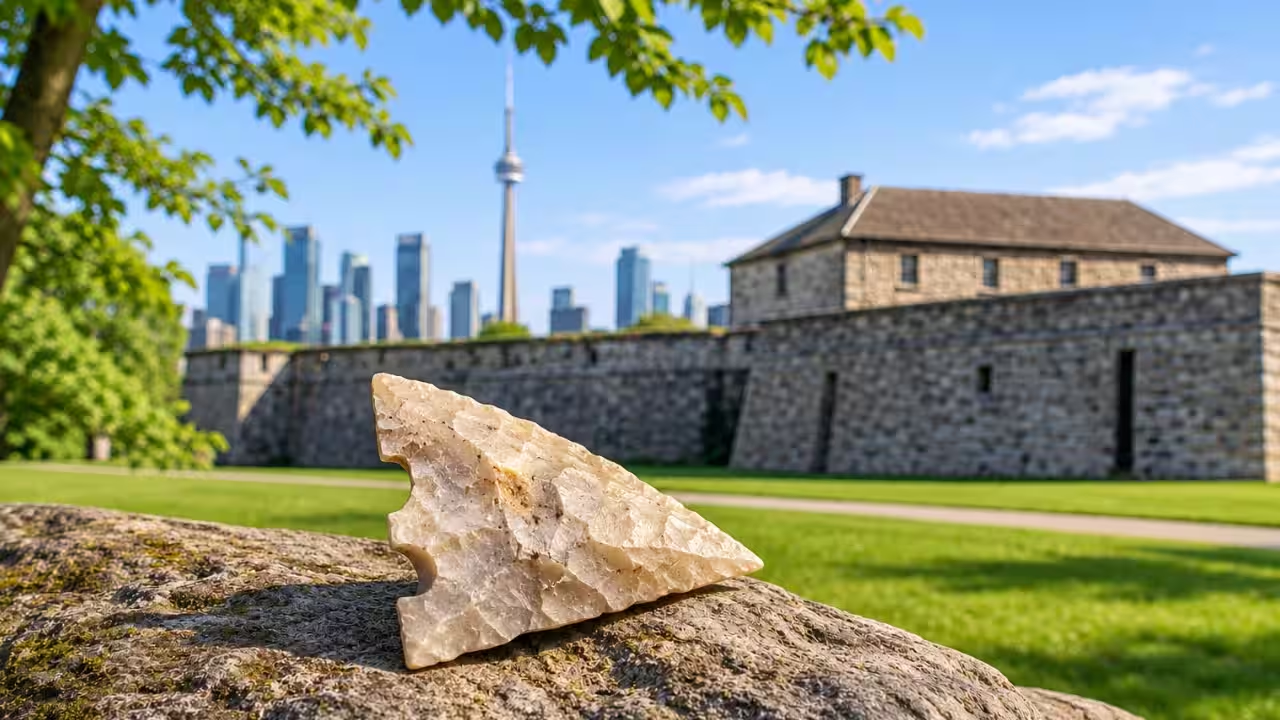
According to the Friends of Fort York newsletter, a school trip to Fort York in Toronto in 1935 gave ten-year-old Jeanne Carter an unusual souvenir. While walking along a sandy path towards a building, she noticed a small white stone on the ground and picked it up. She had no idea how old it was or why it might be important. Carter kept the artefact in her curio cabinet for about eighty years until a historian analysed it and found it had been made 4,000 to 6,000 years ago. The artefact was a quartzite projectile point, which dated back to the Archaic period in the Indigenous history of that place. It provided insight into the history of the area many years prior to the establishment of Fort York as a military installation.A small discovery during a school tripThe stone was found by Carter at the Fort York field trip in 1935. In one of her recollections, Carter remembered approaching a building on a sandy track where she saw a white piece. She picked it up and took it back home. It spent nearly eight decades in her curio cabinet before it was given by Carter to her friend working in the museum. This friend then handed it over to Richard Gerrard, a historian in the City of Toronto who identified the archaeological value of the item. According to the Friends of Fort York, the stone was made from quartzite. Gerrard considered the material unusual for this part of Ontario, raising the possibility that it had travelled a considerable distance through trade or movement between communities.A tool in the Archaic periodThis item was estimated to be 4,000 to 6,000 years old; hence, it belonged to the Archaic period, a broad period of Indigenous history prior to the arrival of Europeans. Projectile points were part of Indigenous technologies and as Ontario Parks notes, were often used for hunting or butchering, yet no clear application of Carter's artefact had been defined. Neither the identity of its original owner nor the circumstances behind how it ended up at Fort York had been determined. The fact that it was made of quartzite was especially intriguing. Gerrard proposed that the arrival of this material in Toronto could indicate long-distance migration or trade. No information was provided about the origin of the rock used for creating this artefact.One of only four projectilesWhat made Carter's discovery unique was that it was one of just four projectile points ever found at Fort York, according to the Friends of Fort York newsletter. The other three were uncovered during excavations conducted by archaeologists. Carter, in turn, made her discovery while walking through the site during her field trip. Moreover, the artefact proved to be one of the oldest items in the City of Toronto's collection, according to the Friends of Fort York newsletter, which demonstrated that there was a lot of history hidden under the current urban environment. It was generally known that Fort York was strongly connected with Toronto's military history, namely with the War of 1812.The findings showed that people used the area for thousands of years before the fort was built. According to Wayne Reeves, who is the chief curator of Museums and Heritage Services, the archaeological material demonstrated the presence of First Nations over thousands of years. This kind of item is important historical proof because the Archaic period predates written records in the region, so archaeological finds are essential to knowing the story of the people who lived there. Having been in the possession of Carter for almost 80 years, the point was finally donated and the Friends of Fort York newsletter describes it as one of the oldest artefacts in the City of Toronto's collection.You use AI every day. Now get your AI Quotient. Take the AIQ test.
Topics in this story
Gathered from external sources. Rights to this text belong to whoever originally published it.