What is Meta accusing SoFloAntonio of? YouTuber Coffeezilla breaks down $8 million lawsuit and ad claims
US Streamers News: YouTuber and investigative journalist Stephen “Coffeezilla” has taken a closer look at Meta’s lawsuit against fellow creator Antonio “SoFloAntonio” Li.
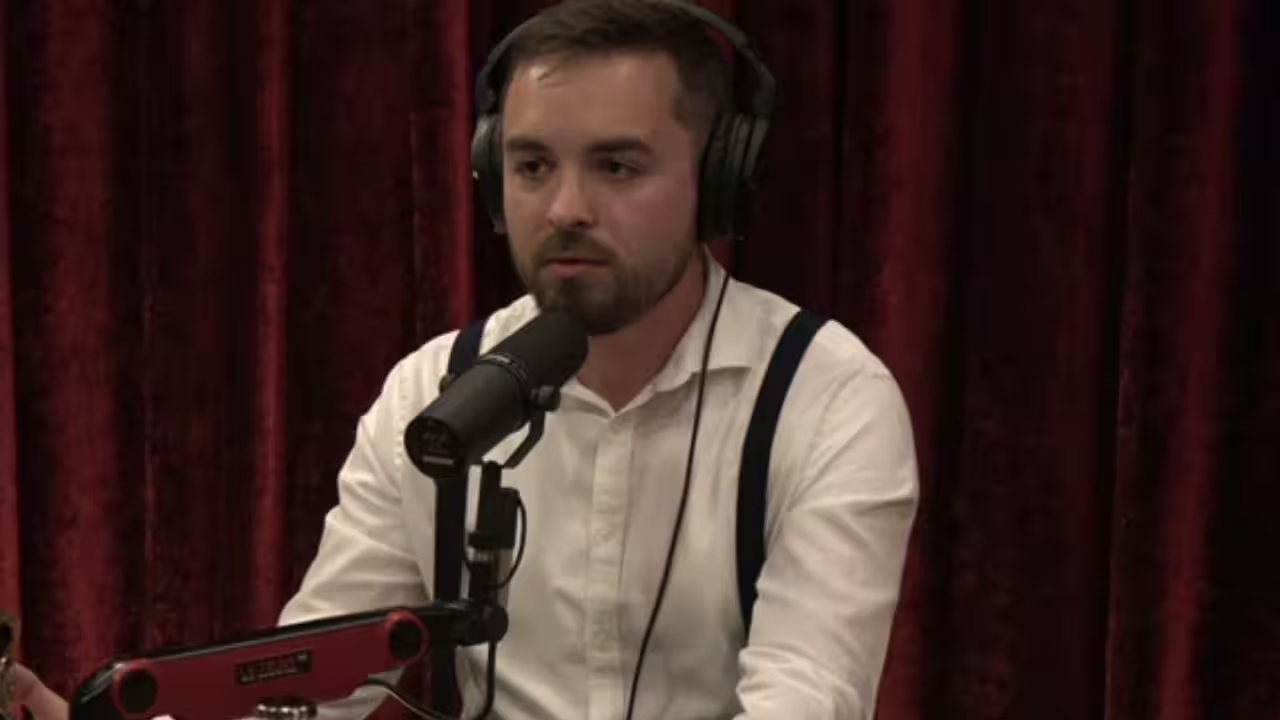
YouTuber and investigative journalist Stephen “Coffeezilla” has taken a closer look at Meta’s lawsuit against fellow creator Antonio “SoFloAntonio” Liévano. The case, filed in federal court, accuses Liévano and his businesses of using misleading financial documents to obtain more than $8 million in advertising credit from Meta. The company also alleges that those credits were used to run thousands of deceptive ads on Facebook and Instagram. Coffeezilla discussed the case and focused on the alleged subscription schemes behind some of the products promoted through those advertisements. Liévano has denied that his businesses were running a deceptive rebilling scam.Coffeezilla explains Meta’s allegations against SoFloAntonioCoffeezilla recently broke down the lawsuit, titled Meta Platforms, Inc. v. Judang Team LLC et al. Meta alleges that Liévano and his companies used false financial documents to convince the company to increase their advertising credit lines.According to court records, Meta says the defendants received more than $8.1 million in credit and stopped paying their advertising invoices in April 2024. The outstanding balance was at least $8,111,746.62. Meta also alleges that the defendants used the credit to purchase advertisements that promoted bait-and-switch and subscription schemes.Coffeezilla highlighted the financial allegations during his breakdown.He said:“[Meta] says: ‘Defendant used false and misleading documents to induce Meta to provide more than $8.1 million in ad credit lines.’ Meta goes on to argue that SoFloAntonio used various business snapshots that were misleading to make him seem like he's in better financial health than he actually was in order to get Meta to give him more and more ad credit lines.”The lawsuit also alleges that the defendants created and ran more than 9,000 advertisements on Facebook and Instagram between February 2021 and July 2024. Meta claims some of those advertisements were connected to merchandise and subscription offers.Coffeezilla described the alleged advertising strategy as a “bait-and-switch” and criticized the use of advertisements to direct customers toward subscription-based products.He said:“Where I have a problem is where Antonio has targeted regular customers to induce them into bait-and-switch subscription schemes in order to siphon money out of their pockets.”Coffeezilla says he found a $49 subscription while testing a SoFloAntonio websiteCoffeezilla also discussed one of the websites linked to the allegations. He said he purchased a Bible from a site called Dawn or Dusk while investigating the claims.According to Coffeezilla, the item had not arrived when he discussed the case. He also said the checkout page contained information about a $49 recurring subscription in small print.He explained:“I actually purchased one of these. Spoiler, I haven't gotten it, but I noticed the fine print at the very bottom if you scroll way below the ‘buy now’ page... you're signing up for the Dawn or Dusk Club priced at $49 every 28 days until you decide to terminate.”Coffeezilla strongly criticized what he saw as the use of religious products in the alleged business model.“You shouldn't do this. This is really disgusting and grotesque. Literally trying to appeal to people at their lowest moments.”Liévano disputed that characterization when responding to Coffeezilla’s questions. He said the Bible product line was introduced by his business partner Chester and was not created as a way to exploit people’s faith.Liévano said:“That product line was brought into the business by Chester. It's not a concept I developed as a strategy to target people because of their religion or exploit anyone's faith.”He also denied that the businesses were operating a deceptive rebilling scheme.“‘I dispute the characterization that these businesses were operating a deceptive re-billing scam,’ he says. ‘That's because customers had a way to contact us regarding cancellations, and our customer service team handled cancellations and refunds. We were flexible with resolving these issues.’”The court has not ruled that the alleged fraud occurred. In January 2026, Judge Thomas S. Hixson denied the defendants’ motion to dismiss, allowing Meta’s claims to continue.The case remains active. In August 2026, the court extended the schedule, with fact and expert discovery set to close in February 2027 and a jury trial currently scheduled for September 2027.Catch the latest World News and Live updates. Download the TOI app.
Topics in this story
Gathered from external sources. Rights to this text belong to whoever originally published it.