In 2021, Iowa road projects used plastic additive equal to 15 million bottles; on one busy test stretch, it held up better than adjacent regular asphalt
Explore how Iowa's incorporation of recycled plastic in asphalt projects, equivalent to 15 million bottles, is promising better road durability and sustainability.
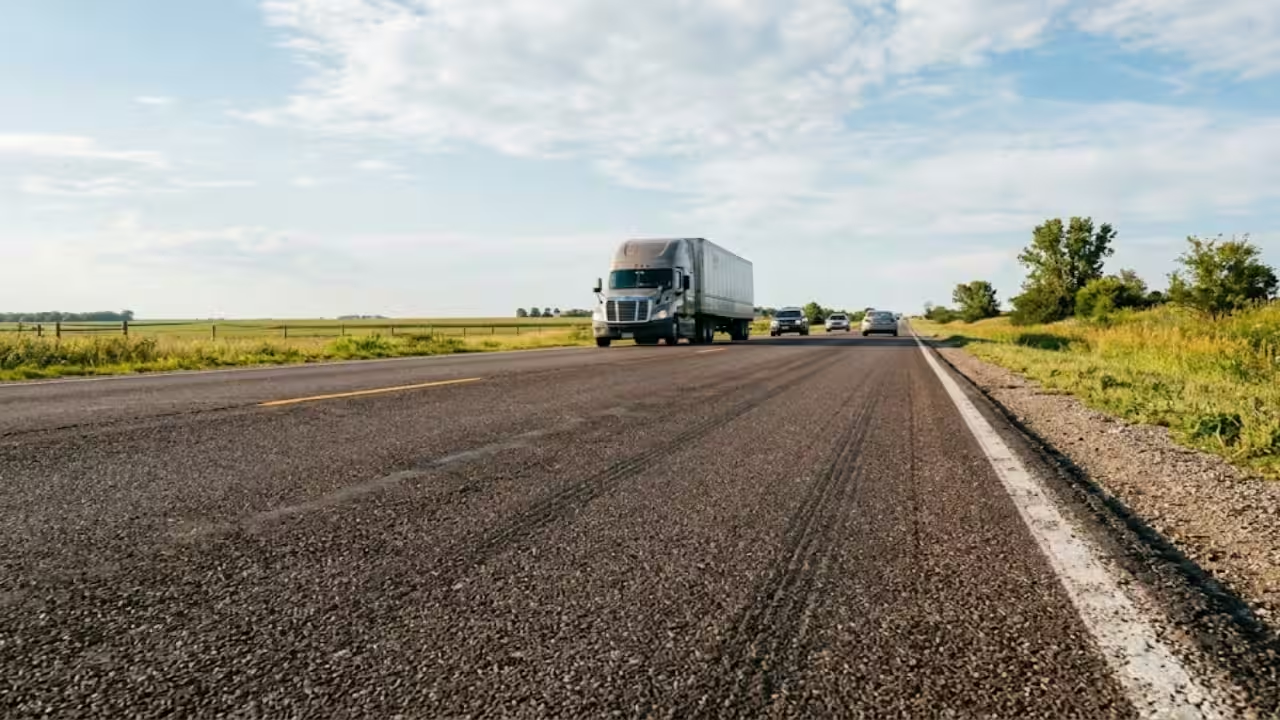
Despite its rather unremarkable appearance, asphalt is a substance that is difficult to enhance. It is cracked by frigid winters, rutted by heavy trucks, and the budget of a road agency is depleted with each pothole repair. According to OECD data used in a 2025 Iowa State University study, only roughly 9% of plastic garbage is successfully recycled, indicating that the globe has its own plastic problem. Some engineers think that by incorporating recycled plastic into the road itself, both problems might be resolved simultaneously. In the Des Moines area, Iowa has been attempting precisely that, and preliminary results from one test stretch are promising.The additive, called NewRoad, is developed by NVI Advanced Materials Group of Florida, which characterises it as a designed polymer derived from recycled industrial and post-consumer plastic. Some 300,000 pounds of it went into road projects throughout the Des Moines area in 2021, about the same as 15 million water bottles. On the oldest test length, a heavily utilised segment of Northeast 22nd Street, Iowa Department of Transportation workers claimed the plastic section was holding up better than the traditional asphalt beside it.What went into the roadThe first Des Moines-area trial began in 2016, after Construction Material Testing president Doug Clement approached the Iowa Department of Transportation about using NewRoad. The initial test used a polystyrene-based additive in about 500 U.S. tons of asphalt mix placed on sections of Northeast 22nd Street. This was a small field trial on an active road, separate from the broader use of the additive across metro-area projects in later years.Separately, more than 300,000 pounds of NewRoad additive were used across Des Moines-area road projects in 2021, equivalent to about 136 metric tonnes of the product. Axios Des Moines reported that this regional total was equivalent to 15 million water bottles. The figure refers to the additive used across multiple projects, not to the total weight of asphalt on the original 2016 test stretch or to 300,000 pounds of pure plastic in that one road.The company believes its polymers reinforce the asphalt mix and help reduce rutting, moisture damage and cracking. Its website says it can deliver up to 50 per cent longer pavement life and up to 50 per cent less rutting in a Hamburg test, a lab test where a loaded wheel rolls over a wet asphalt sample again and again. These are the manufacturer's data, not independently obtained figures. The real question is, what happened to the plastic under traffic?Progress on the test stretchThe strongest public evidence so far comes from preliminary observations by Iowa DOT staff. In a January 2022 report, Axios Des Moines quoted construction technician Matt Miller saying that a heavily trafficked section near the Polk County Jail was holding up better than an adjacent section made with conventional asphalt. The report also quoted field technician Shane Fetters, who said a comparison made more than five years after installation showed less rutting and cracking in the treated section. These were field observations, not a published long-term engineering evaluation.A separate laboratory study offers a note of caution. Iowa State University researchers tested recycled plastics in asphalt and concrete for the Minnesota Department of Transportation, and their final report was published in August 2025. The study found that an asphalt mixture made by adding post-consumer recycled plastic to the binder through a wet process had lower cracking resistance than an otherwise identical mixture without plastic, according to the published report. The researchers also reported that some plastic separated from the modified binder and raised concerns about variation in plastic quality and long-term durability. The study tested specific laboratory mixtures for Minnesota, not the NewRoad sections in Des Moines. Its findings therefore do not directly confirm or disprove the Iowa DOT staff’s roadside observations; they show that results depend on the plastic, blending method and asphalt mix design.The Next stepsThe Iowa DOT isn't planning to stop with visual impressions. The department aims to remove sections of the road that employed the plastic mix and the standard asphalt, and then compare how each is holding up, WOI said. Testing samples from the treated and conventional asphalt sections side by side could provide stronger evidence of differences in cracking, rutting and overall pavement condition. The research portion of the Iowa State paper finds a similar conclusion. It also calls for wide-scale field experiments and long-term performance monitoring while highlighting the other promise of the plastic: less landfill trash and lower carbon emissions.Iowa is also considering plastic beyond the road surface. In October 2021, the Iowa Highway Research Board approved a $349,960 Iowa State University project to evaluate recycled plastics, including material from defunct wind turbine blades, as a method to improve the base of gravel roadways. It also includes pilot test parts on actual roads.For anyone following this story, the short version is easy. Iowa has been adding a recycled plastic additive to asphalt on an increasing number of Des Moines area roadways, including an earlier test stretch on Northeast 22nd Street, where state transportation staff reported less rutting and cracking than on adjacent conventional asphalt. The research is promising but early, based on only preliminary DOT observations and corporate data. Independent lab testing suggests results depend on how the plastic is added. The cut-out comparison planned by the DOT should provide the clearest answer yet.You use AI every day. Now get your AI Quotient. Take the AIQ test.
Topics in this story
Gathered from external sources. Rights to this text belong to whoever originally published it.