The Rashtriya Rifles: The temporary force that stayed 36 years
The Rashtriya Rifles was raised as a force that could be wound up by executive order.
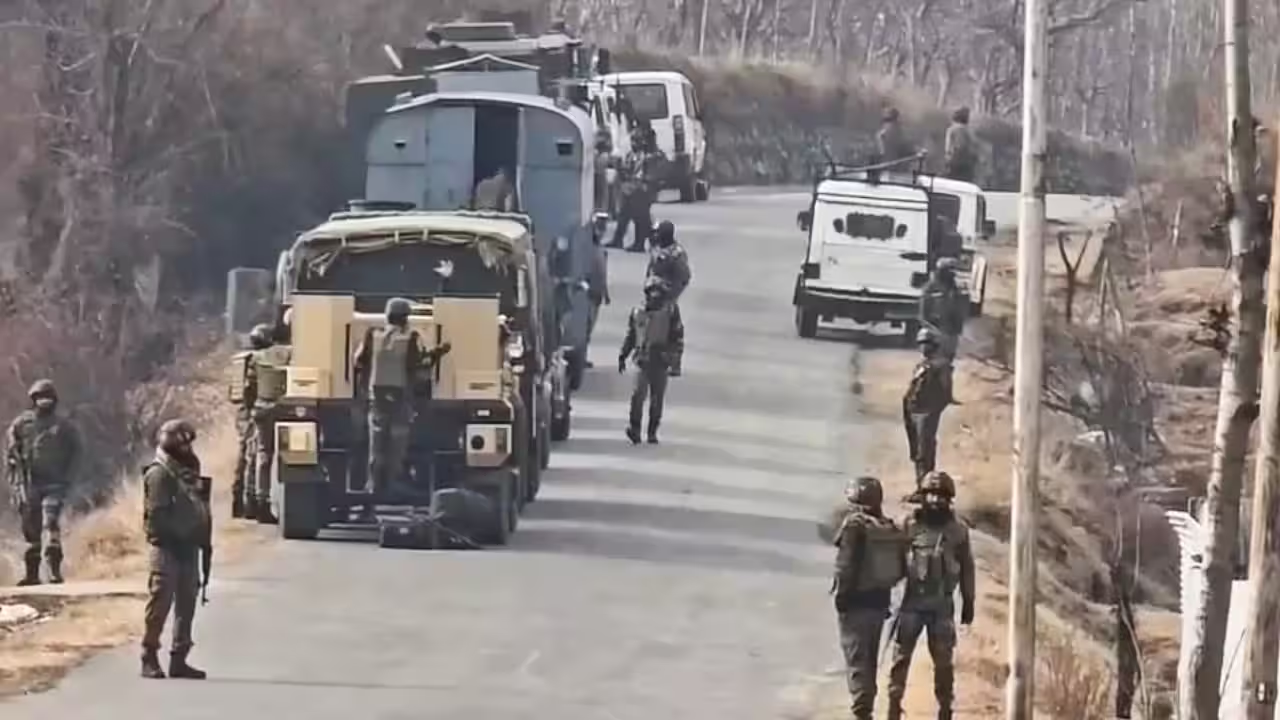
The Rashtriya Rifles was raised as a force that could be wound up by executive order. Thirty-six years later, it is among the Indian Army’s most decorated formations.Indian governments have a particular talent for the permanent temporary arrangement. The Calcutta tram, which has spent most of my adult life apparently months away from abolition, is one example. The Rashtriya Rifles is another, though rather better armed.When it was raised on 1 October 1990, with six battalions - three sent to Punjab, three to Jammu and Kashmir - the RR was constituted under a provision of the Union Composite Table that allowed it to be disbanded by executive order. Thirty-six years, roughly 63 battalions and a budget line of ₹12,052 crore for 2026-27 later, the order remains unsigned.On Thursday (October 1), then, the force marked its raising day as what it has quietly become: routinely described as the largest counter-insurgency formation in the world and, for a generation of Kashmiris born or brought up after 1990, among the most visible faces of the Indian state, sometimes more visible than the state itself.A force nobody particularly wanted to pay forThe proposal for a dedicated counter-insurgency force went to the government in 1988, and even the question of who raised it has the faintly comic quality of a file that passed through too many desks.A 2017 Defence Ministry release credits General V.N. Sharma. Most histories give the credit to General S.F. Rodrigues, who was chief when the force was actually raised. The name that recurs most consistently, however, is General B.C. Joshi, whose idea it was and who, after becoming chief, pushed its expansion to 36 battalions by 1994, the year he died in office. Its first Director General was Lieutenant General P.C. Mankotia.The original design was a hybrid. Only a quarter of the men were meant to come from the regular Army; the rest would be ex-servicemen and lateral inductees from the paramilitary, somewhat in the manner of the Assam Rifles.That is not what happened. The Rashtriya Rifles became, and remains, an all-Army force: officers and jawans on deputation, drawn on an all-India, all-class basis from virtually every arm and service, serving tenures of roughly thirty months before returning to their parent units.The money was messier still. Since internal security fell under the Home Ministry, the Home Ministry initially paid for the RR. By the time that arrangement ended in 1997, it reportedly owed the Army ₹950 crore for raising and equipping the force. From 1998-99, the Defence Ministry took the bill onto its own books; the allocation that first year was ₹263 crore.The Home Ministry, meanwhile, had questioned whether the force should exist at all, arguing that its creation amounted to accepting that internal rebellion had become a permanent feature of Indian life.It remains one of the more clear-eyed sentences produced by any ministry on Kashmir, and among the more comprehensively ignored.What the borrowed soldiers didThe RR’s finest hour is probably the one almost nobody remembers.In the summer of 1999, while the country watched the ridgelines of Kargil, 26 RR units held the Valley and another three guarded the Banihal and Jawahar Tunnel approaches. Roads remained open. Lines of communication remained usable. The war on the heights could therefore be fought without the Valley unravelling behind it.There is, unfortunately, no battle honour for a highway that stays open.The structure of the force explains much of the method. An RR battalion carries six rifle companies rather than the infantry’s four, leaves much of its heavy weaponry at base and, unlike a regular unit rotating between stations, remains tied to the same terrain: the same district, villages, orchards, roads and families.Five Counter Insurgency Force headquarters — Victor, Kilo, Delta, Romeo and Uniform — divide the territory between them.The rifles, in that sense, are only part of the inventory. The other asset is accumulated memory: which family had a son disappear in 2016, which hillside trail is usable after the snow, which village argument is merely a village argument and which one means somebody ought to pay attention.By the force’s own 2015 tally, it had neutralised 16,368 militants: 8,522 killed, 6,737 apprehended and 1,109 who surrendered.The latter two figures deserve more attention than they usually get. Nearly half the men in that total were either captured alive or surrendered. Counter-insurgency is often narrated through body counts because body counts are simple, but a man who gives up his weapon is, in several respects, the more interesting outcome.By its 27th raising day in 2017, RR personnel had received 7 Ashok Chakras, 34 Kirti Chakras, 238 Shaurya Chakras and 1,637 Sena Medals.Names on the ledgerOne of the more complicated arguments for the RR model was made by a man who had once stood on the other side of it.Nazir Ahmad Wani, from Cheki Ashmuji in Kulgam, had been a militant before surrendering and joining the Territorial Army in 2004. In November 2018, operating with 34 RR at Batagund in Shopian against six heavily armed Hizbul Mujahideen and Lashkar militants, he continued fighting after being mortally wounded and killed two of them.He became the first Kashmiri to receive the Ashok Chakra. His widow, Mahajabeen, accepted it at the Republic Day parade.Five years later, in September 2023, the price was paid in a single morning in the Gadole forests above Kokernag.Colonel Manpreet Singh, commanding 19 RR and four months from the end of his tenure, Major Aashish Dhonchak, who left behind a two-year-old daughter, and Sepoy Pradeep Singh died alongside Deputy Superintendent Humayun Bhat of the J&K Police. Bhat’s father, himself a retired police officer, laid a wreath on his son’s coffin.Two uniforms, one forest. It is worth remembering, especially in the easy shorthand of conversations about Kashmir, that the Kashmiri policeman has spent these decades in the same line of fire.Some names travelled further. Major Mukund Varadarajan of 44 RR became the subject of the Tamil film Amaran in 2024. Others travelled less: Naik Dilwar Khan of 28 RR, killed in Kupwara in July 2024, was awarded the Kirti Chakra the following January.An anniversary piece that mentions the medals must mention something else as well.A force that has operated among civilians under AFSPA for thirty-six years cannot be the sole author of its own report card. Kashmir keeps a ledger too, and not every entry in it is a citation. A country confident about its institutions ought to be capable of reading both without pretending that one makes the other disappear.The quiet handoverThe unwinding has, in fact, already begun, in the manner Indian institutions generally prefer: gradually, administratively and without anybody standing at a lectern to announce that history has changed direction.In 2021, the RR headquarters moved from Delhi to Northern Command in Udhampur, and its chief was downgraded from lieutenant general to major general. A year earlier, after Galwan, Uniform Force had been moved to Ladakh to face a considerably more conventional adversary.After the Pahalgam attack of April 2025, the Defence and Home ministries began discussing the movement of RR battalions out of the hinterland and towards the Line of Control, with the CRPF taking a larger internal-security role. Three CRPF battalions were moved into Udhampur and Kathua as part of that process.Last month brought a more concrete step: around 2,100 CRPF personnel and at least nine CoBRA teams are to take over 21 sensitive locations across those two districts, operating from existing Army camps. Reports have been equally careful to point out that a substantial RR presence will remain.The budget, meanwhile, continues to rise. In May, the Army began procuring 159 bullet-proof troop carriers for RR units, capable of operating at altitudes of up to 5,000 metres.A force preparing to disappear does not usually buy new vehicles.The better description, therefore, is probably redeployment rather than withdrawal: away, slowly, from the orchard and towards the frontier. That is a sensible direction, but nearly everything depends on the pace.Retired officers who support the shift have also cautioned against pulling RR battalions out abruptly, because what the CRPF needs to inherit is not merely a camp. Camps are easy. There are registers, stores, maps, keys and handover notes.Thirty-six years of village-level memory is rather harder to put into a folder. The Army can transfer the barracks. It cannot transfer an informer’s trust.General Joshi built the Rashtriya Rifles as a bridge, meant to carry the state across a crisis for which it had not prepared. Bridges sometimes remain standing long after the emergency that required them, partly because they continue to be useful and partly because institutions, like people, become reluctant to give up arrangements that work.Usefulness is not the same thing as permanence. The most meaningful raising-day gift for the Rashtriya Rifles would therefore not be another parade or another citation. It would be the slow, careful fulfilment of the possibility written into its creation in 1990: that there might come a day when the force was needed less.Not because it had failed, but , in enough places, it had done what it was raised to do.
Topics in this story
Gathered from external sources. Rights to this text belong to whoever originally published it.