In 1944, Canadian Captain W. E. Duggan Gray lost his engraved silver flask in France; fellow soldier James McCorriston kept it and returned it nearly 48 years later
Discover the remarkable story of how a silver flask, lost by Canadian Captain W.E. Duggan Gray in 1944 during WWII, was returned 48 years later by fellow soldier James McCorriston, showcasing the enduring power of memories and connections forged in battle.
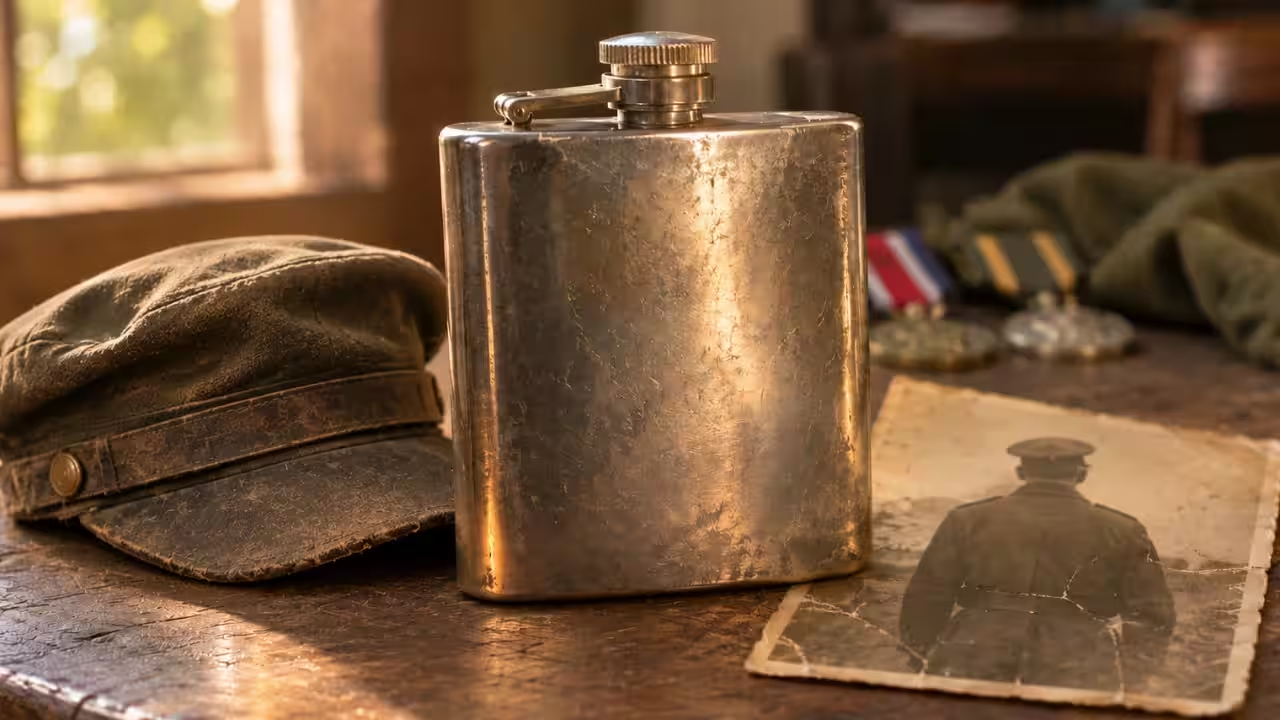
Some lost things remain lost forever. Others show up when least expected. According to the Royal Canadian Artillery Museum, an engraved silver flask belonging to Canadian captain W.E. Duggan Gray was lost in France in 1944. It ended up with another soldier, James McCorriston, who kept it safe for decades. Finally, in 1992, he returned it, nearly 48 years after it disappeared.A young officer on Juno BeachGray landed on Juno Beach on D-Day, June 6, 1944. He was serving with the 3rd Anti-Tank Regiment, a unit in the 3rd Canadian Division. A Veterans Affairs Canada backgrounder says there were approximately 14,000 Canadians who landed at Juno Beach on June 6, 1944, where they were met with intense enemy fire. The Germans had heavily fortified the coastline with machine guns, mines, and barbed wire. A separate Veterans Affairs Canada web page on the Bény-sur-Mer Canadian War Cemetery states that the 3rd Division and the 2nd Armoured Brigade formed the main Canadian ground force for that day. Gray’s regiment paid dearly for the war. The museum notes one of his batteries had lost 50 percent over 3 days.A wound and a terrible mix-up In 1944, Gray was still fighting in France when a German mortar hit his leg. British soldiers found him and took him to a hospital. Then things went wrong. His unit thought he was dead and sent a telegram to his family saying so. His parents were grief-stricken. The unit corrected the mistake shortly after they found out Gray was alive and recovering. In a 1992 newspaper article, Gray described himself back in 1944 as “young, stupid, and very fatalistic.” He added that he laughed about the mix-up afterwards.How the flask went missingThere was yet another consequence of the false news. Before anyone realised that Gray was alive, his regiment had sent his kit to the divisional headquarters to get rid of it. The kit had his silver flask with the inscription “D.Gray” on it, and it was full of military rum. Once Gray was discovered alive, his regiment went back for his belongings. By that time, however, the rum and the flask had disappeared. The loss was minor compared to the war around it. Gray didn't know that McCorriston, another Canadian soldier, was carrying the flask through the rest of the war.The search that ended at a dinnerMcCorriston kept the flask for decades after the war. With the assistance of the War Graves Commission and Legion Magazine, he traced its owner in 1991. He returned it to Gray in 1992 at the reunion dinner of the 3rd Anti-Tank Regiment. The Vernon Daily News published a story on January 18, 1992, with a headline saying the flask was back after 47 years. McCorriston said that a girl had given him the flask, while Gray believed McCorriston had helped himself to the rum.Why a small object still matters Gray was mentioned twice in dispatches by the Canadian military for service in France and Belgium. Later, he passed his wartime keepsakes to his son. In 2008, his son, Nairne Gray, of Vancouver, donated them to the museum. The collection included the flask, a Second World War helmet, a framed set of medals, discharge papers and one newspaper article. The family donated the items to the museum to keep the legacy of their father, the museum said. A flask is just metal, but this one held an entire story of a wound, a fake death notice and a very long wait. The story shows that behind every great date in history are real people, and little things like this one help keep their stories alive.You use AI every day. Now get your AI Quotient. Take the AIQ test.
Topics in this story
Gathered from external sources. Rights to this text belong to whoever originally published it.