In 1996, Indiana turned foundry waste sand into a 275-metre highway embankment; Purdue later found the material worked successfully as full-scale road fill
Explore how Indiana transformed industrial foundry waste sand into a successful highway embankment project in 1996, showcasing its effectiveness as a structural fill material and its environmental safety.
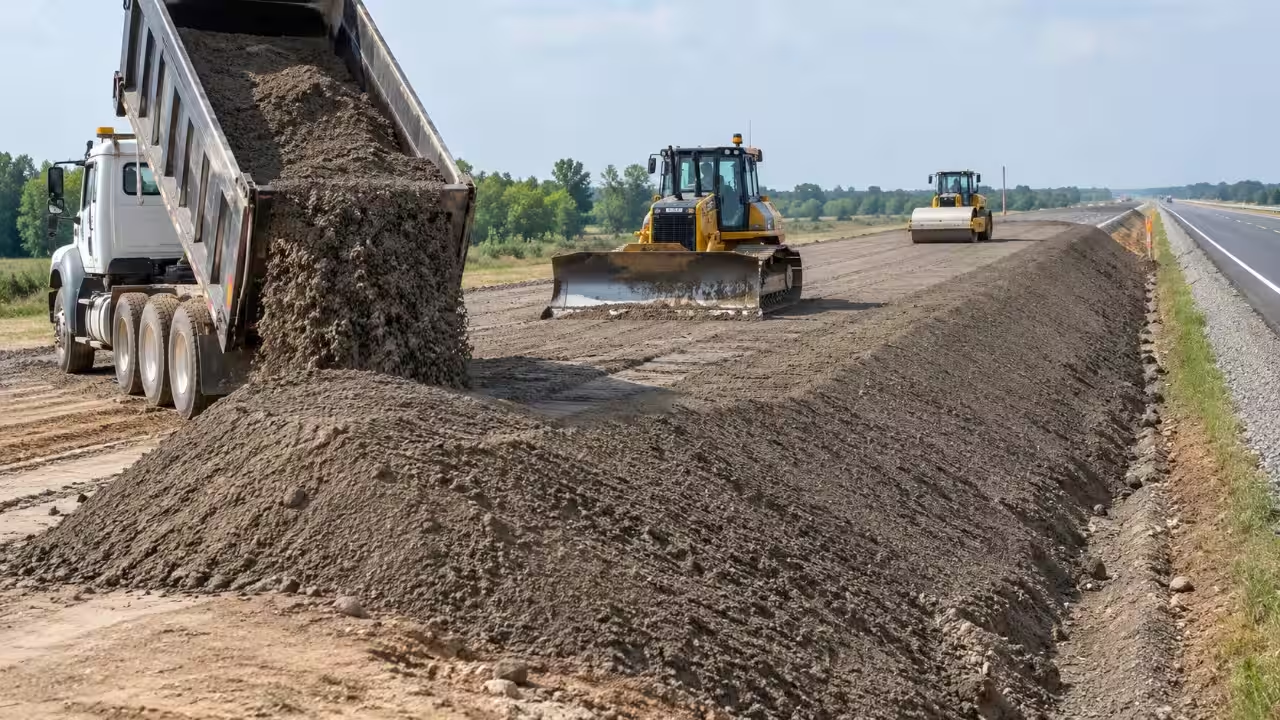
In 1996, an unusual road-building experiment in Indiana gave an industrial waste product a second life. Instead of landfilling used foundry sand, the Indiana Department of Transportation (INDOT) and Purdue University used it to build part of a highway embankment near Butler. The project covered a 275-metre section of the Country Road 37 highway project and was designed to test whether waste sand from a metal foundry could perform as a structural fill material.According to Purdue e-Pubs, the experiment was more than a laboratory test. Engineers constructed the embankment at full scale and compared the foundry-sand section with sections made using conventional clay borrow and natural sand. The researchers monitored how the materials behaved during and after construction, examining settlement, strength, water movement and other engineering characteristics.From foundry floors to a road embankmentFoundry sand is reused in metal casting to make moulds and cores. However, once it is no longer useful in metal casting, large amounts of foundry sand may be treated as waste. The material used in the Indiana case study was supplied by Auburn Foundry Inc. in Auburn, Indiana. Instead of disposing of it, the material's engineering properties were investigated.According to Transportation Research Record, the 1996 demonstration used waste foundry sand from a ferrous foundry and included both WFS and control sections that were instrumented to monitor their geotechnical and environmental performance. The researchers found that the foundry sand had strength and deformation characteristics comparable to natural sand, supporting its use as structural fill. The demonstration was carried out on a full-scale section of highway embankment about 275 metres long, with engineers first constructing a test pad to determine how the material should be compacted and to assess its behaviour during construction.What happened when the waste was put to work?The scientists monitored movements within the embankment and changes in the material beneath it. Their observations involved both vertical and lateral deformations, pore water pressure, and penetration resistance. This provided a way of comparing the foundry sand layer with the other two layers of clay and natural sand. These findings were positive from a geotechnical point of view. The foundry sand displayed low internal deformations and high penetration resistance; its overall behaviour was similar to that of natural sand. It was concluded that, from the geotechnical point of view, foundry sand could be successfully used as an embankment material in highway construction projects.However, there were certain limitations to this approach. For one, the compaction of the foundry sand resulted in its low hydraulic conductivity compared to that of the natural sand, which means it could not be assumed to be a freely draining material. There was also a difficulty associated with the construction process due to the presence of foreign materials in the waste sand. Hence, foundry sand cannot be considered an appropriate substitute for all types of road building materials.Testing whether waste could become a resourceEnvironmental performance was yet another critical factor in the demonstration process. The testing included laboratory and field tests such as bioassays and analysis of metals and other elements, as the groundwater levels were monitored within the embankment area. The results showed that there was migration of some ions from the foundry sand, although concentrations were below the relevant regulatory thresholds. The researchers thus determined that no adverse environmental effects arose from using the material.This was another practical example of why the material deserved further study. Therefore, recycling the material would lessen the need for disposal and provide construction material. Research by the Recycled Materials Resource Center estimated that the Indiana project saved about $145,000 in material costs. The Indiana test did not imply that all foundry waste could be used on roads. Different foundries produce sands with different properties, so testing and quality control are still necessary. The case showed that an industrial waste material could be processed, tested and used in a real highway project to evaluate its performance. From this perspective, the 1996 embankment construction represented a step from laboratory testing to practical application.You use AI every day. Now get your AI Quotient. Take the AIQ test.
Topics in this story
Gathered from external sources. Rights to this text belong to whoever originally published it.