Noah Donohoe: Inquest verdict delivered but questions remain
After years of delay, the jury has reached a verdict but some questions remain unanswered over what happened to the 14-year-old.
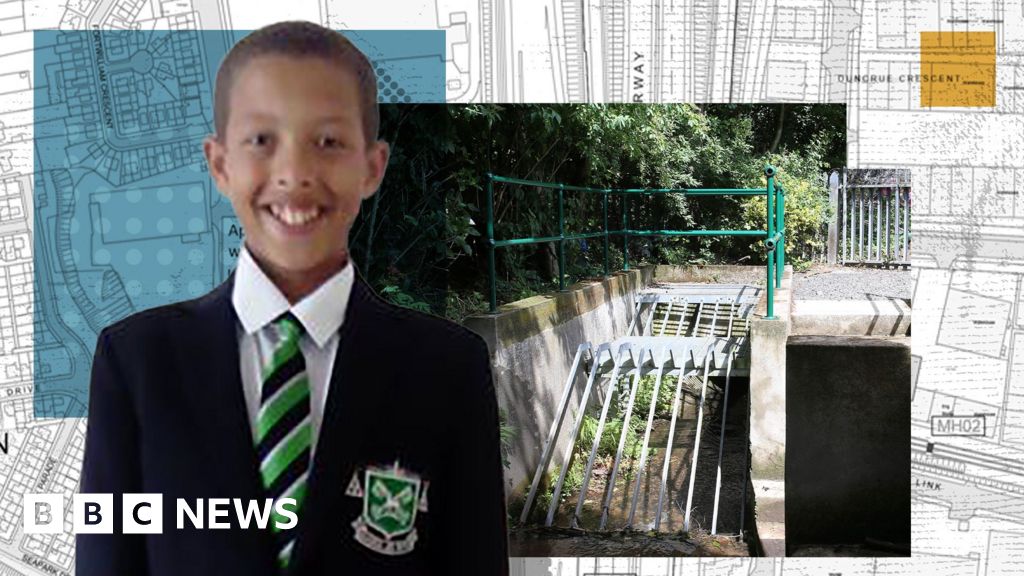
It's been more than six years since teenager Noah Donohoe was found dead 600m into a freezing underground water tunnel in Belfast.
His death – and the speculation over what happened to him in the week between his daylight disappearance and the discovery of his body – became a huge news story that provoked countless unanswered questions.
Now, after an inquest and months of exhaustive hearings and long deliberations by a jury, there is a verdict – but much is still unknown about what happened to Noah.
Why, the night before he disappeared, did he leave his home in the middle of the rain-soaked night? Where did he go? Why did he come back 34 minutes later, as documented by CCTV, barefoot?
Hours later, on Sunday 21 June 2020, he left the south Belfast home he shared with his mother for the final time.
Why did he leave and go to an unfamiliar part of north Belfast? Why was the teenager naked when he was last seen in the area of the water tunnel entrance?
And what might have been if he had seen the social media message sent him by one of two friends he planned to meet in north Belfast telling him their plans were cancelled?
An autopsy found Noah had died from drowning, with the tunnel he was found in heading towards Belfast Lough and its tides.
Now, after years of delays, a jury has found that it was possible, but not probable, that failings by the Department of Infrastructure over the tunnel in which he was found contribute to his death.
They also found 13 failings by the Police Service of Northern Ireland (PSNI) but that these did not in any way contribute to the 14-year-old's death.
Having spent months in court following all the evidence, it was clearly not an easy process for the men and women of the jury.
They heard from dozens of witnesses and received voluminous amounts of official and expert documentation.
This week they deliberated on Monday and Tuesday. But it came more than two months after the inquest was dramatically adjourned in the early hours after three days of deliberations did not lead to a verdict.
While these findings will help his family and the community to understand a little bit more about what happened after Noah went missing, there is no certainty about many of the mysteries surrounding some of the unusual and extraordinary events in the lead-up to his disappearance.
It may be that there will never be definitive answers to many of those questions.
But one thing was very clear at the inquest – there was no evidence of any physical interaction between Noah and anyone else during his final bicycle ride from his home to north Belfast.
During his summing up, the coroner Mr Justice Rooney ruled out several possibilities, including drugs, foul play, suicide, or a psychotic experience.
He told the jury before they began deliberations that there was no evidence to support such findings and their verdict had to be based "solely on the evidence you have heard and seen in this court".
There was no evidence of drugs in Noah's body during the postmortem.
But the inquest heard expert witness evidence that explained, in some cases, drugs can degrade in a body after a few days, so the possibility of drugs having been in his system "cannot be completely excluded".
The inquest also heard no evidence of third-party involvement or any link to loyalist paramilitaries, at odds with years of endless social media speculation that sometimes leaned into conspiracies.
Many phases of the inquest focused on next-of-kin concerns about the Police Service of Northern Ireland's (PSNI) investigation into Noah's disappearance, as well as public safety around the tunnel system where Noah's body was found. The tunnel is maintained by Stormont's Department for Infrastructure.
The police accepted that they had missed some investigative opportunities and have since apologised to Noah's mum, Fiona Donohoe.
And throughout it all, day after day, Fiona Donohoe was a constant, quietly dignified presence, often sitting alone in a corner at the back of the Coroner's Court.
The road to the inquest was a long one for Fiona and her family.
They mounted a high-profile public campaign around Noah's death, with dozens of supporters soon growing to hundreds and then thousands under the umbrella name of Noah's Army.
They took their campaign to the streets in the form of cavalcades around Belfast, as well as protests at Stormont's Parliament Buildings and at PSNI headquarters.
Frustration at the police came to a head in August 2022, when thousands of campaigners protested outside Belfast City Hall over the PSNI's decision to seek a public interest immunity (PII) certificate in relation to the case.
As the years went on, the pre-inquest process was plagued by delays.
The original coroner in the case stepped aside and the Donohoe family made a request for the inquest to be heard in front of a jury.
Finally, five-and-a-half years after he disappeared, the inquest into Noah's death began in January 2026.
What happened the night before Noah disappeared?
Questions about Noah's mindset and behavioural changes before he went missing featured prominently at the inquest.
The inquest heard how the schoolboy went out onto streets beside his home in the Holylands area of Belfast in the early hours of the day of his disappearance.
Shortly after 03:30 BST, Noah walked out of his home into the rain.
He was alone and wearing light summer clothing, including shorts and flip flops. He also had a set of headphones.
During the following 34 minutes, some of his movements were captured on CCTV as he walked along nearby streets barefoot.
When he returned home, shortly after 04:00 BST, the flip flops he was wearing were missing, he no longer had his headphones and a belt on his shorts was hanging loose.
The inquest heard from one witness who examined the CCTV footage and the hearing explored the possibility there may have been the "shape of something" inside one of the pockets of his shorts when he returned home.
But there was no evidence to explain what might have been in his pocket.
The inquest was also unable to find out why he left his home in the darkness, or if he went to any property or met anyone while he was away from his home in the early hours of that morning.
What happened the day of Noah Donohoe's disappearance?
About 12 hours later, Noah was preparing to leave home again, this time to meet his school friends Charlie Rocks and Jay Tierney.
They were part of a close group of friends at St Malachy's College, who Jay affectionately described to the inquest as "very nerdy kids".
He told the court Noah was "the most intelligent human being I have ever met", while Charlie said he was "the smartest kid, always asking questions".
The three were to meet up after a long period of Covid-enforced lockdown, with plans made to go to Cave Hill, a country park in the north of the city.
Noah cycled away from his home off the Lower Ormeau Road at about 17:40, messaging one of his friends a few minutes before he left to check all was going to plan.
"Ok the cav?" he asked, before immediately sending a correction to "cave".
There was no reply before he headed off but one minute after he cycled away, a reply landed in his Instagram account.
"Shit weather no can do today," it read.
Noah had no internet credit for his mobile phone or laptop, so he didn't see the message on his final bicycle ride.
Within half an hour, the 14-year-old had cycled through Belfast city centre and onwards towards north Belfast, but he never reached Cave Hill.
His journey would end at a residential cul de sac at Northwood Road. Eyewitnesses who were the last to see Noah said he was naked at the time.
There were repeated questions about why he no longer had his possessions or the clothing and shoes he was wearing when he left home.
His possessions included his phone and rucksack, which contained a laptop, some school material, and a book he was reading, 12 Rules for Life: An Antidote to Chaos by Jordan Peterson.
The inquest heard some of the clothes he was wearing were found close to where he was last seen before he went between private houses and towards wasteground where an entrance to an underground water system is located.
CCTV footage provided some brief insights, but none of the recordings explained how he came to be naked.
The inquest also heard from Daryl Paul, who was jailed in 2021 for stealing the rucksack containing Noah's laptop.
In summing up the case to the jury, the coroner said that CCTV evidence had demonstrated that Paul could not have had any interaction with Noah from the time he left his home until his disappearance about 25 minutes later.
Panicked police call and a raw witness statement
About four hours after Noah left their home on the day he went missing, his mother made an emergency 101 call to police and that call prompted a major search.
A recording of the call was played in the courtroom on the first day of the inquest.
The raw emotion of a panicking mother was clear as she desperately pleaded for help to find her only son.
She described Noah with affection and told the call handler she had been concerned about Noah's mental health, saying he "had not been himself at all" during the previous week.
She had concerns that isolation during the Covid19 lockdown might have "come to a head" and that she had found Noah crying in his bedroom earlier that day.
The boy's mother referred to the book 12 Rules for Life by Jordan Peterson, which she said Noah had been "obsessed" by and that he "hasn't taken it out of his hands".
The sound of that 25-minute recording alongside the sight of Fiona Donohoe listening to it, her head frequently bowed, cut deep in the coroner's court that day.
Then came a 90-minute video of Fiona's witness statement to the inquest which laid bare, in stark and emotional detail, her grief at the death of her only son.
She described their "beautiful, magical bonds" and how "his beautiful mind was a gift for me to be in the presence of in his fourteen short years of life".
The court heard how Noah had "a lust for life and learning" and "a thirst for knowledge".
"We had what we needed," she said. "And we had each other."
Through her grief, Fiona Donohoe's witness statement illuminated her love for her son and her unstinting desire to understand what led to his untimely death.
That was highlighted in one particularly heartbreaking moment when Fiona described how she stood outside their home on the night of Noah's disappearance, looking towards the end of the street to see if he would come around the corner.
Now the inquest is over, there is some official clarity on some events surrounding Noah's disappearance and death.
But much remains unknown about his decision-making and behavioural changes in the hours and moments before he went missing.
Many questions – in the absence of conclusive evidence – remain unanswered.
Where did Noah go on that nocturnal walk in the early hours of the day of his disappearance, and did he meet anyone?
Why was he cycling naked at the end of a bicycle ride that was initially intended to bring him to meet two school friends on the longest day of the year?
Why did he end up in a different area after taking an unusual and unfamiliar route?
And poignantly, what if Noah had seen the message from his friend saying their planned day trip to the Cave Hill country park had been cancelled?
Topics in this story
Gathered from external sources. Rights to this text belong to whoever originally published it.