Hawaii fenced feral pigs out of a damaged native forest; 16 years later woody plants had multiplied sixfold and young tree ferns were up 51.2%
A comprehensive study of Hawaii's Puʻu O ʻUmi Natural Area Reserve reveals significant recovery of woody plants and tree ferns after feral pigs were fenced out for 16 years, highlighting the complexities of ecosystem restoration.
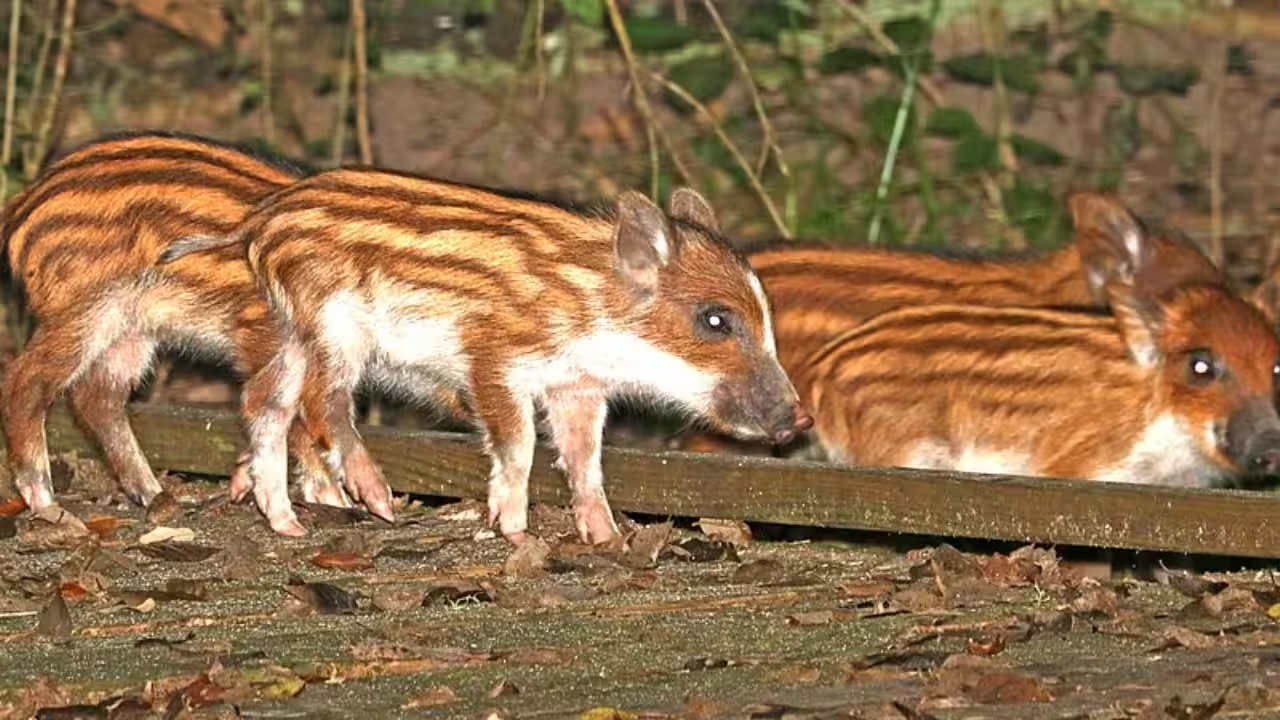
Forests recover slowly, often without obvious signs at first. Signs appear in the seedlings sprouting where the soil was once tilled and in the ferns spreading where no plants grew before. Long-term data are essential for showing whether a forest is recovering. A one-time assessment may point to destruction, but only repeat assessments can tell if the destruction recovers. In Hawaiʻi Volcanoes National Park on Hawaiʻi Island, researchers assessed the impact of feral pigs by comparing forest sites where fencing kept pigs out with sites where pigs remained. They went back to the exact plots, using the same method of measurement.Why feral pigs harm Hawaiian wet forestsFeral pigs change the vegetation of an area through feeding and trampling, and they may also help other species invade, as the researchers argued in their 2011 Ecological Society of America conference abstract and in the peer-reviewed 2012 Biotropica paper that followed. Hawaiian wet forests are particularly vulnerable to feral pig disturbance because many native species evolved without large mammalian herbivores, leaving ecosystems exposed to a type of disturbance that was not historically present. Fencing out pigs is often considered an important first step in conserving these forests.Five paired sites in Hawaii Volcanoes National Park, 1994 to 2010Rebecca Cole, Creighton Litton, Michael Koontz and Rhonda Loh reported their results in Vegetation Recovery 16 Years after Feral Pig Removal from a Wet Hawaiian Forest, published in Biotropica in 2012. The study reports a six-fold increase in woody plants rooted in mineral soil at sites without pigs over 16 years, along with a 51.2% rise in the stem density of young tree ferns. At sites with pigs, herbaceous cover fell by 67.9%. The team recorded the amount of ground cover, herbaceous cover, density of tree ferns, and the density, diversity, and rooting substrate of the woody plants, which was either mineral soil or another plant. The first data were collected in 1994 after fencing and elimination of the pigs and then again in 2010.Ground conditions diverged and strawberry guava gained tooThe ground also had changed its appearance by 2010. As is stated in the study, exposed soil covered 32.0 percent of pig presence locations and just 0.08 percent of locations where pigs were absent. On the other hand, litter covered 53.4 percent of pig presence locations and 88.6 percent of sites where there were no pigs. Release from pigs did not mean recovery of only native species. Density of nonnative woody plants such as strawberry guava (Psidium cattleianum), an invasive shrub, increased fivefold at the pig-free sites over the same period.Hakalau Forest refuge: 16 years of monitoring, 1987 to 2004A second record comes from a different forest and a looser form of management. The USGS lists Effects of ungulate management on vegetation at Hakalau Forest National Wildlife Refuge, Hawai'i Island, by Steven Hess, John Jeffrey, Linda Pratt and Donna Ball, published in 2010 in Pacific Conservation Biology. The researchers observed an increase in cover of native ferns, a decline in bryophytes and exposed soil cover, but no explosive growth in alien grass following the decrease in ungulates, in stark contrast to many Hawaiian forests.Six line-intercept transects were monitored, three in areas that had previously experienced high ungulate activity and three in areas with low ungulate activity. Nine plant-cover classes, including native ferns, native woody plants, alien grasses and soil, were surveyed on four occasions over 16 years, as documented by the U.S. Geological Survey.Native fern cover rises at Hakalau, with some differences left unprovenNative fern cover increased considerably at Hakalau, with bryophyte and exposed soil cover decreasing marginally, according to the USGS report. Native plant cover tended to be higher where grazing pressure had been lower, and alien grass and herb cover tended to be higher where it had been greater. These differences were not statistically significant, so they cannot be presented as confirmed effects.What the results mean for managersTaken together, the studies suggest that reducing or excluding non-native ungulates may help native vegetation recover, although the extent of recovery can vary by ecosystem and may depend on additional restoration measures. The above-mentioned study concluded that control of invasive plants and the introduction of rare native species were needed after pigs were removed.You use AI every day. Now get your AI Quotient. Take the AIQ test.
Topics in this story
- Hawaii feral pigs
- native forest recovery
- feral pig impact on forests
- ecosystem restoration Hawaii
- puʻu o ʻumi natural area reserve
- feral pig impact on vegetation
- ecological restoration Hawaii
- invasive species control in Hawaii
- Hakalau Forest refuge
- woody plants increase
- forest conservation efforts
- young tree ferns growth
Gathered from external sources. Rights to this text belong to whoever originally published it.