In 1941, comedian Jack Oakie bought a California ranch; decades later his widow fought to save its last 9 acres from development
US News: In 1937, actress Barbara Stanwyck built a roughly 6,000-square-foot residence on a hilltop in Northridge, in Los Angeles' San Fernando Valley. The hou.
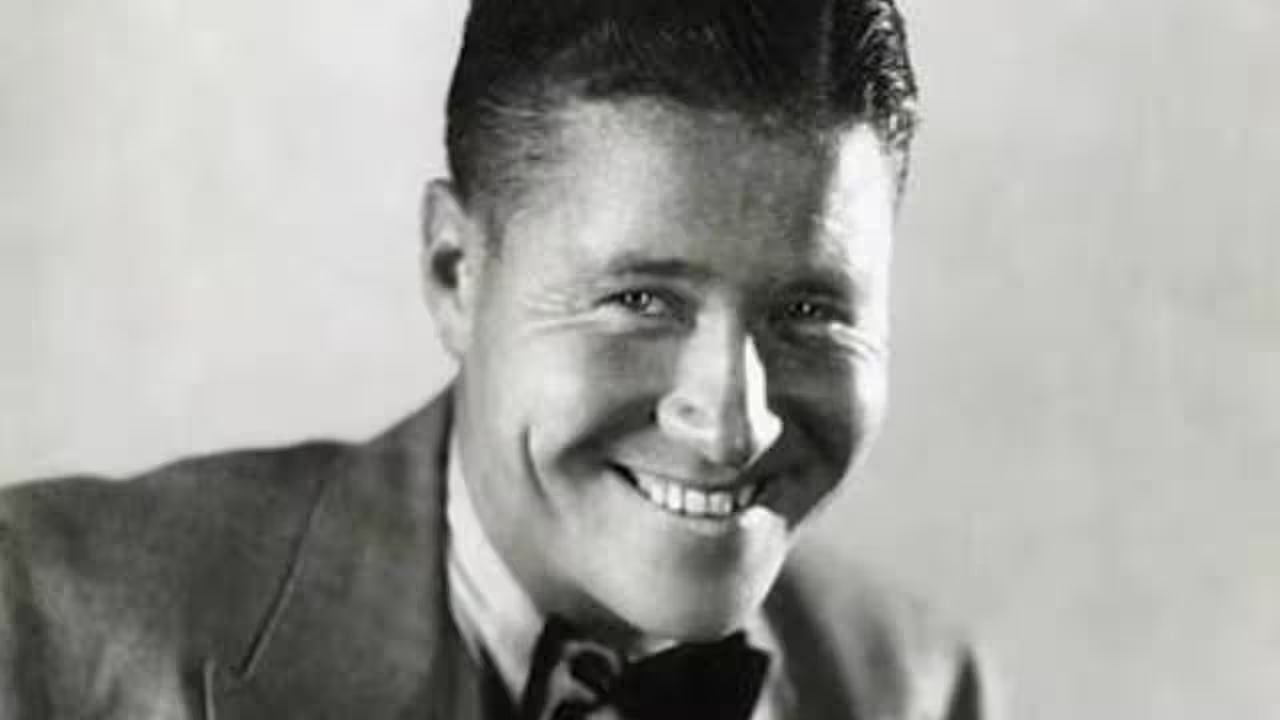
In 1937, actress Barbara Stanwyck built a roughly 6,000-square-foot residence on a hilltop in Northridge, in Los Angeles' San Fernando Valley. The house was part of Marwyck Ranch, a roughly 130-acre thoroughbred breeding and training operation associated with Stanwyck and her business partner and agent, Zeppo Marx. The home's architectural history is disputed: it has traditionally been attributed to architect Paul R. Williams, although Robert Finkelhor is listed as the architect of record on the original building permit. Stanwyck lived at the property for about two years before marrying actor Robert Taylor and moving closer to Hollywood. In 1941, comedian Jack Oakie purchased the estate and renamed it Oakridge, eventually making it his longtime home with actress Victoria Horne. Oakie, best known for playing Benzino Napaloni in Charlie Chaplin's The Great Dictator, maintained a citrus orchard and Afghan Hounds on the grounds. After his death in 1978, Victoria continued efforts to preserve the property. Oakridge was designated a Los Angeles Historic-Cultural Monument in 1990, and she donated it to the University of Southern California in 2000. When residential development later threatened the surviving estate, the City of Los Angeles acquired its remaining 9.47 acres in 2009.Why Victoria Oakie fought to protect OakridgeStanwyck lived at the Northridge property from 1937 to 1939. After marrying Robert Taylor in 1939, she and Taylor moved closer to the Hollywood film community, and Stanwyck eventually sold the estate. In 1941, Oakie acquired the property and renamed it Oakridge. He initially lived there with his first wife, actress Venita Vardon. Their marriage ended in divorce in 1944, and Vardon died in a 1948 plane crash. Oakie married actress Victoria Horne in 1950, and the couple continued to make Oakridge their home. Oakie maintained a citrus orchard on the property and kept Afghan Hounds, reportedly having as many as 100 dogs on the grounds at one point. When Oakie died in 1978, Victoria remained at Oakridge for another 25 years and became closely associated with efforts to preserve the estate as the San Fernando Valley around it underwent rapid development.Oakridge was designated Los Angeles Historic-Cultural Monument No. 484 in 1990, giving the property formal historic recognition as development continued to transform the Valley's former ranches, agricultural land and large estates. In 2000, Victoria donated Oakridge to the University of Southern California's School of Cinematic Arts. Her instructions called for USC to sell the estate and use the proceeds to establish a university chair in comedy named for Jack Oakie. Victoria died in 2003 at the age of 91, 25 years after her husband. Her donation gave the property a future beyond her lifetime, but it did not immediately guarantee that the surrounding acreage would remain undeveloped.How the estate survived residential developmentAfter USC took ownership, developers proposed residential construction on the remaining property. One proposal called for 28 single-family homes on land surrounding the historic house, a plan that would have significantly changed the open setting around the residence. The development effort ultimately failed when the deal fell out of escrow amid the economic downturn of the late 2000s. The property's future remained uncertain until Los Angeles officials became involved in efforts to preserve it through public ownership.Los Angeles City Councilmember Greig Smith played a role in efforts to secure Oakridge for the city. In 2009, the City of Los Angeles acquired the property for $3.35 million using Quimby and related park fees. City records indicate that approximately $3.8 million in Quimby funds had been secured for the acquisition, rehabilitation and improvement of the estate. The purchase transferred Oakridge into public ownership, with the property dedicated as parkland in perpetuity. Instead of being converted into the proposed residential development, the historic house and the remaining acreage were preserved as part of the city's park system.What remains of Marwyck Ranch and Oakridge todayVery little of the original Marwyck Ranch survives. Sources vary on the precise size of the original property, with historical accounts putting it at roughly 127 to 130 acres, while numerous accounts of Oakridge describe the original ranch as approximately 130 acres. The surviving Oakridge property covers 9.47 acres. The historic residence remains the centrepiece of the site, although its architectural attribution requires qualification. Paul R. Williams has traditionally been associated with the design and is frequently credited as its architect, but Robert Finkelhor is identified as the architect of record on the original 1937 building permit. The house remains an important surviving example of the large country residences that once appeared across the San Fernando Valley.The landscape around Oakridge has changed dramatically since Stanwyck established the estate. In the 1930s and 1940s, Northridge and surrounding parts of the Valley were substantially more rural, with agricultural land, citrus groves, horse ranches and large country properties. Hollywood figures were drawn to the area because it offered space and privacy while remaining within reach of the city's film studios. Pat LoPresti, who served as outreach committee chair for the Oakridge Estate Park Advisory Board, has discussed Oakridge in the context of this earlier San Fernando Valley, recalling a period when citrus groves and Hollywood figures were part of Northridge's landscape.Why Oakridge matters beyond Barbara Stanwyck and Jack OakieOakridge's significance extends beyond the famous people who lived there. The property's history connects several stages in the transformation of the San Fernando Valley, from its agricultural and equestrian past to its association with Hollywood and, eventually, the suburban development that replaced many of its ranches and estates. Stanwyck's residence became part of the Marwyck thoroughbred operation before becoming Jack Oakie's home, while Victoria Horne Oakie later became central to efforts to preserve the property. Her work helped secure its historic designation, and her 2000 donation to USC provided another chapter in the effort to determine the estate's future. When residential development subsequently threatened the remaining property, the City of Los Angeles acquired Oakridge in 2009.The original Marwyck Ranch is gone, but a 9.47-acre portion survives as Oakridge. The property cannot recreate the landscape that once surrounded Stanwyck and Oakie, but its historic house and grounds preserve a tangible piece of the earlier San Fernando Valley. What remains is a small fragment of a much larger ranch, offering a physical link to a period when citrus groves, horse properties and Hollywood estates occupied land that is now surrounded by a densely developed Los Angeles.Catch the latest World News and Live updates. Download the TOI app.
Topics in this story
Gathered from external sources. Rights to this text belong to whoever originally published it.