In 1990, Switzerland crushed an old A13 road and reused its concrete in new pavement; after 20 years, mixes with up to 100% recycled aggregate remained durable
In 1990, the A13 between Oberriet and Haag in the St Gallen Rhine Valley was converted from a motorway to an autobahn, and the 1967 road was completely
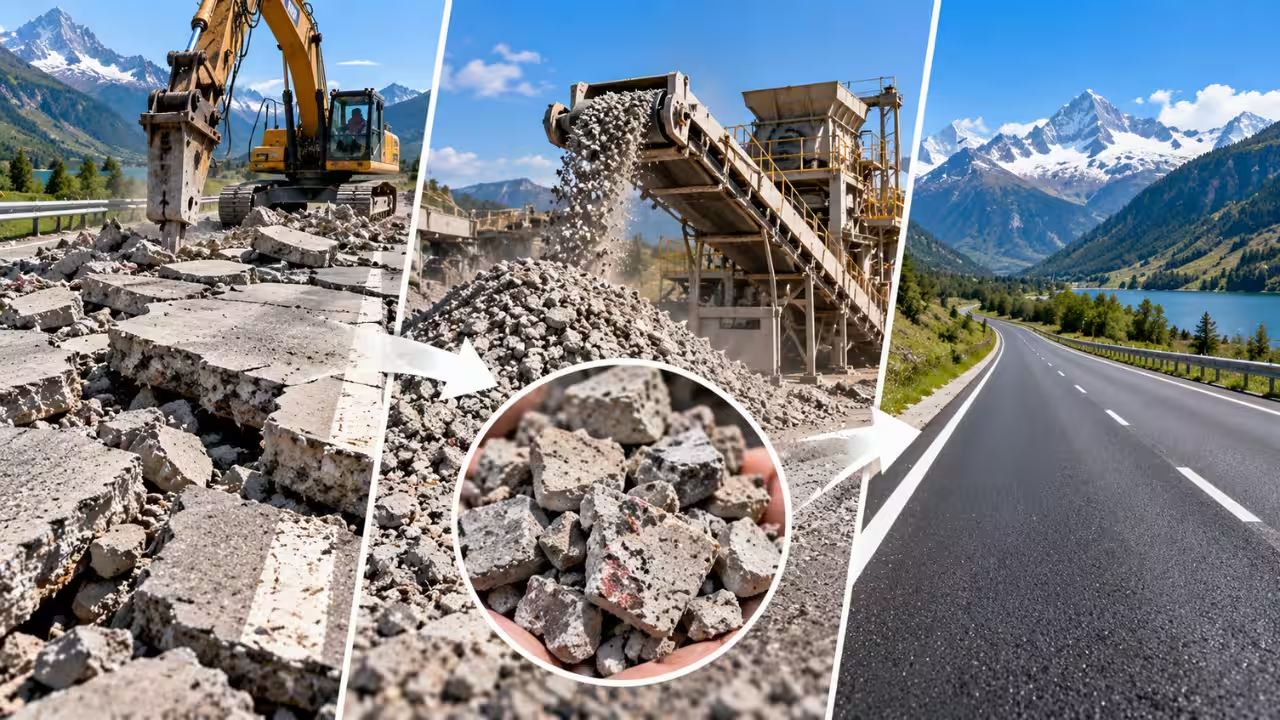
In 1990, the A13 between Oberriet and Haag in the St Gallen Rhine Valley was converted from a motorway to an autobahn, and the 1967 road was completely renewed. Its old concrete pavement was crushed and processed. At the same time, a large-scale experiment put the recycled aggregate into new road concrete, where it made up 66 to 100 per cent by mass. These mixes were compared with a reference concrete made only from natural aggregate. After 20 years of use, all the recycled concretes were still in a good or very good state, according to the report for the Swiss Federal Roads Office.How the 1990 A13 road project reused old concrete pavementAccording to the study published in ResearchGate, titled ‘Dauerhaftigkeit von Betonfahrbahnen aus Betongranulat (Durability of concrete pavements of recycled concrete),’ the A13 between Oberriet and Haag was converted from a motorway to an autobahn in 1990/91. The 1967 road was completely renewed. The former concrete pavement was crushed, processed and used for the cement stabilisation of the underground.At the same time, the report states that a large-scale experiment was started to use the processed concrete aggregate for the new road pavement of the A13. The authors note that for a harsh environment of freezing, de-icing salt and traffic, hardly any experience with recycled concrete was available. They add that concrete from old pavements will become available in increasing amounts in future, and describe recycling these pavements into new ones as an ecologically and economically highly reasonable solution.Recycled concrete aggregate made up 66 to 100% of the test mixesAccording to the report, several types of concrete with different amounts of recycled concrete aggregate were manufactured and placed. In these recycled concretes, the recycled aggregate made up between 66 and 100 per cent by mass. Their behaviour was compared with the reference concrete, which contained only aggregate of natural origin.The report distinguishes between two kinds of aggregate preparation. The aggregate of recycled concrete 1a/1b consisted of all-in aggregate rather than separate size fractions. The other recycled concretes used aggregate made from different size fractions: 0/4, 4/8, 8/16 and 16/32. The authors also looked at whether the 0/4 fraction was made from recycled or natural aggregate.20-year tests showed strong durability of recycled concrete aggregateAccording to the report, the recycled concretes and the reference concrete were investigated in detail after 20 years of use. The methods were visual inspection, microscopy, permeability to air, carbonation depth, chloride content, water conductivity, resistance to chloride migration and compressive strength. The goal was to evaluate the durability of recycled concrete in a severe environment of freezing, de-icing salt and traffic.The analyses showed that all types of concrete with recycled aggregate were still "in a good or very good state". Recycled concrete 1a/1b showed slightly worse properties than the other recycled concretes, and the reference concrete performed slightly better than all of them. The report attributes the slight damage to 1a/1b to difficulties during the earlier preparation of the recycled aggregate and during placing and compacting. All the concretes showed a beginning alkali-silica reaction. The authors found no influence on concrete quality from whether the 0/4 fraction was recycled or natural.Recycled concrete aggregate can last 40–50 yearsThe report states that all the investigated recycled concrete pavements can continue to be used and are expected to reach an estimated service life of 40 to 50 years, even though the damage will increase. The investigations also showed that recycled concrete made with 100 per cent recycled aggregate can be used for new concrete pavements. The authors stress that this applies only to the aggregate used in this case. If concrete is to be processed into aggregate, it should be tested for possible damage such as alkali-silica reaction and for harmful substances such as de-icing salt.According to the authors, concrete pavements from roads and airfield traffic areas are especially suitable for producing concrete aggregate, because they generally have a high concrete quality and are homogeneous. Building concrete pavements in two layers in future, with recycled concrete aggregate in the lower layer and natural aggregate in the upper layer. The authors say this allows the requirements for noise reduction to be addressed in a more targeted way.You use AI every day. Now get your AI Quotient. Take the AIQ test.
Topics in this story
Gathered from external sources. Rights to this text belong to whoever originally published it.