A former luxury steam yacht sank off San Francisco in 1920; researchers brought back the first underwater images using underwater robots
The Ituna was built in 1886 as a luxury steam yacht and was lost in 1920 while working as a steam trawler.
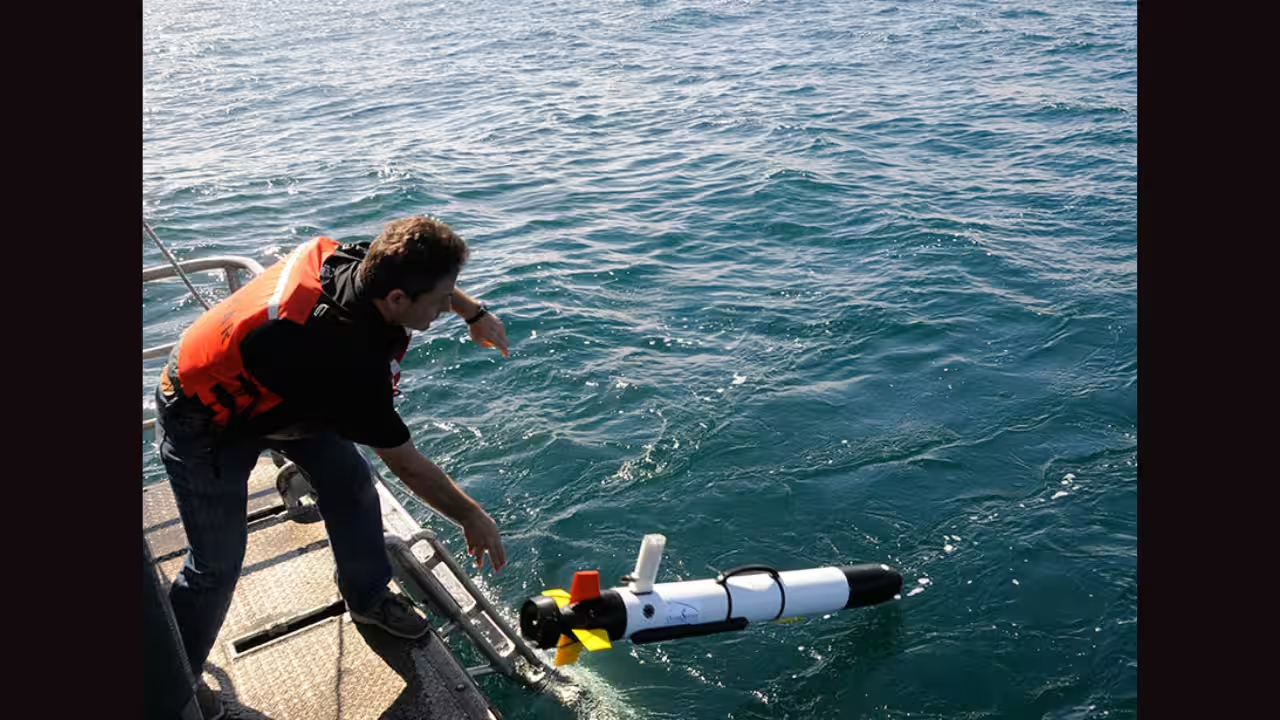
The Ituna was built in 1886 as a luxury steam yacht and was lost in 1920 while working as a steam trawler. A gale struck north of the San Francisco Lightship station on 13 March 1920, and the 34-year-old vessel sank in 10 minutes. Twelve of the 14 crew members escaped, and two did not. According to the National Oceanic and Atmospheric Administration's Office of National Marine Sanctuaries, sonar expert Gary Fabian has since used a remotely operated vehicle and an autonomous underwater vehicle to bring back what NOAA describes as the first underwater images of the shipwreck.How did the luxury steam yacht Ituna sink off San FranciscoThe Ituna was heading from San Francisco to Reedsport, Oregon, when the storm struck on 13 March 1920. The agency states that the seas split the ship's seams and flooded the forward hold, which plunged the vessel bow-first to the bottom of the ocean. The sinking took only 10 minutes.12 of the 14 crew members escaped and struggled for hours to keep their lifeboat afloat on the journey to the San Francisco Lightship. Two crew members were trapped in their bunks and went down with the ship. The vessel's cargo of machinery, bound for the Reedsport Fish Company, was valued at $30,000 at the time.What was the Ituna before it became a commercial fishing vesselNOAA states that the Ituna began life as a luxury steam yacht, built for John G. Mackie in 1886 by A. & J. Inglis in Glasgow, Scotland. It was named for the Latin name of the Solway Firth, the coastline border between England and Scotland. After several changes of ownership, it was bought by Allison V. Amour of Chicago, Illinois, whom NOAA describes as a wealthy socialite interested in natural sciences. In December 1894, the Ituna left New York for Havana and Mexico on a three-month scientific research expedition. The results were published as Archaeological Studies Among the Ancient Cities of Mexico, which scholars of Mesoamerican anthropology valued immensely.The vessel later became a first-class passenger cargo steamer, running between ports along the United States West Coast and Mexican ports under the flag of the Mexican Navigation and Commercial Company. Two years after that, it was purchased by the Frank E. Booth Canning Company of San Francisco and converted into a seagoing steam trawler. According to NOAA, it was one of the largest steam trawlers fishing off California's central coast and one of the first commercial fishing vessels to introduce the "otter trawl" to the Pacific coast, in 1918.Sonar technology helped identify the Ituna shipwreck off CaliforniaIts Office of National Marine Sanctuaries Maritime Heritage Program worked in partnership with Teledyne SeaBotix, Inc. and sonar expert Gary Fabian. The team used a remotely operated vehicle and an autonomous underwater vehicle to collect high-definition video footage, still images and side-scan sonar data for analysis. NOAA credits Cyril Poissonnett of Teledyne SeaBotix with deploying the autonomous underwater vehicle for the side-scan sonar survey of the Ituna.The images show the vessel's steel hull, which was designed by the yacht designer George Lennox Watson, as well as its triple expansion steam engine and its cargo of machinery. The agency reports that the clipper-ship bow of the former yacht provided identification of the wreck. NOAA adds that multiple marine species have colonised the shipwreck, including giant green anemones (Anthopleura xanthogrammica) and white plumose anemones (Metridium farcimen).How many shipwrecks lie beneath the Greater Farallones National Marine SanctuaryNearly 400 ships and aircraft wrecks lie on the seafloor of the recently expanded Greater Farallones National Marine Sanctuary and the nearby Golden Gate National Recreation Area, including four never-before-found vessels. The Maritime Heritage Program is engaged in a two-year study to discover and document these wrecks. 20 ships have been plotted so far, including the USS Independence and the freighter S.S. Selja.NOAA quotes Robert Schwemmer, West Coast Regional Maritime Heritage Coordinator, as saying the Ituna's story is an example of "the rich maritime legacy that rests beneath the waves of San Francisco Bay." Schwemmer also states that mapping and examining the wrecks is a key part of preserving them for future generations. He says exploration allows researchers to learn about the past of the United States as a seafaring nation and to test recent advances in technology that will help protect these marine resources.You use AI every day. Now get your AI Quotient. Take the AIQ test.
Topics in this story
Gathered from external sources. Rights to this text belong to whoever originally published it.