Calcutta HC orders CWC to return 3-year-old to couple despite adoption procedure not being followed
News News: NEW DELHI: The Calcutta high court has directed a Child Welfare Committee to return a three-year-old child to the couple who had been caring for him s.
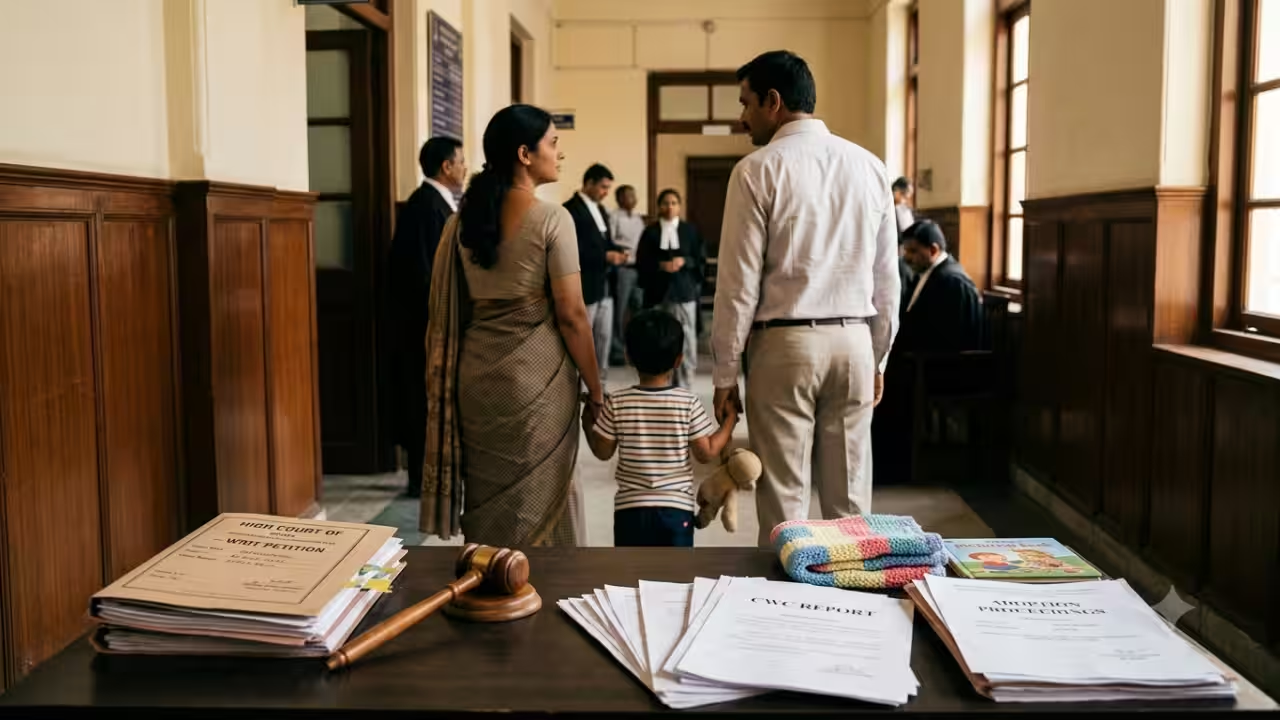
NEW DELHI: The Calcutta high court has directed a Child Welfare Committee to return a three-year-old child to the couple who had been caring for him since birth, holding that the committee had no legal basis to take custody of the child. The court in a judgment delivered on September 17, 2026, also directed the couple to approach the appropriate court to establish their legal status as the child’s adoptive parents.Why did the Child Welfare Committee take custody of the child?According to the court order, the child was born prematurely in February 2023 at M R Bangur Hospital, Kolkata. He was born at around 29 weeks and weighed about 1.68 kg. He remained in the hospital’s special newborn care unit for about 25 days.The child’s biological parents handed him over to the petitioners on the day he was discharged from hospital. The couple then cared for him and a notarised adoption deed was executed between them and the biological parents in April 2023.In February 2026, the couple approached the Child Welfare Committee after hospital authorities told them to approach the committee for adoption-related formalities before obtaining the child’s birth certificate. The committee took custody of the child and did not return him to the couple.What did the couple tell the high court?The couple said they had been looking after the child since he was born and there were no allegations that they had abused, neglected or harmed him. They argued that they had approached the committee only to complete the required formalities and should have been guided through the adoption process instead of losing custody of the child.The State, however, said the adoption had not followed the procedure required under the Juvenile Justice (Care and Protection of Children) Act, 2015 and the Adoption Regulations, 2022. It said a private adoption deed could not replace the legal process.What did the high court find?Justice Krishna Rao agreed that the proper adoption procedure had not been followed. It noted that the child was neither an orphan nor an abandoned child. It also found that the child did not fall within the legal category of a “child in need of care and protection”.The court explained that the Juvenile Justice Act gives the Child Welfare Committee powers to deal with children who fall within that category. It said the committee could not use those powers in a case where the child did not meet the legal definition.“There is no dispute that biological parents have given the child in adoption to the present petitioners without following the proper procedure. Admittedly, the child is neither “orphan” nor “abandoned”. The petitioners have accepted the child and decided to take care of the child by obtaining custody of the child from the biological parents. The Deed of Adoption executed between the parties is a notarized document. As per the Hindu Adoption and Maintenance Act, 1956, merely by executing the notarized Adoption Deed, the petitioners cannot claim that they have right to hold the custody of the child. On the other hand, the Child Welfare Committee does not get any power to deal with the child who is neither “abandoned” nor “orphan”. The child involved in the present case also does not fall in the category of ‘children in need of care and protection’,” the court said.The court also considered the child’s welfare and the fact that he had been living with the couple since infancy. Section 3 of the Juvenile Justice Act lays down principles for dealing with children, including that their best interests, safety and family care should be given primary consideration.“For the ends of justice, it would be appropriate to direct the Child Welfare Committee to return of child to the petitioners. This is by the following the principle of the best interest of the child, principle of family responsibility, principle of safety, positive measures, principle of institutionalization as a measure of last resort, principle of repatriation and restoration, which are also enunciated as general principles in Section 3 of the Act of 2015,” it added.The court therefore held that the committee’s decision to take custody of the child was not in accordance with law because the child did not fall within the category of children who could be dealt with by the committee under the Act.“As the child is neither “orphan” nor “abandoned” and does not fall in the category of ‘children in need of care and protection’ in terms of Section 2(14) of the Act of 2015, the action of the Child Welfare Committee taking the custody of the child from the petitioners is not is accordance with law,” the court further observed.The high court directed the Child Welfare Committee to hand over the child to the couple by 4 pm on September 18, 2026. It also directed the District Legal Services Committee to seek quarterly reports on the child’s welfare and progress from December 2026.At the same time, the court made clear that the adoption process had not been legally completed. It directed the couple to approach the appropriate court for a declaration that they are the child’s adoptive parents.
Topics in this story
Gathered from external sources. Rights to this text belong to whoever originally published it.