A British woman sought £135,000 for caring for her mother for 900 days; the High Court awarded her £127,500 plus interest after finding an informal care agreement existed
A British woman has been awarded £127,500 plus interest from her late mother’s estate after the High Court upheld her claim for years of unpaid care.
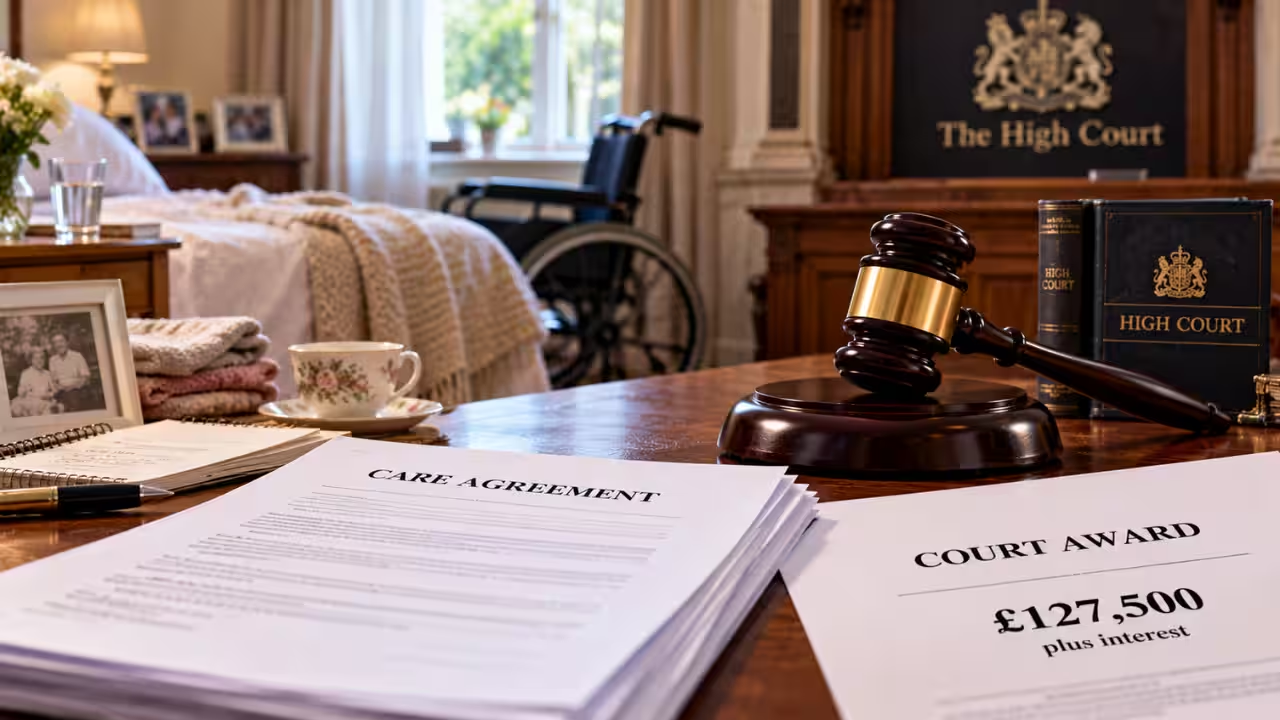
A British woman has been awarded £127,500 plus interest from her late mother’s estate after the High Court upheld her claim for years of unpaid care. Bernadette Rogers had initially sought £135,000, arguing that her mother, Ursula Wills, known as Sheila, had agreed to pay her a reasonable sum for looking after her in her later years. According to the High Court judgment, handed down on 25 August 2026, the court found that a binding informal contract existed between mother and daughter. The ruling followed a dispute with Rogers’s brother, the executor of their mother’s estate, over the amount payable for the care provided.How did a daughter claim £135,000 for caring for her motherRogers’s mother, Ursula Wills, was known within the family as Sheila. She was born in Birkenhead on 26 August 1927 and had lived with her husband, John Wills, in Southrepps, near Cromer on the East Anglian coast, for many years. After her husband died in 2012, Sheila eventually became unable to continue living independently because of her frailty, forgetfulness and episodes of confusion. In September 2017, she moved into the Bristol home of Rogers and her husband, Dr Rogers, a retired general practitioner.The earlier liability judgment found that the agreement was reached in October 2017. According to the findings reproduced in the August 2026 judgment, Sheila wanted to pay for the care she received rather than depend on charity. HHJ Matthews recorded that Sheila had insisted that her return to Bristol would be on terms that she “wanted to pay her way” and that Rogers would be “paid properly” for looking after her. The judgment stated that there had been no discussion about a specific amount, with the sum to be determined later. The court concluded that the absence of an agreed figure did not prevent the arrangement from constituting a contract for services at a reasonable price.How did Rogers care for her mother until her deathRogers was found to have been the principal carer for her mother during the relevant period. Sheila lived in the family’s Bristol home from September 2017 until her death on 19 April 2020. The judgment described her as suffering from several health conditions, including vascular dementia, diabetes, angina, chronic kidney disease, glaucoma and recurring rectal prolapse. She also experienced impaired mobility, incontinence and periods of confusion. The court accepted Rogers’s evidence that her mother required continuous supervision and that either Rogers or her husband generally had to remain at home with her.The care included preparing meals, cleaning, doing laundry, helping with washing and toileting, managing medication and arranging medical appointments. Rogers also provided companionship, reassurance and activities, while helping to manage her mother’s medical conditions. The court found that the arrangement affected Rogers’s household routine and prevented her from continuing to care for her grandchildren for payment two days a week. The family also incurred additional expenses associated with accommodation, heating, utilities, food, transport and other household needs. During the final weeks of Sheila’s life, after she suffered a fall on 2 April 2020 and sustained a head injury, fractured ribs and a fractured hip, Rogers and her husband worked in shifts to care for her. Sheila died at their home on 19 April 2020.Why did the High Court award £127,500 instead of £135,000Rogers sought payment at a rate of £150 a day for 900 days, amounting to £135,000. However, the court identified a distinction between the total period during which care had been provided and the period covered by the contract. Although the evidence established 900 days of care, the agreement was found to have been formed on or around 2 November 2017. The contractual period was therefore 850 days. The court assessed the claim on that basis rather than awarding the full amount initially sought.In determining reasonable payment, the court considered evidence about the cost of obtaining comparable care from commercial providers, including live-in care services and nursing homes. It also examined the defendant’s proposed valuation, which was based on local government care-worker pay rates and a lower estimate of the number of hours of care required each day. District Judge Wales concluded that the evidence supported a live-in care comparison, taking account of supervision, personal assistance, medical and dementia care, overnight support, accommodation and travel. The judgment stated: “I am satisfied that the sum claimed by the Claimant represents a reasonable contractual charge for the services she in fact provided.” The court ultimately awarded Rogers £127,500, together with interest, and ruled that her claim succeeded.You use AI every day. Now get your AI Quotient. Take the AIQ test.
Topics in this story
Gathered from external sources. Rights to this text belong to whoever originally published it.