Japan's first named ankylosaur, Nipponopelta yezoensis, was more closely related to North American and European nodosaurids millions of years ago
More than three decades after a partial ankylosaur skull was first discovered in a Hokkaido riverbank deposit, researchers have formally named it as a new
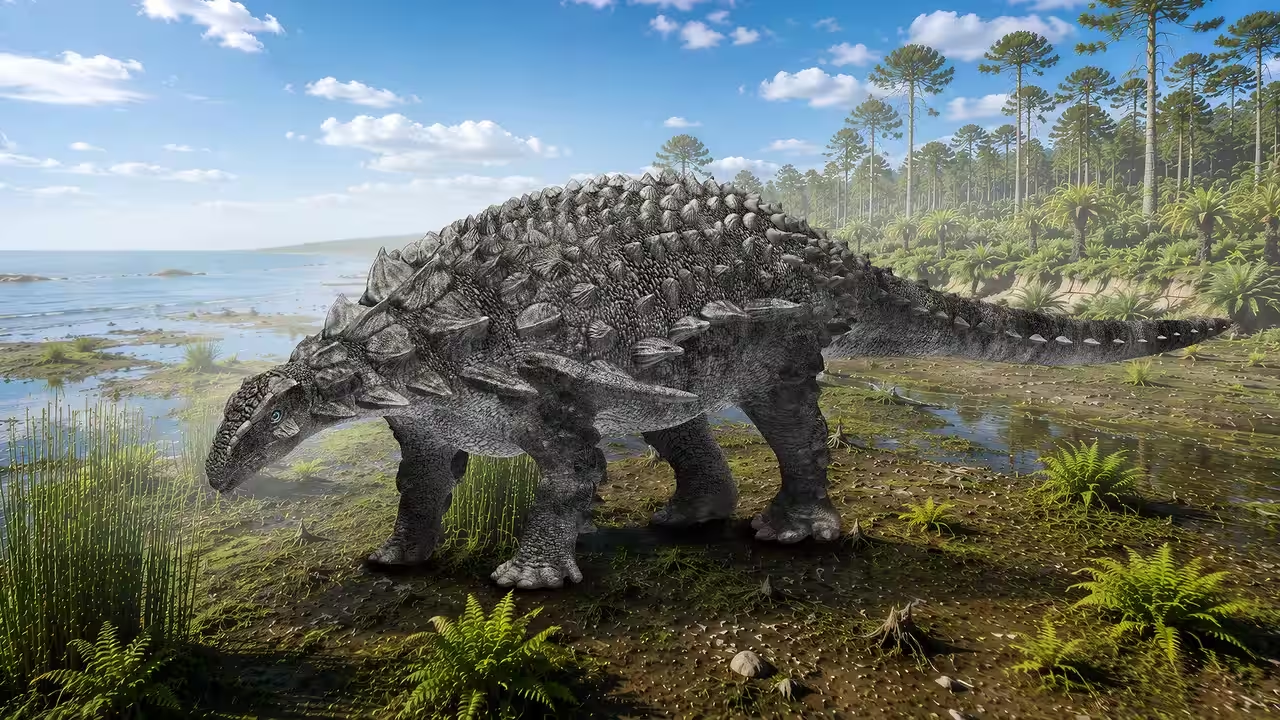
More than three decades after a partial ankylosaur skull was first discovered in a Hokkaido riverbank deposit, researchers have formally named it as a new genus and species, Nipponopelta yezoensis, the first ankylosaur ever formally named from Japan. The study, ‘A new nodosaurid ankylosaur (Dinosauria: Ornithischia) from the Upper Cretaceous Hikagenosawa Formation in Japan reveals dispersal pattern of Asian nodosaurid ankylosaurs,’ published in Cretaceous Research, was led by Shumpei Oyabu of Hokkaido University alongside colleagues from Japan, Canada and the United States.Using CT scanning and phylogenetic analysis, the researchers resolved the specimen's identity and uncovered an unexpected evolutionary relationship with nodosaurids from North America and Europe. Here's how the fossil was rediscovered, and what it reveals about how armoured dinosaurs were distributed across ancient continents.A Hokkaido fossil in storage, how the specimen was finally identifiedA partial skull, the atlas, or first cervical vertebra, and several teeth, catalogued as MCM A522, were discovered in a concretion from the Hikagenosawa Formation along the Omakizawa River, a tributary of the Shuparo River in Yubari, Hokkaido, and donated to the Mikasa City Museum by Eijiro Goto. The specimen was first described in 2005 by Hayakawa and colleagues, who identified it as a nodosaurid ankylosaur based on its teeth and occipital bone morphology, but its precise taxonomic position remained unresolved for years. Acid preparation and the limited exposure of teeth preserved within the skull made detailed morphological study difficult.What CT scanning revealed about the new speciesTo finally resolve the specimen's identity, Oyabu and colleagues applied three-dimensional CT reconstruction, digitally revealing parts of the skull that had previously remained hidden, including a section of the lower jaw, two intact teeth and the dinosaur's left inner ear. The scans exposed a distinctive combination of features in the back of the skull, unique enough to justify naming a new taxon, Nipponopelta yezoensis. The specimen is particularly important because it is the only Asian nodosaurid currently known from skull elements; other Asian nodosaurids are known only from postcranial material, making it an important reference point for understanding the group's anatomy.A surprising family tree, closer to North America than AsiaRather than grouping with the handful of other nodosaurids previously described from Asia, phylogenetic analysis placed Nipponopelta yezoensis deeply within derived North American and European nodosaurids, including Pawpawsaurus, Panoplosaurus, Nodosaurus, Edmontonia and Denversaurus, as well as the European taxon Dracopelta. This unexpected placement showed that Nipponopelta was more closely related to these North American and European forms than to other Asian nodosaurids, prompting the researchers to examine how different nodosaurid lineages may have become distributed across regions over millions of years.How Nipponopelta's ancestors spread across continentsAncestral geographic analysis suggested that the lineage containing Nipponopelta yezoensis and its close relatives had a broad ancestral distribution spanning Laramidia, Appalachia and Asia. Habitat reconstruction further showed that Nipponopelta yezoensis preferred marine-influenced environments, likely inhabiting coastal or estuarine areas. The researchers suggested that this coastal preference may have played an important role in shaping its dispersal patterns across different regions. The Hikagenosawa Formation itself, part of the mostly marine Yezo Group, has also previously yielded other significant dinosaur finds, including the hadrosaurid Kamuysaurus japonicus and the therizinosaurid Paralitherizinosaurus japonicus. Together, these discoveries add to the importance of Hokkaido's Cretaceous rocks for understanding dinosaur diversity in ancient marine-influenced environments million years ago.You use AI every day. Now get your AI Quotient. Take the AIQ test.
Topics in this story
Gathered from external sources. Rights to this text belong to whoever originally published it.