A Canadian homebuyer agreed to pay over $1 million for a pre-construction condo but couldn't secure a mortgage; builder resold the unit for $699,900, yet court ordered it to return his $121,098 deposit with interest
A Canadian homebuyer who could not secure a mortgage for a pre-construction condominium in Ontario has won a court battle to recover his $121,098 deposit,
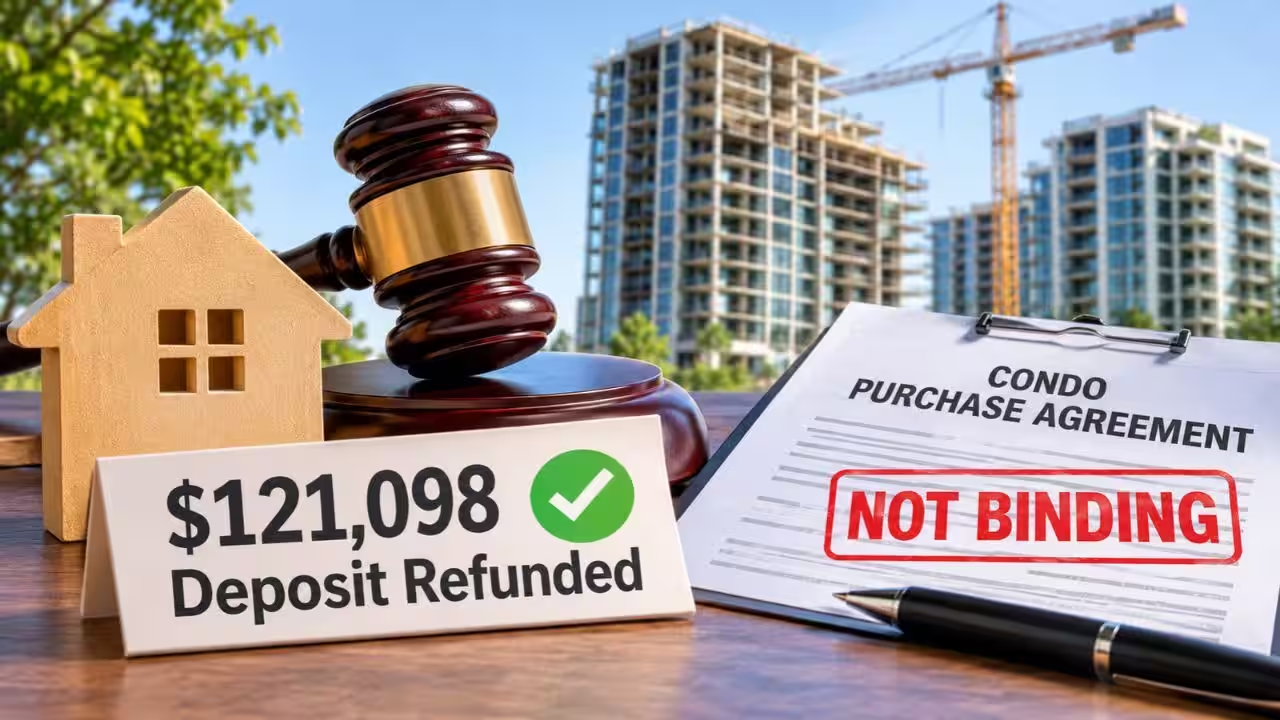
A Canadian homebuyer who could not secure a mortgage for a pre-construction condominium in Ontario has won a court battle to recover his $121,098 deposit, despite the builder reselling the property for considerably less than the original purchase price. The Ontario Superior Court of Justice ruled that the purchase agreement was not binding because the developer could not prove it had delivered a legally required condominium buyers’ guide. The March 2026 decision also awarded the buyer interest on his deposit and $31,000 towards his legal costs.Court orders builder to return $121,098 condo depositThe dispute involved a pre-construction condominium in Hamilton, Ontario, which the buyer agreed to purchase in March 2022 for just over $1 million. According to the ‘Money,’ the buyer paid a total deposit of $121,098 towards the property.However, when the transaction reached its closing stage in February 2024, he was unable to secure the financing needed to complete the purchase. The sale consequently fell through, leaving the builder with a unit it needed to sell again.The developer subsequently resold the condominium for $699,900, substantially below the original agreed price. The difference was approximately $300,000, creating a significant financial dispute between the two parties.The builder sought to retain the buyer’s deposit and also to recover other losses resulting from the lower resale price and costs of holding the property. But the buyer challenged the contract itself, arguing that the developer had not fulfilled an important legal prerequisite before the sale.As explained by Lumen LLP, the buyer argued that the purchase agreement had never become legally binding because he had not received Ontario's required Residential Condominium Buyers' Guide.What does Ontario law require from condominium buildersThe central issue in the case was the documents that developers are legally required to provide when selling new condominium units.In Ontario, the Condominium Act, 1998 requires that developers provide buyers with two important documents; the Residential Condominium Buyers’ Guide and the most current disclosure statement. These documents explain the buying process, and the rights and risks of a purchaser in buying a property before it is constructed.According to the case analysis of Lumen LLP, developers have been required to provide the disclosure statement with the condominium guide as of January 1, 2021, pursuant to Section 72(1) of the Act. Furthermore, section 72(2) provides that a purchase agreement shall not be binding on the buyer unless both documents have been delivered.The legislation also gives buyers a 10-day cooling-off period in which to cancel the agreement without a financial penalty. But the signing of the contract does not automatically start this period.The Condominium Authority of Ontario says the 10 days don’t start until the purchaser has received all three documents: the buyers’ guide, the latest disclosure statement and a copy of the purchase agreement signed by both the buyer and developer. If the buyer cancels within this period, the developer is obliged to return the deposit immediately, plus any interest earned.The builder's electronic acknowledgment failedThe developer attempted to defend its position by relying on an electronic acknowledgment included in the purchase agreement. The document carried the buyer's electronic signature and indicated that he had received the condominium guide.However, the court was not convinced that this acknowledgment established actual delivery. According to Lumen LLP, the same acknowledgment also confirmed that the buyer had received a fully signed purchase agreement and the disclosure statement. Evidence suggested that he could not have received those documents on the date he signed the acknowledgment.The builder was able to produce records showing when certain other documents had been emailed to the purchaser. However, it could not provide comparable evidence showing when or how the condominium guide had been sent.This distinction became central to the case. A signed acknowledgment was not sufficient evidence of actual receipt of the document as required by law.The developer could not prove delivery of the guide, the court held. Therefore, the agreement had never been binding on the purchaser and the 10-day cancellation period had not been triggered.The March 2026 ruling went beyond the deposit disputeThe Ontario Superior Court of Justice ruled in the buyer’s favor in March 2026. The developer was ordered to repay the full deposit of $121,098 plus interest.The builder also claimed further damages in relation to the resale of the condominium and carrying costs associated with it. The court dismissed this claim too. The buyer also was awarded $31,000 in legal fees.The builder also argued that the buyer's actions, including paying deposits and signing amendments to the agreement, meant he had accepted the contract. The court rejected this position.What the decision means for other pre-construction buyersThe judgment could be important for other Ontario homebuyers who find themselves unable to complete pre-construction purchases. However, it does not mean that anyone who fails to obtain a mortgage can automatically walk away from a condominium agreement and recover their deposit.‘Money’ reported that the outcome depended on the builder's failure to establish that it had fulfilled its legal disclosure obligations. The distinction matters because financing difficulties alone are not a valid reason to cancel an otherwise binding purchase agreement.Lumen LLP also referenced a prior case, Chen v. Brookfield Residential (Ontario) Limited, 2022 ONCA 887, in which a buyer who received a low appraisal of the property attempted to back out of a purchase. The court held that the buyer's notice of cancellation was void and that he was in breach of the agreement. Buyers are at risk of losing their deposits and being held liable for the developer’s loss on resale.The Condominium Authority of Ontario recommends that purchasers maintain written records of every document received during the buying process.You use AI every day. Now get your AI Quotient. Take the AIQ test.
Topics in this story
Gathered from external sources. Rights to this text belong to whoever originally published it.