Rebuilt with India aid, flood-erased Nepal school seeks help to rebuild on higher ground
South Asia News: TRISHULI BAZAAR (NUWAKOT, NEPAL): Three warnings came within minutes the day it flooded, an accountant rushed in saying water was gushing in, a teache.
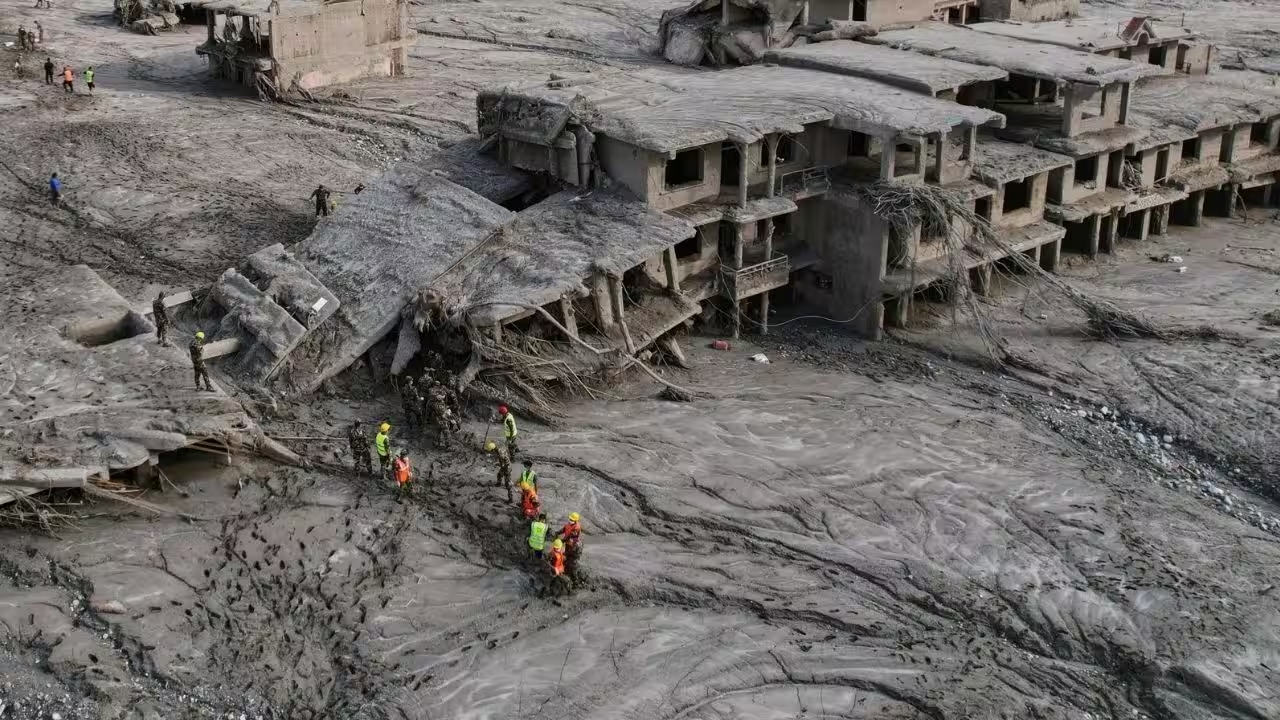
TRISHULI BAZAAR (NUWAKOT, NEPAL): Three warnings came within minutes the day it flooded, an accountant rushed in saying water was gushing in, a teacher relayed a phone call from upstream saying the area had been “swallowed”, and a parent arrived on a scooter to take his daughter away.Principal Rajendra Dawadi immediately ordered around 900 students at Tribhuvan Trishuli Secondary School out. They escaped before the river wiped out the 76-year-old campus. Now, Dawadi, teachers and students agree on one thing: classes must restart at the earliest, but the school must never be rebuilt beside the river. It has to rise on higher ground.“The children -- even some of our teachers and domestic staff -- are scared of the river.... it is a snaking ghost,” Dawadi, 47, told TOI on Sunday. “When they look at it, they feel afraid.”Close to a thousand people, including the children, had been inside the school when the warnings arrived. Thirty girls were in the residential hostel. When they asked Dawadi where they could go because their homes were far away, he told them to follow him uphill.Dawadi ordered a non-teaching employee to ring the bell and teachers began clearing classrooms. Staff helped students suffering panic attacks. One girl was being examined by a nurse in the infirmary. All students who were inside the school survived.Two staff members remain missing, Dawadi said. Non-teaching employee Chulrim Lama had been behind him during the evacuation and may have turned back towards the school, possibly to close a door. Lower-secondary teacher Santos Parihar was believed to have been in his room in the teachers’ quarters.Tribhuvan Trishuli, the oldest school across the flood-hit Rasuwa, Dhading and Nuwakot districts, had 1,643 students. The flood destroyed virtually everything it owned, including an 18-room, three-storey block constructed with assistance from the Embassy of India after the 2015 earthquake. All that remained of the school’s property were two buses. One of them had been provided by the Embassy of India.“Everything is washed away by the flood,” Dawadi said. “Previously, at the time of many disasters, Indian govt helped us. We are also hopeful this time that the Indian govt will help us re-establish our school.”Dawadi said India’s association with the school went back to before the 2015 earthquake. The proposal for the 18-room building had already been accepted before the quake, and the three-storey block was subsequently constructed with the embassy's assistance.Students described the terror of watching their school disappear.“We were getting ready for the morning assembly when teachers started screaming for us to run up the hill. I left my backpack and books behind in the classroom. Looking back down from the ridge and seeing the river wash over our playground was terrifying, but I am just glad all my friends made it safely,” Class 10 student Sunita Tamang told TOI.Class 12 student Rohan Shrestha remembered hearing the flood before seeing it. “The roar of the river sounded like a low thunder before we even saw the mud coming. The teachers moved fast getting everyone out of the hostels and to higher ground. The school is completely covered in mud now, and we don't know when we can go back to class, but we are looking after each other in the temporary camp,” he said.For Dawadi, restarting classes quickly was as much about restoring a sense of normalcy as education. “The children needed to see their friends and teachers again and return to some routine after the trauma,” he said.A large room in a private house, rented premises, a banquet hall or a govt building could serve as a temporary school. The municipality could also help establish a temporary learning centre, teachers hoped. Dawadi’s only non-negotiable condition was that it had to be on higher ground. “In a safe area, we will start the temporary school or temporary learning centre,” he said. “If possible, we will take rented houses and think about how to continue their learning.”Connectivity, however, remained the immediate hurdle. Dawadi said around 65-70% of the school’s students lived on one side of Trishuli river and 30-35% on the other. Others depended on buses, rented rooms near the school or its residential hostel. With river crossings destroyed, children who had studied together until Wednesday were now separated by Trishuli. “Connectivity is more important. If a Bailey bridge is established here, then we can restart very soon,” Dawadi said.Catch the latest World News and Live updates. Download the TOI app.
Topics in this story
Gathered from external sources. Rights to this text belong to whoever originally published it.