Divers found a 400-year-old shipwreck while clearing a German gas pipeline route; two anchors, woodworking tools and a mystery brick survived in the silt
Divers sent to clear dangerous metal from a planned gas pipeline route in Germany's Bay of Greifswald expected to find only modern debris and wartime
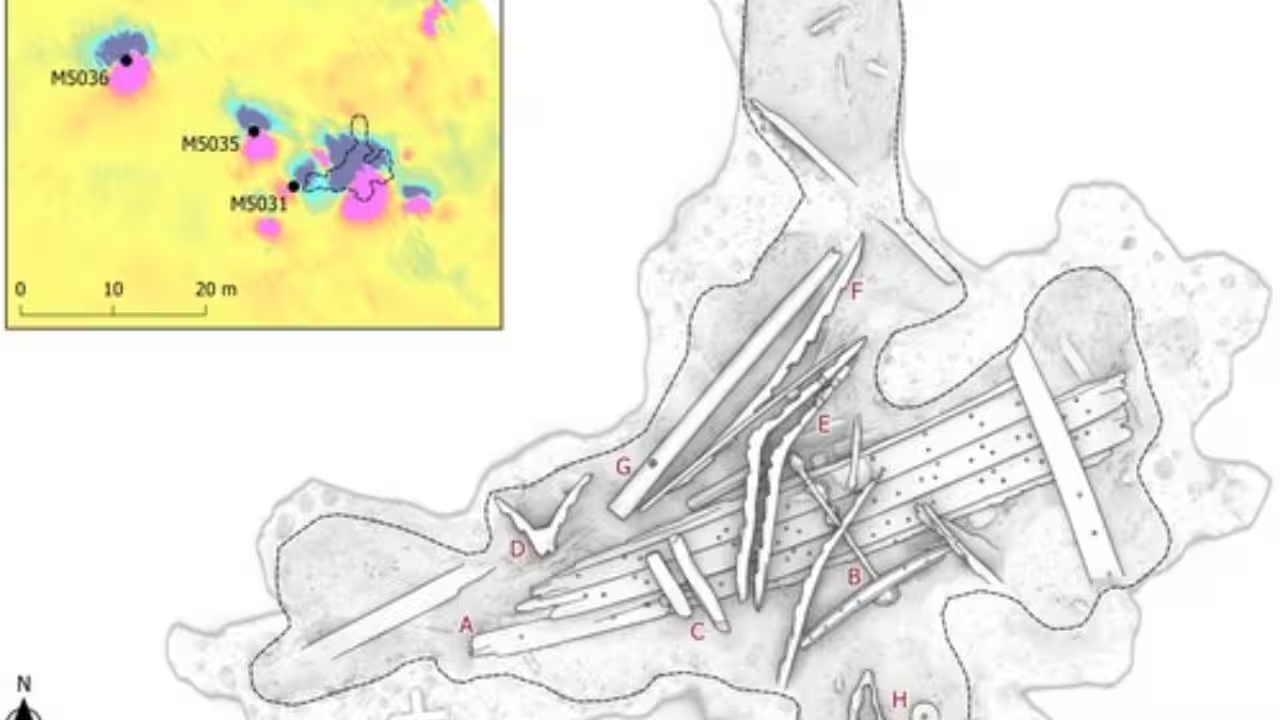
Divers sent to clear dangerous metal from a planned gas pipeline route in Germany's Bay of Greifswald expected to find only modern debris and wartime leftovers. Instead, in 2023, they pulled up shoe soles, wooden pulley blocks and an iron anchor from a seventeenth-century ship. Underwater archaeologist Michał Konrad Grabowski describes the discovery in a preliminary report in the International Journal of Nautical Archaeology, published by Taylor and Francis. The rescue team had only twelve days before dredging began, yet it recovered more than sixty objects, including one baffling brick-like item that still has no explanation.A routine search for dangerous seabed objects before gas pipeline construction uncovered a lost shipAccording to Grabowski's report, the find began with the Ostsee Anbindungsleitung project. It is a fifty-kilometre underwater gas pipeline linking a new liquefied natural gas terminal at Mukran, on the island of Rügen, with a gas transmission facility near the seaside resort of Lubmin. Before building, crews must neutralise hazardous objects on the seabed, such as unexploded wartime munitions and metal debris, and an archaeological watching brief usually accompanies this work.About three kilometres north of Lubmin, clearance divers investigated a cluster of magnetic anomalies. They brought up wooden blocks, rigging, leather shoe soles and a large stock anchor with its wooden stock still attached. Work stopped immediately, and the state heritage authority for Mecklenburg-Western Pomerania was notified. The finds were kept in wet storage to prevent drying out, and a full archaeological campaign began in early July 2023.How divers raced the dredging schedule to record the wreckThe team made twenty-two dives over twelve days. The divers were a mix of commercial divers and maritime archaeologists, working from a thirty-metre vessel with surface-supplied air and radio communication. Their positions were tracked in real time and combined with magnetic, sonar and photographic survey data.The wreck lay at an average depth of seven and a half metres, almost entirely buried in soft, fine silt. Even slight disturbance clouded the water, so visibility was poor. The first large timbers appeared only half a metre below the seabed, and most objects lay between half a metre and one metre underground, scattered and disconnected.What survives of this seventeenth-century hullThe largest surviving piece of hull measures roughly seven and a half metres by one metre. It has five overlapping planks and a few frames, and Grabowski identified it as part of the rear starboard side. The planks are about four centimetres thick and overlap in the clinker style, like roof shingles. They were fastened with iron nails and sealed with a mixture of tar and animal hair. The frame arrangement is consistent with a shell-first building method, in which the outer planking is assembled before the internal frames.One striking object is a bilge pump tube, hollowed from a single oak trunk and about 3.6 metres long. By comparing it with other Baltic wrecks, Grabowski tentatively estimated a vessel of nineteen to twenty-two metres in length, six to seven metres in width and about three metres in internal depth. He stresses that this is conjecture, because so little of the hull survives.Anchors, rigging blocks, a grindstone and woodworking tools suggest a ship prepared for long voyagesThe two wrought-iron stock anchors are very similar, with shanks of about 1.8 metres and wooden stocks of about 2.2 metres. They may be a matched pair of bow anchors. Nearby lay a solid pine buoy, probably used to mark an anchor's position, and a similar buoy was found on the Swedish warship Vasa.The rigging finds include single-sheave wooden blocks, mostly of ash, along with deadeyes and heart blocks. A grindstone about thirty centimetres across and several carpentry tools point to an onboard workshop, which Grabowski links to long-distance merchant ships or warships. The hand brace handle closely resembles examples from the Tudor warship Mary Rose. Nearly all the tools came from one magnetic anomaly, together with barrel staves and what may be spare iron fasteners stored in casks.The pierced clay brick in an oak housing remains an unexplained objectThe most puzzling find is a flat fragment of fine yellowish clay brick, about thirteen by seven centimetres and three centimetres thick. It is pierced by four cone-shaped holes, with part of a fifth, and is fitted tightly into an oak housing about fifteen by twelve centimetres. Grabowski found no direct parallels anywhere.His cautious suggestion is a sharpening device for drill bits or chisels, possibly made from a damaged tool and remounted in a new wooden frame. Until a match turns up, the object remains the wreck's central mystery.Dating the wreck and glimpsing the crew's everyday life aboardFive oak samples went for tree-ring analysis. One plank gave a felling date between 1626 and 1639, and another was cut no earlier than 1615. The two datable samples matched different regions, one in north-eastern Germany between Stralsund and Güstrow and the other in southern Norway, so the ship's place of origin cannot be determined.Personal belongings are scarce. There are two shoe soles from two different pairs, one about twenty-three centimetres long and one about seventeen, plus a stitched leather strap. Six animal bones from pigs and sheep or goats hint at meals eaten on board.Why the ship sank is unknown; the Peene Strait shipping route is nearbySeveral timbers show signs of burning, which may point to a dramatic end. The two anchors and the buoy lay close together, suggesting the ship may have been deliberately anchored before it sank. About seven kilometres east lies the Peene Strait, the main route between the Oder estuary and the Baltic Sea until the late eighteenth century. An eighteenth-century Dutch sea chart shows anchorages nearby, the westernmost close to the wreck.Grabowski treats all of this as tentative. With no cargo and only a fragment of hull, the ship's name, origin, destination, and crew remain unknown.Test pits to the west found no further remains, so the pipeline trench was moved twenty-six metres southwest to avoid the wreck. Layers of sandbags covered the exposed timbers during construction, and divers re-examined the site in 2024 to check for damage. The seabed to the east has never been surveyed, so more of the ship may still lie buried there.You use AI every day. Now get your AI Quotient. Take the AIQ test.
Topics in this story
Gathered from external sources. Rights to this text belong to whoever originally published it.