Canadian author Anne Carson awarded 2026 Nobel Prize in Literature
NEW DELHI: The 2026 Nobel Prize in Literature has been awarded to Canadian author Anne Carson, the Swedish Academy announced on Thursday.
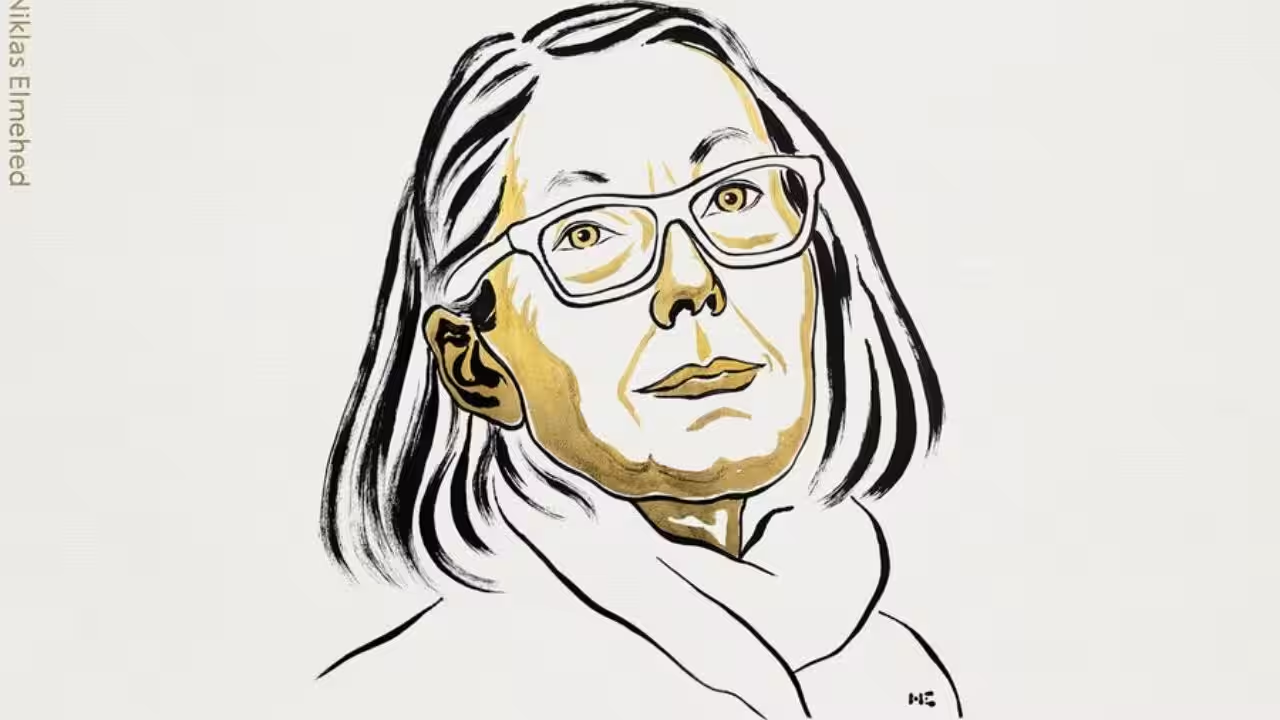
NEW DELHI: The 2026 Nobel Prize in Literature has been awarded to Canadian author Anne Carson, the Swedish Academy announced on Thursday.2025: László KrasznahorkaiHungarian novelist and screenwriter László Krasznahorkai won the 2025 Nobel Prize in Literature for what the Swedish Academy described as his "compelling and visionary oeuvre that, in the midst of apocalyptic terror, reaffirms the power of art".Krasznahorkai, born in 1954 in Gyula, Hungary, is known for novels marked by long, winding sentences, bleak landscapes, absurdity and a persistent sense of impending catastrophe. His work often places individuals in societies marked by collapse, disorder and uncertainty.His international breakthrough came with his 1985 novel Satantango, a work that follows the inhabitants of a failing collective farm and explores manipulation, despair and the search for meaning. The book was later adapted into a celebrated seven-hour film by Hungarian director Béla Tarr.Another major work, The Melancholy of Resistance, published in 1989, centres on a travelling circus and a mysterious whale whose arrival throws a small Hungarian town into chaos. The novel explores social breakdown and the fragility of order.Krasznahorkai's work has also included War & War, Seiobo There Below and Baron Wenckheim's Homecoming. His writing has been translated into numerous languages and has earned him a reputation as one of the most distinctive contemporary European novelists.The Swedish Academy's citation focused not simply on the darkness in his writing but on the role of art within that darkness. His Nobel recognition therefore placed the idea of literature surviving and resisting chaos at the centre of the award.2024: Han KangA year earlier, the Nobel Prize in Literature went to South Korean writer Han Kang, making her the first South Korean recipient of the literature prize.The Swedish Academy honoured her "for her intense poetic prose that confronts historical traumas and exposes the fragility of human life".Born in Gwangju in 1970, Han Kang moved with her family to Seoul when she was nine. She began her literary career with poetry in 1993 before making her prose debut in 1995.Her international breakthrough came with The Vegetarian, originally published in South Korea in 2007 and later translated into English. The novel tells the story of Yeong-hye, a woman who abruptly decides to stop eating meat. What begins as a seemingly personal decision develops into a confrontation with family, social expectations, violence and control.The English translation of The Vegetarian, by Deborah Smith, won the International Booker Prize in 2016, helping introduce Han Kang's work to a much wider international readership.Han Kang's writing frequently explores the relationship between physical and psychological suffering. Her novels also return to questions of memory, violence, grief and the ways individuals carry the trauma of historical events.Her 2014 novel Human Acts deals with the 1980 Gwangju massacre, an event of particular personal significance because Han Kang was born in the city. The novel gives voice to victims of the military crackdown and examines the physical and emotional consequences of political violence.Another major work, The White Book, is built around grief and the death of an infant sister. Her later novel We Do Not Part explores the lingering trauma of the Jeju massacres of the late 1940s.The Swedish Academy said Han Kang's work confronts historical trauma and "exposes the fragility of human life", while also pointing to her distinctive understanding of the relationship between the body and the soul, and between the living and the dead.2023: Jon FosseBefore Han Kang, the 2023 Nobel Prize in Literature went to Norwegian author Jon Fosse, recognised "for his innovative plays and prose which give voice to the unsayable".Born in Haugesund, Norway, in 1959, Fosse has written across several forms, including novels, plays, poetry, essays, children's books and translations. Much of his work is written in Nynorsk, one of Norway's two official written forms of the Norwegian language.Fosse is particularly known as a playwright, with his work performed widely across Europe and beyond. His writing is often spare and repetitive, with pauses, silences and seemingly ordinary conversations used to explore loneliness, anxiety, death, relationships and spirituality.His debut novel, Raudt, svart, was published in 1983. His international breakthrough as a dramatist came with Someone Is Going to Come, first published in 1996 and later staged internationally.The Swedish Academy described Fosse's writing as giving expression to experiences that are difficult to put into words. His work often strips away conventional dramatic action and instead focuses on repetition, silence and the inner lives of his characters.Fosse's recognition also brought attention to a literary tradition rooted in Norway's Nynorsk language while using modernist techniques. The Nobel Committee noted that he combines strong local and linguistic roots with influences from modernist writers including Samuel Beckett and Thomas Bernhard.You use AI every day. Now get your AI Quotient. Take the AIQ test.
Topics in this story
Gathered from external sources. Rights to this text belong to whoever originally published it.