France turned 127 hectares of abandoned gravel pits into Europe’s largest floating solar farm; 135,000 panels now generate power for 37,000 people
France has turned a former gravel-quarry site in Haute-Marne into Europe’s largest floating solar farm, covering 127 hectares and carrying 135,000
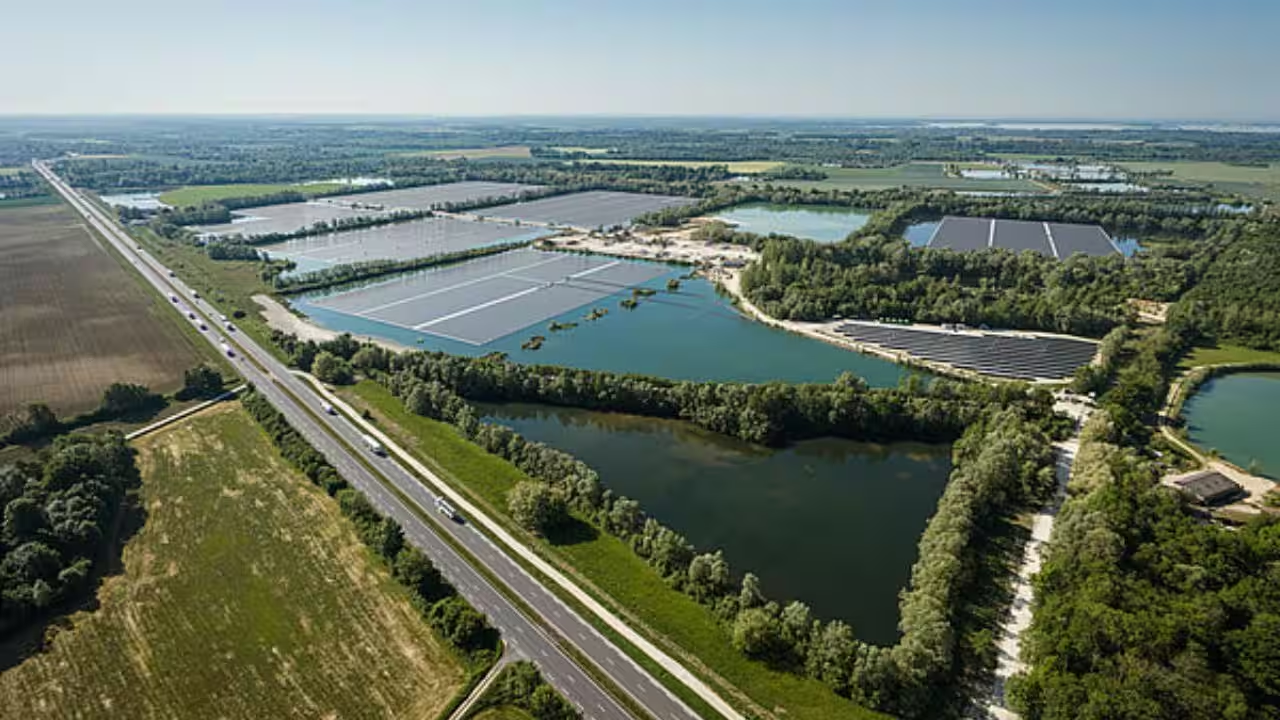
France has turned a former gravel-quarry site in Haute-Marne into Europe’s largest floating solar farm, covering 127 hectares and carrying 135,000 photovoltaic modules. The Les Ilots Blandin project near Perthes began operating in June 2025, using quarry basins to produce renewable electricity. With a total capacity of 74.3 MW, the installation is expected to generate power for around 37,000 people annually while avoiding massive CO2 emissions. Q ENERGY and Grand Est Development International provided these details about the project.How did France turn 127 hectares of gravel pits into Europe’s largest floating solar farmThe project was built on 6 unused basins created by former gravel extraction at the Blandin site. According to Grand Est Developpement International, the 127-hectare site had been left after quarrying activity and was repurposed rather than using a new area of land for the solar installation. The organisation describes the project as Europe’s largest floating solar park.Q ENERGY began developing the project in 2019, with the idea of using unused industrial basins for renewable energy. The company said the former gravel pits were suitable because they offered strong solar potential while creating little conflict over land use. The quarry operations were due to end in 2020.The location also meant the project could make use of water surfaces that had already been created by industrial activity. Instead of covering open ground with solar panels, much of the installation sits on floating structures placed across the former quarry basins.What makes the Les Ilots Blandin project so largeThe scale becomes clearer from the number of panels involved. More than 135,000 photovoltaic modules have been installed across the site on floating platforms developed in France. Grand Est Developpement International says the project involved about 100 people, while construction took 15 months.The solar panels themselves cover 45.5 hectares, even though the overall project extends across 127 hectares. Balkan Green Energy News reports that 72.3 MW of the plant’s capacity is installed on floating platforms, while another 2 MW comes from a ground-mounted section. The 6 floating platforms range from 8 MW to 17 MW each.That small ground-mounted section was included for practical reasons. Q ENERGY says the 2 MW system was designed into the project to improve the overall energy output and economic performance of the site.Electricity production capacity of the floating solar farmThe plant has a total capacity of 74.3 MWp. Q ENERGY says it can generate enough renewable electricity each year to supply 37,000 people and is expected to prevent 18,000 tonnes of CO2 emissions annually.The electricity output gives the former industrial site a new role. What was once associated with gravel extraction is now being used to produce power without requiring the entire project to occupy additional land.The installation was officially inaugurated on 20 June 2025. Q ENERGY said construction began in September 2023 after more than five years of planning, with the plant reaching full commissioning in June 2025.Why was floating solar chosen for the former quarriesFloating solar is still an emerging technology in France, particularly in the northern parts of the country. Q ENERGY says such projects can make use of areas where land-use conflicts are limited, but they also face a significant financial challenge.Floating installations generally cost more to construct and maintain than conventional ground-mounted solar farms. Balkan Green Energy News reports that they must also compete directly with ground-based solar projects in France’s public tender system rather than having a separate tender process.That made the design and economics of Les Ilots Blandin especially important. Q ENERGY said several configurations were considered before the final arrangement was selected, including the addition of the 2 MW ground-mounted section.Companies involved in bringing the project into operationLes Ilots Blandin was developed through a partnership involving several companies. Q ENERGY initiated the project, while Ciel & Terre supplied and installed the floating structures, solar modules and inverters. Perpetum handled the electrical infrastructure and construction of the ground-mounted array, while Solutions30 was responsible for cabling, grid connection and overall commissioning.Funding for construction was secured in September 2024, with more than €50 million raised through Credit Agricole Transitions & Energies and Bpifrance. In early 2025, Spanish renewable energy company Velto Renewables acquired a 50% stake and became the long-term owner of the asset.You use AI every day. Now get your AI Quotient. Take the AIQ test.
Topics in this story
Gathered from external sources. Rights to this text belong to whoever originally published it.