Chris Hemsworth and Elsa Pataky helped return Tasmanian devils to mainland Australia after 3,000 years; the endangered marsupials could help restore ecosystems
For the first time in 3,000 years, the Tasmanian devil is back in the wild on mainland Australia.
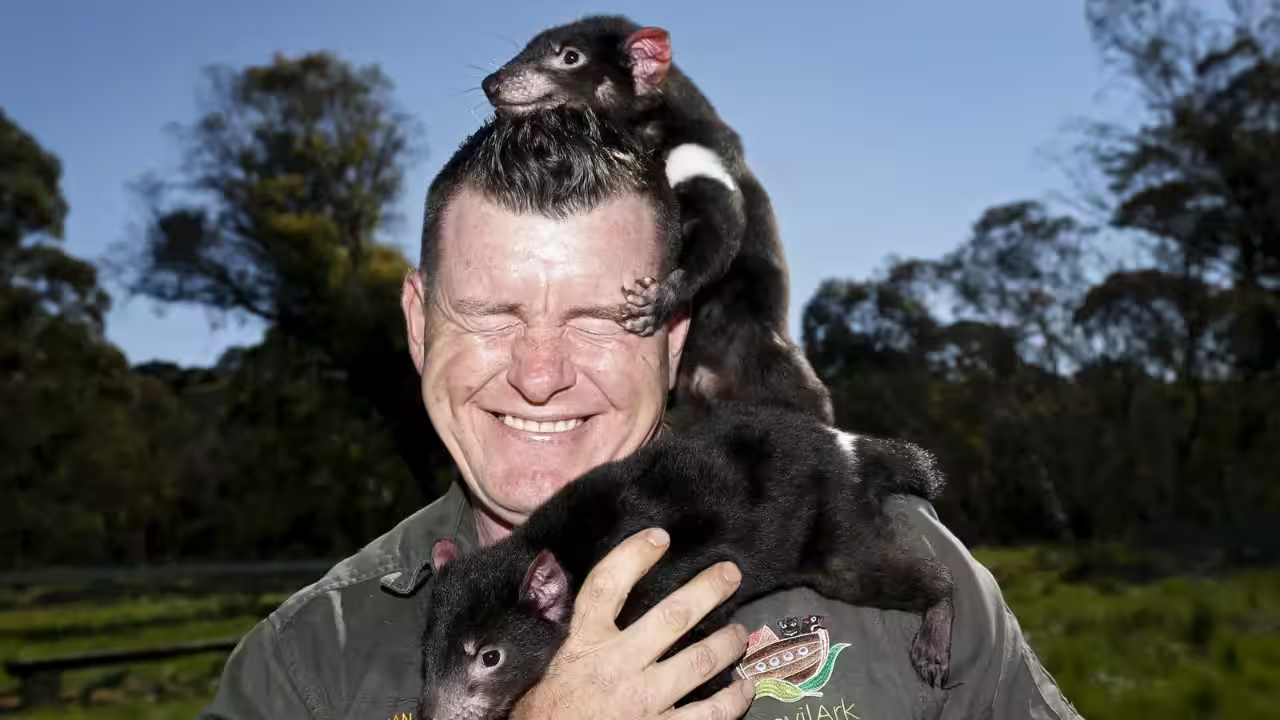
For the first time in 3,000 years, the Tasmanian devil is back in the wild on mainland Australia. The actors Chris Hemsworth and Elsa Pataky helped release some of the animals, including Lenny and Lisa, into a 400-hectare wildlife sanctuary on Barrington Tops in New South Wales. Aussie Ark carried out the release with Global Wildlife Conservation and WildArk. Eleven devils were released into the sanctuary, and 20 more were planned for 2020. Twenty-six devils now live in the wild on the Australian mainland, after a trial release of 15 devils preceded the main release on 10 September.How did Chris Hemsworth help release Tasmanian devilsAussie Ark, working with Global Wildlife Conservation and WildArk, released 11 Tasmanian devils into a 400-hectare (nearly 1,000 acres) wildlife sanctuary on Barrington Tops. WildArk states that Hemsworth and Pataky helped release some of the animals, including Lenny and Lisa, into their new home.According to the World Economic Forum, the actor couple joined conservation groups last month to release the 11 animals into a wildlife sanctuary in New South Wales. It describes Hemsworth as best known for playing Thor in Marvel Cinematic Universe films, and says he spoke of laying traps to catch the devils before releasing them into the wild. Tim Faulkner, president of Aussie Ark, said: "This release of devils will be the first of many."Why did Tasmanian devils disappear from mainland AustraliaAccording to WildArk, Tasmanian devils vanished from mainland Australia in large part because of introduced dingoes, which hunt in packs. Dingoes never reached Tasmania. The devils were wiped out on the mainland after being hunted by dingoes, a pack animal, and were left confined to the island state.In Tasmania, a transmissible, painful and fatal disease called Devil Facial Tumour Disease, the only known contagious cancer, decimated up to 90 per cent of the wild population, leaving just 25,000 devils in the wild there. The World Economic Forum says numbers in Tasmania have dropped since the 1990s because of facial tumour disease. It adds that the devil, the world's largest surviving marsupial carnivore, is about the size of a small dog and was listed as endangered on the Red List in 2008.How will the sanctuary protect Tasmanian devilsThe 400-hectare sanctuary on Barrington Tops will prevent the spread of disease, feral pests, noxious weeds and fire. It described fire as catastrophic for the country earlier in the year. The sanctuary will also keep cars out, so that the devils learn not to associate cars with food. WildArk says that association could be deadly when the animals are more widely released.Aussie Ark chose the devils for release because they were the most suitable to breed with one another without inbreeding. For the past decade, the Aussie Ark team has been building an insurance population and studying the animals' reproductive physiology, behaviour and ecological needs. The release took place on 10 September and followed a successful assisted trial release of 15 devils. WildArk states that 26 devils now live in the wild on the mainland.How will Tasmanian devils help restore Australian ecosystemsFaulkner said that in 100 years people will look back on the day as the one that set in motion "the ecological restoration of an entire country". He said the devil will engineer the environment around it, restoring and rebalancing forest ecology after centuries of devastation from introduced foxes, cats and other invasive predators.Aussie Ark has been breeding young devils and plans to release 20 more next year and another 20 the year after. It reports that Aussie Ark has bred nearly 400 joeys and can now return some of them to the wild. Mark Hutchinson, co-founder of WildArk, said the reintroduction is paving the way for future introductions that are already being mapped out. Aussie Ark is New South Wales's largest independently owned and operated conservation organisation, with a vision of building insurance populations of threatened Australian mammals for release into predator-free sanctuaries.You use AI every day. Now get your AI Quotient. Take the AIQ test.
Topics in this story
Gathered from external sources. Rights to this text belong to whoever originally published it.