Epidermolysis bullosa: I was told my baby was as fragile as glass
Ciara says she found it hard to imagine her son being happy but has started to believe he could be.
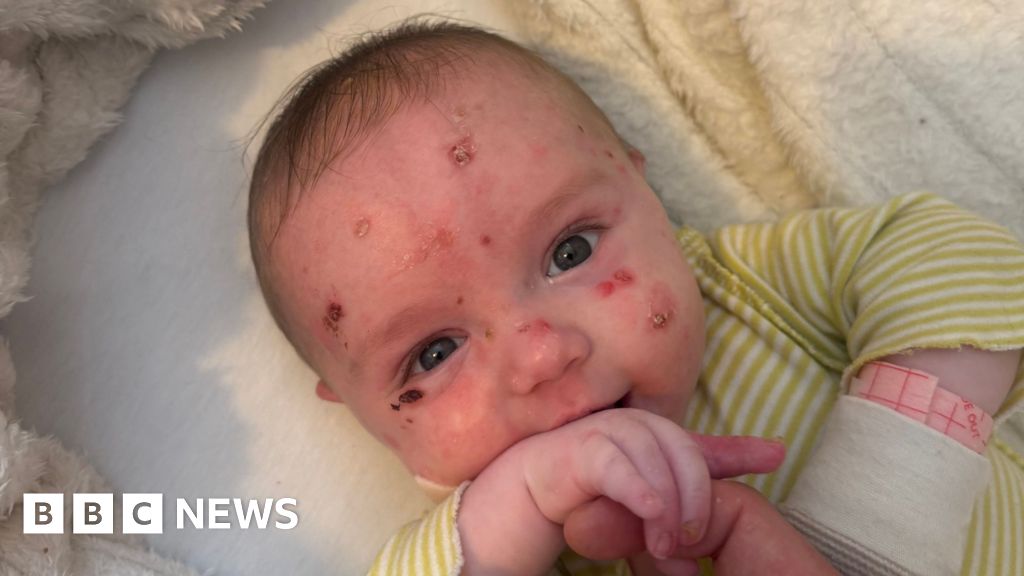
When Ciara's son Ralph was born, he had skin missing from his hands and feet. Doctors said he was as fragile as glass.
Ralph was diagnosed with junctional epidermolysis bullosa (JEB), also known as butterfly skin, at a few days old.
Ciara and her partner Lewis had to become experts in the rare genetic disorder, which causes skin to tear or blister at the slightest touch.
"We were new parents, we had never heard about this before and we had basically been told my son was like glass," Ciara, from Arlesey in Bedfordshire, says.
The 30-year-old mum is now calling on the government to increase funding and research into rare skin conditions, with the hope of one day finding a cure.
Five minutes after Ralph was born, following what Ciara describes as a normal pregnancy, she noticed "big raw patches" on his hands and feet.
"My partner Lewis went to the NICU [neonatal intensive care unit] with him and left me with a picture of him," she says.
"I spent the whole time looking at that picture questioning what on earth was going on."
After being put in a heated incubator, Ralph's body broke out in head-to-toe blisters.
Two days later, the couple received a diagnosis of epidermolysis bullosa, with the specific subtype of junctional epidermolysis bullosa (JEB), of which there are two main forms.
Ralph's form is generally milder, rather than the severe type which can be life-threatening. But there is no cure and limited treatment options.
Ralph's parents grease bottle teats to avoid damaging his mouth and turn his baby-grows inside out to avoid friction from the seams. They spend up to three hours each night replacing bandages on his feet.
"At the start, when he was a newborn, everything felt so heavy. It was really hard to imagine him being happy.
"Doctors from Great Ormond Street were essentially saying 'we need to teach you how to care for him' and we were expected to learn it – the medical professionals around us at the local hospital were learning on the job with us," she says.
What is junctional epidermolysis bullosa?
Young people with the condition are sometimes called "butterfly children", due to their skin's fragility, like a butterfly's wing.
According to DEBRA UK, the charity for people living with the disorder, it leads to blistering across the body, alopecia, malformed fingers and toenails and irregular tooth enamel.
It is caused by a gene mutation which results in faulty or missing proteins in layers of the skin and internal organs. Ralph's DNA lacks the instructions for sticking his epidermis (the surface layer of our skin) to the dermis (the next one down).
Two of the most common symptoms are pain and itching from frequent and extensive blistering.
Ciara recently started a petition calling for more research into the condition and after reaching 10,000 signatures, she received a response from the Department of Health and Social Care (DHSC).
The DHSC, which has also been contacted by the BBC for comment, said it had already committed £1.075m over five years for projects specifically related to EB.
It said research had so far covered advanced treatments, symptom management, supportive care and better care co-ordination.
But Ciara worries her son's rare condition could get "left behind" in the world of research.
"It feels like families like ours are the ones being left to connect the dots. It just doesn't feel good enough.
"If enough people knew how devastating this condition is, something would have to happen because no-one, no human in the world, would stand by and allow children to suffer from birth for the rest of their lives.
"If the system in place is working, why are families like ours still having to work so tirelessly to raise awareness, contact researchers and campaign for anything that might improve our children's quality of life?"
Tony Byrne, chief executive officer of DEBRA UK, says research is "not an abstract ambition" for people with butterfly skin, but "the route to less pain, better treatments, and the hope of a cure".
"This petition matters because dedicated, ring-fenced government investment would give researches greater certainty, help promising discoveries move into UK clinical trials and ensure rare conditions are not overlooked," he adds.
Despite how painful the condition is and the need for more research, Ciara says she has finally started to believe that Ralph can live a happy life.
"He is just the most stubborn, funny, resilient little boy. He loves simple things. When the trees move in the wind, it makes him so happy," she says.
"Ralph can have the most awful wounds on his stomach or his elbows and he's still rolling over trying to get toys. He doesn't let anything stand in his way. He's so fragile, but so desperate to move.
"Despite everything he's so happy, he's so smiley. He won't let anything hold him back."
Do you have a story suggestion for Beds, Herts or Bucks? Contact us below.
Follow Beds, Herts and Bucks news on BBC Sounds , Facebook , Instagram and X .
A cuddle could tear my son's skin due to rare disorder
'Holding my son made my skin blister and fall off'
'We take it day by day with son's skin condition'
Topics in this story
Gathered from external sources. Rights to this text belong to whoever originally published it.