In 1971, a Canadian art student visited a fogbound island to draw wild horses; she stayed nearly 50 years studying its wildlife, and Sable became a national park reserve
Rest of World News: Discover the inspiring journey of Zoe Lucas, a Canadian art student who dedicated nearly 50 years to studying and conserving the wildlife of Sable Island, now a national park reserve. Learn about the impact of her work on wild horses, seals, and the island's ecosystem.
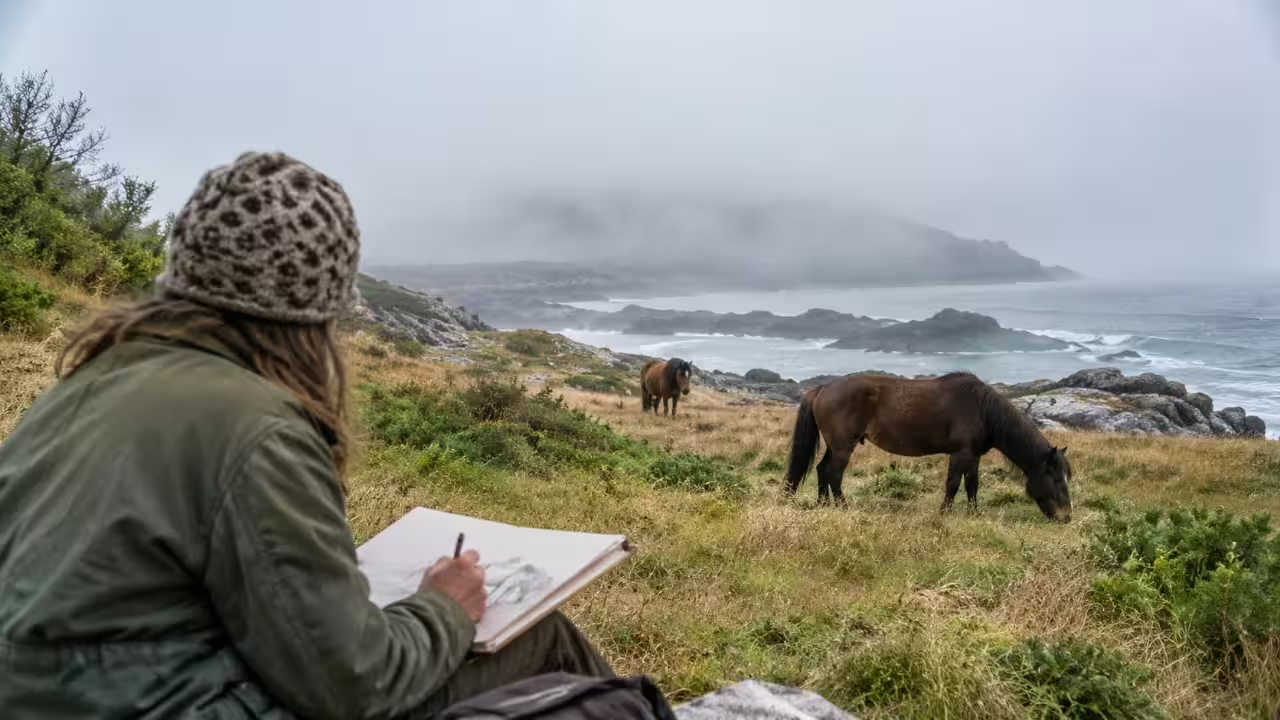
In 1971, Zoe Lucas arrived on Sable Island as a young art student, drawn by its remote landscape and wild horses. What began as a short visit to the windswept island soon became a lifelong connection. Lucas kept returning, eventually spending more than five decades documenting its horses, wildlife and changing ecosystem through field observation and research.According to Parks Canada, Sable Island lies about 290 kilometres southeast of Halifax, Nova Scotia, and stretches roughly 42 kilometres across the North Atlantic. The island's shifting sand, dunes, freshwater ponds and coastal habitats support wild horses, grey seals and large seabird colonies. More than 350 shipwrecks have also been recorded in its surrounding waters since the 16th century. For Lucas, an early fascination with Sable Island's horses grew into decades of observing and documenting its wider wildlife and changing ecosystem.From sketches to field notebooksLucas did not arrive as a trained biologist. She studied art and goldsmithing, and first visited the island while she was a student. She later became involved with a Dalhousie University seal research programme, an experience that shifted her attention from simply observing the island to documenting its wildlife. By the mid-1980s, she had moved permanently to Sable Island and was spending much of her time there. Her efforts did not just include horses. As years passed, she kept track of seals, conducted beach surveys for birds affected by oil and other forms of marine debris, and documented the occurrence of other organisms. She worked on many flora-and-fauna projects, helping turn the island into a place where long-term changes could be observed.The horses remained central to much of Lucas’s work. She and other researchers built detailed records of individual animals, tracking family relationships, movements, births and deaths. Their observations also helped investigate the long-standing question of the horses’ origins. According to the Journal of Heredity, genetic analysis found no evidence to support the popular theory that Sable Island’s horses descended from shipwrecked Spanish horses. Instead, the horses were found to be more closely related to light draft and multipurpose breeds common in eastern Canada, while remaining genetically distinct as a population.A complicated relationship with the landscapeThe horses are not simply picturesque symbols of wilderness. They are large herbivores living on a narrow island where vegetation, freshwater and dunes are closely connected. Their grazing can therefore influence the plants that help hold parts of the sandy landscape together. According to The Canadian Field-Naturalist, a study involving Zoe Lucas compared vegetation inside and outside fenced areas that excluded horses from grazing. The researchers found that the effects were strongest in marram grassland, where standing plant litter and vegetation cover differed between grazed and ungrazed areas, although plant species richness and diversity were not substantially affected. The findings suggest that the horses influence parts of the island's vegetation, particularly its marram-dominated grasslands.The relationship between the horses and vegetation also needs to be viewed in the context of Sable Island’s constantly changing landscape and fluctuating horse population. Parks Canada records show the number of horses increasing from 138 in 2004 to 591 in 2022, before falling to 374 in 2023 and rising to 420 in 2024. However, Parks Canada cautions that the estimates vary in precision, with most based on annual counts and some on aerial photography. The figures should therefore be interpreted with care rather than seen as a straightforward population trend. On an island shaped by shifting dunes, storms and changing vegetation, grazing is just one of several forces influencing the landscape.From remote refuge to protected landscape Lucas's long association with Sable Island also unfolded alongside growing efforts to protect it. According to Parks Canada, the island was designated a Migratory Bird Sanctuary in 1977 before receiving stronger legal protection decades later. On October 17, 2011, the governments of Canada and Nova Scotia signed an agreement to establish Sable Island as a national park reserve. The final legislative step came on December 1, 2013, when the legislation came into force and formally brought Sable Island National Park Reserve under the Canada National Parks Act, making it Canada's 43rd national park.The designation protects 31 square kilometres of land and its intertidal areas, with ecological integrity at the centre of management. It also reflects the wider value of the island, which supports not only its famous wild horses but also a major breeding colony of grey seals and numerous bird species. In 2024, Lucas was appointed a Member of the Order of Canada in recognition of her decades of work on Sable Island.For more than five decades, Lucas's work has helped turn attention towards an island that might otherwise have remained known mainly for its shipwrecks and wild horses. Her records have provided a long-term view of how its animals, vegetation and shifting landscape change over time. Today, Sable Island remains a place where nature is constantly in motion, and where understanding those changes is as important as protecting the landscape itself.Catch the latest World News and Live updates. Download the TOI app.
Topics in this story
Gathered from external sources. Rights to this text belong to whoever originally published it.