Robert Redford bought 2 acres in Utah for his family in 1961; he later bought a canyon and turned it into Sundance, an arts and conservation retreat
Robert Redford, the actor and director who died in September 2025 at the age of 89, bought two acres in Utah's Provo Canyon in 1961 as a place for his
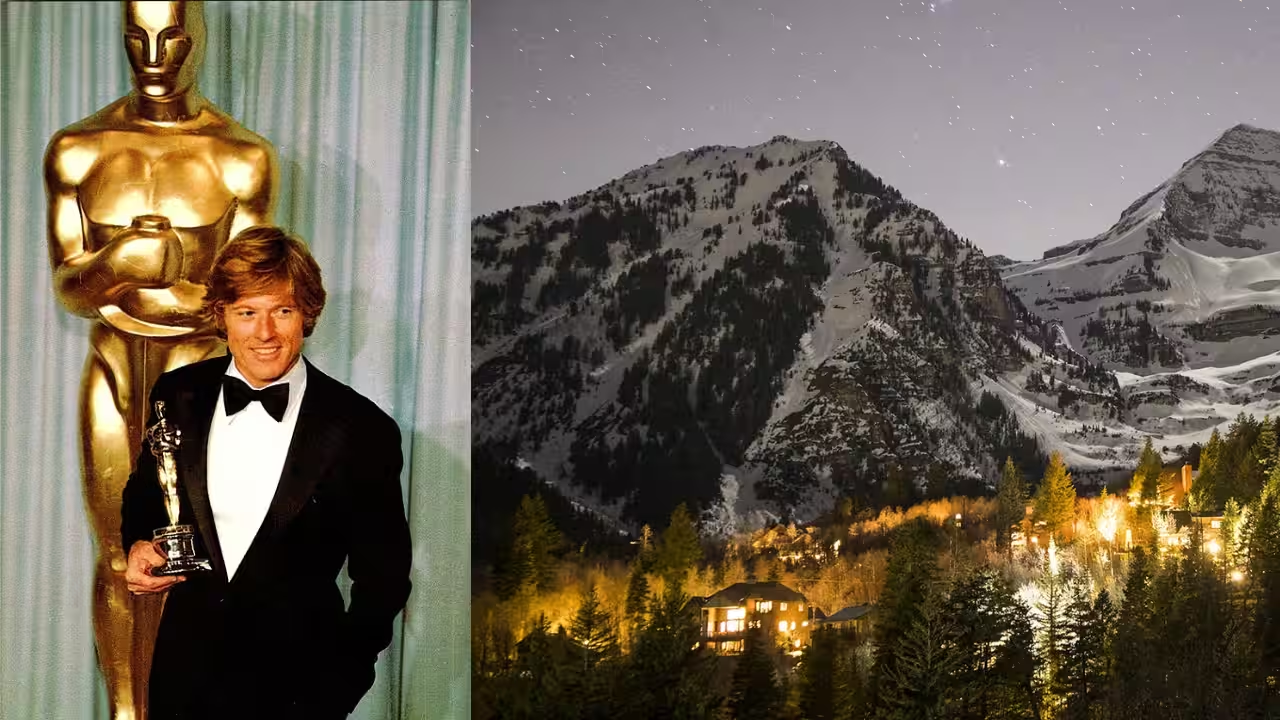
Robert Redford, the actor and director who died in September 2025 at the age of 89, bought two acres in Utah's Provo Canyon in 1961 as a place for his family. Over the following decades, he assembled the surrounding land into Sundance Mountain Resort, which became home to the Sundance Institute, the Sundance Film Festival, and preserved wilderness areas. Redford wanted to develop the canyon without damaging it, so he kept buildings small, rustic, and blending into the landscape. Today, the resort stands as an arts, film, and conservation destination shaped by one man's devotion to the land.How the Provo Canyon land passed from its Ute inhabitants to the Stewart familyArchitectural Digest's 1989 home tour, written by Judith Thurman with photography by Dick Busher, republished in 2025, begins with the canyon's past. In 1900, the federal government sold the glacial bowl at the foot of Mount Timpanogos to the Stewart family, a Mormon family. They bought 3,500 acres at two and a half dollars per acre, pastured sheep there, and eventually built a small ski station with one lift and a Samoan-style restaurant. Before settlement, the magazine notes, the canyon was a Native American hunting and fishing ground. The resort's own story names the Ute as its original inhabitants.What led to the two-acre purchase in 1961 and why Redford fell for itRedford loved this semi-wilderness long before he owned any of it. Travelling home to Los Angeles from college in Colorado, he passed through the canyon and kept returning to camp there. He later studied painting in Florence and moved to New York to act on Broadway, but his marriage to Provo-born Lola Van Wagenen cemented his tie to Utah. In 1961, the couple bought their first, very modest piece of local land, two acres. The magazine describes the view as an upturned palm of alpine meadows and glacial rock. The resort adds that a ride up the canyon in 1961 left him spellbound.How Redford built a family house in 1963, then bought a canyon in the late 1960sRedford summed up his early approach to Architectural Digest with a joke, do another television show, buy another acre. In 1963 he built a small family house on the land, doing the construction himself, which he called the first important thing he had accomplished. By the late 1960s, after several hugely popular films including Butch Cassidy and the Sundance Kid, he had the means for a bigger gamble. He told his lawyer, "I want to buy a canyon," the magazine reports. The purchase forestalled a rumoured plan to divide the land into quarter-acre lots. The resort says he owned thousands of acres by 1968.For the next ten years, Sundance was a low-key, stylishly rustic ski resort with some of the finest powder in the West. Redford recalled a mess behind the charm, he could not get a bank loan, vehicles stalled, waiters did not turn up, sewers backed up, the resort was robbed, and the tree in the Tree Room restaurant died. He was wary of promotion and fiercely protective of the canyon's privacy. He bought out original partners who could not understand why he refused to expand. His lesson was that keeping something intact means keeping your own vision of it intact.How Redford's idea of development shaped rustic buildings that blend into the landRedford came to see Sundance as a small-scale version of the larger challenge facing planners and environmentalists. He asked how one can develop without causing development. His answer came from his own craft, develop the place the way a photograph is developed, by bringing its details into focus without violating the frame. He wanted a place big on ideas and small on buildings, with a rustic shell designed to disappear into the landscape. Limestone, tree-trunk columns, and rough-hewn local cedar echoed the canyon's geology, while facilities stayed modern. The resort's story condenses this into "developed a little, preserved a lot."Redford told Architectural Digest that running a resort was never his ambition. In 1979 he attended an independent film festival in Salt Lake City and realised that experiments were happening in remote places and going unseen. He concluded that Sundance could host a community of artists, with the ski business supporting the arts rather than the reverse. The institute, established in the early 1980s, first offered summer fellowships to screenwriters and directors chosen for original feature scripts. Fellows spent a month in a film laboratory led by mentors including Sydney Pollack, Waldo Salt, and George Roy Hill. Redford said artists there get permission to fail, with no production rules.How Redford's Institute for Resource Management and decades of activism brought environmental causesRedford founded the Institute for Resource Management in 1982, a nonprofit forum at Sundance meant to humanise the debate between the energy industry and environmentalists. Negotiations it sponsored led in 1986 to a pact on offshore drilling in the Bering Sea. The magazine's 2025 introduction adds that he served as a trustee of the Natural Resources Defense Council for 30 years and was elected commissioner of the Provo Canyon sewer district in the 1970s. Disillusioned with politics, he turned to independent activism and filmmaking, including the Redford Center for environmental films. He received the Presidential Medal of Freedom in 2016.How 50 developed acres, 450 recreation acres, and preserved wildlife habitat balanced Sundance's land use50 acres were under development, holding the rehearsal hall, screening room, gift shop, two restaurants, private homes, and rental cottages. Another 450 acres were devoted to skiing and recreation, and an area was set aside to restore wild game. Grouse, mule deer, elk, groundhogs, and a few moose were flourishing again, alongside six rare species of hawk and eagle. Artists were encouraged to come up for mountain solitude. Today the resort says about 70 per cent of its land is permanently preserved, with 4,000 acres set aside for nature conservation.For 20 years, Redford collected Native American art and artefacts, amassing more than 600 pieces that spilt from his home into public spaces. In the Tree Room, a large Navajo weaving from about 1930 covers the back wall. Curator Brent Beck, Vice President of the Sundance Group, says Redford began with Navajo rugs while making Butch Cassidy and the Sundance Kid, to the puzzlement of his financial advisers. The collection spans ancient pottery, historic weavings and beadwork, and modern works. Beck recalls an ancient bowl sitting beside Redford's Oscar for Ordinary People. Redford said he enjoys such ironic pairings because the art reminds him that everything is sacred and nothing is.Redford's own house is a plant-filled solar home from the 1970s, built of wood, glass, and fieldstone, whose finest feature is its setting. It includes a windowless music room shaped like a Pueblo kiva, a small round office in a stone tower, and a thinking room above it with no telephone. Redford called the house an environment for his collection, not a museum. The hillside cottages, designed by Salt Lake City architect John Shirley, keep a low visual impact, and Redford dried wildflowers from his rides to decorate them. An Indian blessing, as the magazine calls it, opens each summer session of the institute.How Sundance changed hands in 2020 and what the resort offers todayRedford sold the resort in 2020, when it spanned 2,800 acres, and he died on 16 September 2025 at home at Sundance, the place he loved. Today the resort says its lodging, lifts, art studios, galleries, restaurants, and spa sit within preserved land. It lists six dining establishments, one Michelin Key designation, twelve artists in residence each year, and an Inn with 63 mountainside rooms. Classes at the Art Studio and Gallery, concerts, skiing, hiking, mountain biking, and fly fishing continue the mix of creativity and outdoor play that Redford imagined.You use AI every day. Now get your AI Quotient. Take the AIQ test.
Topics in this story
Gathered from external sources. Rights to this text belong to whoever originally published it.