Chinaâs 16.18-km undersea high-speed rail tunnel completes 21-day cutter replacement under extreme pressure
China News: Deep beneath the waters off eastern China, engineers are carrying out one of the most demanding stages of construction on a high-speed railway tunnel..
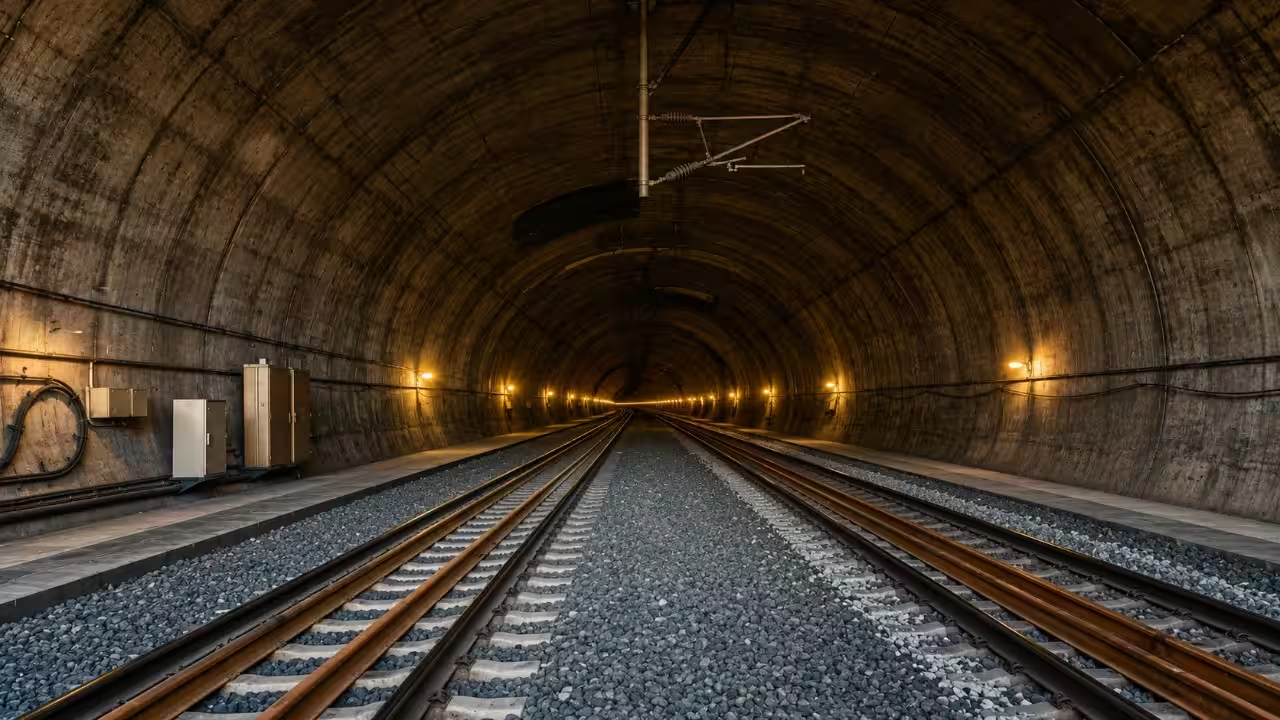
Deep beneath the waters off eastern China, engineers are carrying out one of the most demanding stages of construction on a high-speed railway tunnel. The Jintang undersea tunnel, part of the Ningbo-Zhoushan high-speed railway in Zhejiang Province, has completed the inspection and replacement of 104 shield cutting tools after 21 days of work under intense water and soil pressure. The 16.18-kilometre tunnel is set to become the worldâs longest undersea high-speed rail tunnel, linking Ningbo with Zhoushan and cutting the journey between the two cities from as much as two hours to about 26 minutes. The latest operation also tested a domestically developed saturation hyperbaric system adapted from deep-sea diving technology. The achievement comes as China continues pushing high-speed rail construction through challenging underwater environments, including the recently completed shield-machine crossing beneath the Yangtze River, another major engineering milestone highlighted by Chinaâs State Council Information Office. The operation demonstrates how construction methods are being adapted to underwater conditions safely too.How Chinaâs Jintang undersea tunnel completed high-pressure shield cutter replacementThe Jintang tunnel is the critical undersea section of the Ningbo-Zhoushan high-speed railway and stretches 16.18 kilometres, including an 11.21-kilometre shield-bored section. It will connect the port city of Ningbo with the Zhoushan islands, where journeys currently rely heavily on roads and ferries. Once the railway opens, travel between Ningbo and Zhoushan is expected to take as little as 26 minutes, compared with roughly 1.5 to 2 hours today. The tunnel is being excavated from opposite shores using two super-large-diameter shield machines. One machine, Yongzhou, must bore 4,940 metres through 24 alternating layers of soft and hard rock, representing nearly 70 per cent of its route and creating severe wear on its cutting tools. Excavation progress is being monitored carefully. The geological conditions make the project particularly demanding. Rock strength along the route reaches 191 megapascals, placing some of the material in the high-strength to very-high-strength category. As the cutting head moves through alternating rock layers, its tools experience substantial mechanical stress and wear. That made the latest replacement operation necessary, but carrying out such maintenance deep beneath the seabed presented a challenge of its own. At the tunnelâs deepest point, the excavation reaches about 92 metres below sea level, where combined water and soil pressure can reach 8.5 bar. A roughly 2,000-metre section experiences pressure above 6 bar. These conditions mean that workers cannot simply enter the cutting chamber using conventional methods and carry out maintenance as they would in a normal tunnel.Engineers replaced 104 cutting tools under high pressureThe latest operation involved inspecting and replacing 104 shield cutting tools over 21 days. These tools sit at the front of the tunnel-boring machine and are responsible for breaking through the rock and soil ahead of it. Their condition is critical because worn cutters can reduce excavation efficiency and make continued tunnelling more difficult. The operation was carried out under high water pressure, turning what would ordinarily be a demanding mechanical maintenance job into a complex human-safety challenge. Global Times reported that conventional compressed-air methods provide workers with only around 40 minutes of effective working time per person each day and are generally limited to depths of approximately 60 metres. The Jintang tunnelâs deeper and higher-pressure conditions required a different approach. The construction team spent three years adapting technology derived from deep-sea saturation diving. The result was described as Chinaâs first domestically developed saturation hyperbaric system for shield tunnelling, nicknamed the âDeep-Sea Space Stationâ by the project team. Rather than repeatedly exposing workers to major pressure changes, the system allows them to remain in a controlled pressurised environment for extended periods.The âDeep-Sea Space Stationâ allows longer work shiftsThe system consists of living, transfer and control modules designed to allow workers to operate safely under the extreme conditions surrounding the tunnel boring machine. The system can accommodate nine workers for extended periods, with crew members travelling to the work face through a transfer chamber. They can work for up to eight hours at a time, allowing round-the-clock multi-shift operations for as long as 28 days. One of the key advantages is that workers undergo a single controlled decompression after completing their assignment instead of repeatedly moving between normal atmospheric pressure and the high-pressure working environment. This reduces the risks associated with frequent pressure changes and makes prolonged underwater construction work more manageable. The technology represents an unusual overlap between offshore engineering and underground construction. Techniques developed for people working at significant depths underwater have been adapted to create a controlled environment inside a tunnel-boring operation. In practical terms, the system gives engineers more time at the cutting face while reducing the number of dangerous pressure transitions workers must endure. The successful 21-day cutter replacement operation therefore represents more than routine maintenance. It provided a real-world test of whether the new system could support prolonged work under the pressure conditions encountered by the Jintang tunnel.China is pushing high-speed rail through underwater environmentsThe Jintang project forms part of a broader expansion of high-speed rail infrastructure through some of Chinaâs most challenging terrain. The Ningbo-Zhoushan railway is designed to bring Zhoushan more directly into the national high-speed rail network, with the undersea tunnel providing a crucial connection beneath the water separating the islands from mainland Zhejiang. The project also comes shortly after another major underwater railway milestone in China. On July 31, 2026, the State Council Information Office reported that China had completed excavation of the tunnel beneath the Yangtze River for the Shanghai-Chongqing-Chengdu high-speed railway. The project uses the large-diameter shield machine Linghang and is designed for high-speed trains travelling at up to 350 kilometres per hour without slowing for the underwater section.The two projects involve different waterways and engineering challenges, but together they demonstrate the scale of Chinaâs efforts to extend high-speed rail through difficult underwater environments. While the Yangtze project required a record-setting shield machine to pass beneath one of the countryâs largest rivers, the Jintang project is tackling prolonged excavation beneath the seabed, where high rock strength and intense pressure complicate both boring and maintenance. For the Jintang tunnel, is also another step towards completing a connection expected to dramatically shorten travel between Ningbo and Zhoushan. The Yongzhou shield machine has already advanced 3,936 metres, or nearly 80 per cent of its assigned task. If construction continues as planned, the finished tunnel will not simply provide a faster route between two cities. It will also stand as a demonstration of how large-scale rail infrastructure can be built in environments where conventional tunnelling techniques reach their limits, with workers and machines operating beneath some of the most challenging pressure conditions encountered in modern rail construction.Catch the latest World News and Live updates. Download the TOI app.
Topics in this story
Gathered from external sources. Rights to this text belong to whoever originally published it.