In a 1986 field test, engineers added tiny vortex generators to turbine blades; annual energy output rose nearly 6% at one test site
Explore how tiny vortex generators enhanced wind turbine blade performance, increasing energy output by almost 6% in a pivotal 1986 field test. Discover the impact of design on wind energy efficiency.
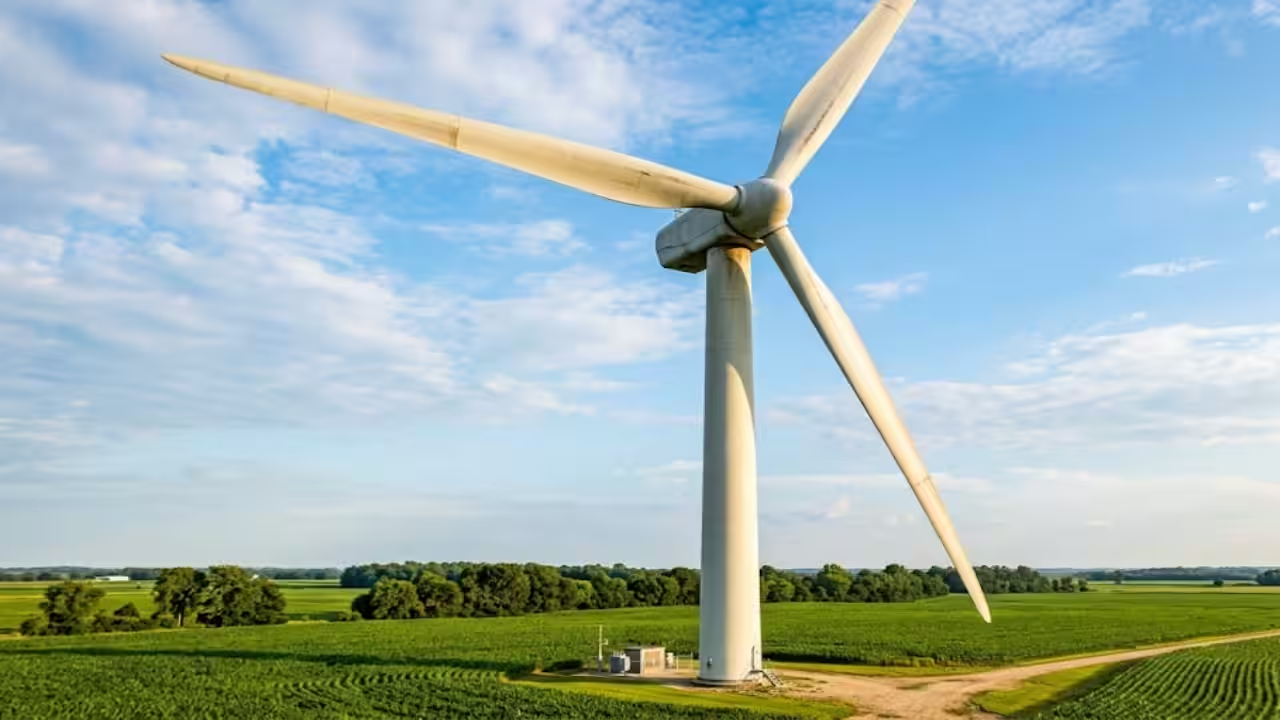
A wind turbine blade works like an aviation wing. For the blade to provide lift and continue rotating, air must flow smoothly over its curved surface. When that smooth flow separates from the surface, lift decreases, drag increases, and the turbine wastes wind that could have been converted into power. For decades, engineers have struggled with this issue, and one of the least expensive solutions is also one of the smallest. To alter the way air behaves as it passes, tiny fins that are only a small portion of the blade's width can be adhered to the surface in tidy rows. Wind energy has a surprisingly lengthy history with what are known as vortex generators.A NASA contractor study dated July 1986 gave some actual data on that history. The paper was written by G. W. Gyatt of the California company AeroVironment and reported on field experiments of vortex generators on a tiny turbine dubbed the Carter Model 25. The fins covered the full blade, and at one test site energy output increased by about 6% annually. That sounds humble. But it was off an inexpensive add-on and was measured on a real machine in actual wind, not on a computer model.Why little fins are goodA vortex generator is a tiny vane that is angled to the oncoming air. The fin makes a little whirlpool when the wind blows past it. This whirlpool is called a vortex. That swirl draws faster-moving air down into the slow, sticky stuff that's clinging to the blade, and the electrified layer stays around longer before the airflow separates and the blade stalls. Wind engineers borrowed the trick, which was first devised to delay stall on aeroplane wings.There is another reason turbine blades can benefit from vortex generators. Insects, dust and grime collect on the leading edge and roughen the surface, disrupting the smooth flow the blade was supposed to have. The 1986 team went straight to the test and added roughness strips to simulate bug and dirt buildup and checked to see if the fins would mitigate the damage. They did. A dirty leading edge was a performance killer, but the fins more than made up for that. A wonderful bonus for blades that spend years outside.What the 1986 test revealedThe Carter Model 25 was a tiny machine with a rotor of around 32 ft (9.8 m) in diameter. The engineers tested the fins in three configurations: on the inner half of each blade, on the outer half and over the whole length. The fins were paired, and the vortices were rotated in opposite directions. Each was four times as long as high, and its height was barely half to one percent of the breadth of the blade.The results varied with wind speed. Above about 10 metres per second (22 miles per hour), the fins increased power output by as much as 20%; at lower wind speeds, they caused a performance penalty of less than 4%. That penalty did not necessarily cancel out the gains over an entire year, because annual energy production reflects performance across the site's full range of wind conditions. Fins on the outer half of the blade performed better than those on the inner half. The full-span configuration increased annual energy output by nearly 6% at a site with an average wind speed of 16 miles per hour (about 7.2 metres per second).There were other ways to change the power curve. The 1986 team noted that increasing the blade pitch angle could produce a similar effect. Vortex generators had another advantage: they reduced performance losses caused by dirt and insects accumulating along the blade's leading edge. Their use on wind turbines dated to 1983, when they were tested on the much larger Boeing MOD-2 machine, increasing annual energy production by 11% to 15%. Results from that earlier test were subsequently scaled to develop the configuration used on the Carter Model 25, as a 1996 NREL review explains.Where the profits end upThe aerodynamics of the MOD 2 blades were less than optimal; therefore, there remained space for improvement. Other turbine designs may gain less from vortex generators, depending on their blade geometry and sensitivity to surface roughness. A separate NREL-funded project in the mid-1990s tested vortex generators on the AWT-26, a two-bladed turbine with a 26.2-metre rotor. Although the fins increased power output at moderate wind speeds, drag reduced output at lower speeds enough to produce a net decline in annual energy at sites with average wind speeds up to 8.5 metres per second (about 19 miles per hour), according to NREL's report.Newer evidence, with careful placement of the fins, looks more promising. In a 2020 study in the journal Wind Energy, which can be seen on the research portal of DTU, the Technical University of Denmark, fins were evaluated on megawatt-scale turbines affected by surface roughness. Over 27 months, six turbines were involved, three of which had fins, and each had a neighbour as a reference. All three installed turbines produced more energy afterwards, with the average gain being 3.3% compared to the 2.8% projected by the authors' model.The researchers also warned that vortex generators placed in the wrong part of a blade, or designed too large or too far out, can reduce annual energy production. Engineering modelling is therefore necessary before the devices are installed on a specific turbine, because their effects depend on blade design, surface condition and the local wind regime. Vortex generators can improve airflow over turbine blades, but their effectiveness depends on the blade design, surface condition and local wind regime. The Carter Model 25 test and later trials show that gains at some wind speeds can be offset by added drag at others. Careful modelling and site-specific testing are therefore essential before fitting the devices to an existing turbine.You use AI every day. Now get your AI Quotient. Take the AIQ test.
Topics in this story
Gathered from external sources. Rights to this text belong to whoever originally published it.