POST SCRIPT | A suitable hire, a not-so suitable employer
Anyone who has tried hiring Gen Z in India lately will have noticed that the correspondence has developed a genre of its own, and that the genre is not,
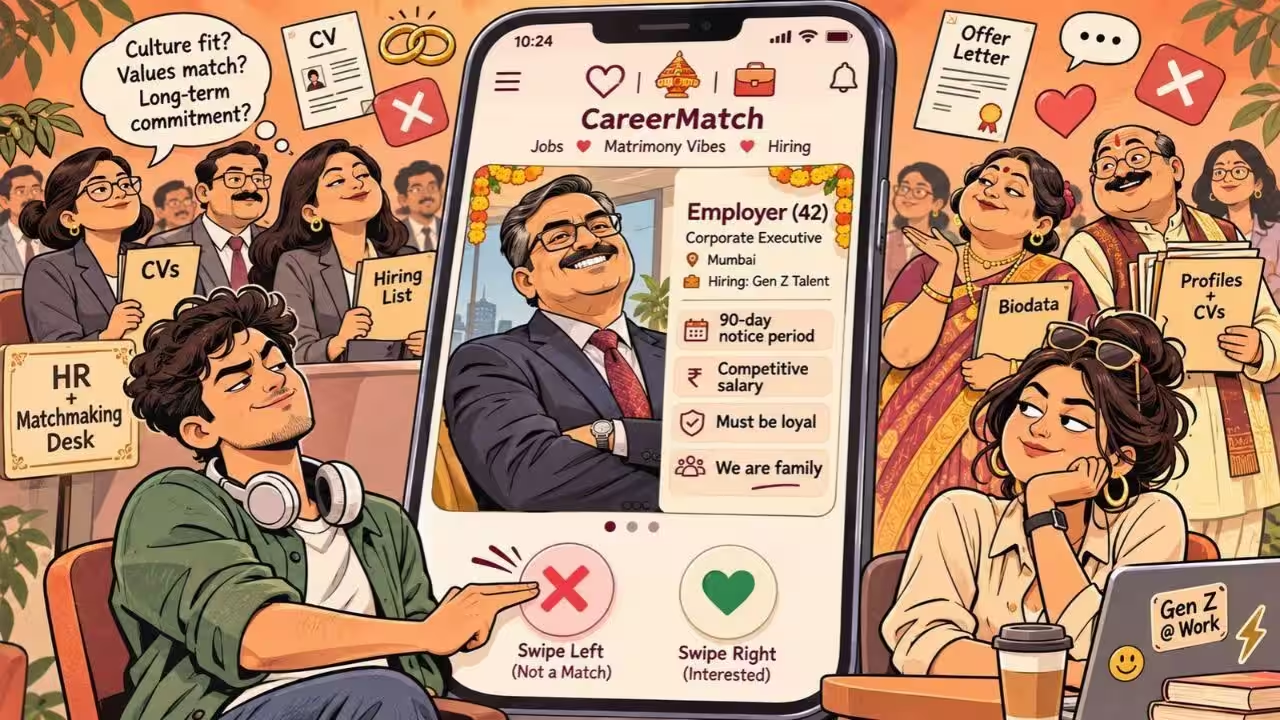
Anyone who has tried hiring Gen Z in India lately will have noticed that the correspondence has developed a genre of its own, and that the genre is not, as one had innocently assumed, the job application. It is the reply to a Sunday matrimonial advertisement, written by someone who isn’t entirely sure they wish to get married, has not read the particulars of the prospective spouse, and would like to know whether the arrangement can be conducted remotely.I don’t offer this as a flourish. Indian hiring has always been an arranged marriage on better stationery, and in a country where a 2018 survey of more than 160,000 households found 93% of married couples describing their marriages as arranged, the template needs little explaining.The job description is the Sunday matrimonial ad, with “fair, homely, convent-educated” replaced by “dynamic, self-starting, comfortable with ambiguity”, the last of which means nobody at the company has decided what the job is, though everyone is agreed that somebody should do it. The placement consultant is the ghatak, the Bengali matchmaker, who has met neither party properly, knows next to nothing about either, and is prepared to stake his reputation, such as it is, on their compatibility. He will subsequently collect his fee and disappear, leaving two families to discover that the boy drinks.The interview panel is konye dekha, at which a girl was once asked to walk across the room and sing a line of Rabindrasangeet, presumably to establish that her legs and vocal cords were in working order. The contemporary candidate is asked for a free three-day assignment, the principal difference being that no prospective father-in-law ever recorded the song and incorporated it into a client presentation. The notice-period buyout is the last bride price still paid in polite company, and the annual appraisal is the occasion on which the in-laws explain why one has not quite lived up to expectations.The latest specimens come courtesy of Amit Ray, whom I have theoretically known forever, our fathers having shared a school classroom. In Bengali society, this establishes a degree of intimacy that actual acquaintance frequently fails to achieve. It also constitutes an excellent reference check. A proposal accompanied by the information that the fathers went to school together would get past the first round in most respectable Bengali households, even if the prospective groom were currently wanted by the police.Practically, I follow Amit with considerable interest on LinkedIn, where he has just shared some questions from shortlisted applicants to his latest job post. He doesn’t specify their ages, and he hardly needs to. The correspondence has the unmistakable air of a generation that has arrived at the marriage market without first consulting its parents, the advertisement or, quite possibly, itself.One applicant writes: “I have a full time role. Is there any way to work around that?”This is rather like answering a matrimonial advertisement to enquire whether one’s existing spouse is likely to present an administrative difficulty. Amit’s response, “Yes, it’s called resigning”, is admirably economical and holds equally well in both institutions. There is little to improve upon it, except perhaps to add that the first spouse should ideally be informed.Corporate India, incidentally, arrived at this metaphor before I did. When the moonlighting controversy broke in 2022, Infosys told its staff “No two-timing”, while Wipro chairman Rishad Premji called the practice “cheating” and said 300 employees found working for a rival had been let go. One almost expected a joint statement from the aggrieved families, followed by a demand for the return of jewellery.Another applicant asks, “What is the role about?”The answer, unfortunately, sits directly below the headline in approximately 1,200 words, a length no Bengali matrimonial biodata has attempted even after including the grandfather’s service record, the maternal uncle’s posting in London and the family’s ancestral connection to a zamindari that ceased to exist before Independence.It is possible, of course, that the question is sincere. By last year, LinkedIn was receiving some 11,000 applications a minute, up 45% in twelve months, while some job seekers now employ AI agents to identify openings and apply on their behalf. We have reached the interesting stage of technological civilisation at which machines propose employment arrangements between people who may subsequently be required to meet one another.The applicant may therefore be hearing about the opportunity for the first time, rather like a Bengali son arriving home to discover that an aunt in Salt Lake has circulated his horoscope across three districts, shortlisted two suitable girls and enquired about the availability of a marriage hall. His participation, while desirable, is no longer essential to the proceedings.A third says, “I applied for the role but I don’t know if I’m a fit”, a doubt that earlier generations carried to the mandap and then kept to themselves for forty years.Of all the replies, this one may be the most honest sentence to pass through an Indian hiring process since liberalisation. Everybody else, after all, has been passionate about the company’s mission since birth, inspired by its leadership since nursery school and deeply committed to its values without having the faintest idea what it sells. This candidate has at least declined to manufacture an emotion for the benefit of Human Resources. Amit is nevertheless right that such candour, offered before the interview, does little to inspire confidence. Honesty is greatly admired in the Indian workplace, provided it is exercised somewhere else.A fourth applicant would like to meet the team, which is to say the in-laws, before proceeding further. There was a time when such a request would have caused considerable distress among the elders. The girl had been shown the boy’s photograph; his salary had been mentioned; the family priest had been consulted. What possible purpose could be served by meeting the people with whom she would be expected to spend the rest of her life?Then there is the ghosting, which Amit lists as his evergreen item: the old runaway groom, whose escape once demanded a night train, a false name and some nerve, and now requires nothing more strenuous than leaving a message on two blue ticks. Technology has done for cowardice what air-conditioning did for the Indian summer. It has made the activity considerably more comfortable.Before those of us past thirty climb too far up the high horse, however, I should declare an interest.I have spent 25 years in Indian media, which is longer than some of these applicants have been alive, and I regret to report that nobody under thirty invented any of this. We did. We invented the job description, that remarkable work of speculative fiction in which a self-starter with eight years’ experience, fifteen skills and the judgment of a seasoned professional is sought at a fresher’s salary. We invented the insistence that the candidate must be a team player, which frequently means agreeing with the captain even when he has steered the ship into a shopping mall.We invented “we are a family here”, which, upon closer examination, turns out to be literally true. Long hours, no boundaries, unsolicited advice, emotional blackmail and a scene if you try to leave. A particularly close-knit corporate family will even object to your having friends outside it. The only significant difference is that your actual family will generally feed you before beginning the interrogation.And we have been ghosting candidates for thirty years under the respectable corporate expression “we’ll get back to you”, which is the employment equivalent of the groom’s family saying they must consult an elderly aunt before committing. The aunt, naturally, is never heard from again.One recruitment trade report puts the proportion of Indian job seekers ghosted by employers at 73%. The great moral gulf between the generations, meanwhile, on figures reported by Newsweek, amounts to 41% of Gen Z job seekers admitting to having cut off a prospective employer, against 37% of millennials.Four percentage points. For this, apparently, civilisation is collapsing.That horse the millennials are now attempting to mount stands approximately four points high, and the difficulty of getting onto it may explain some of the shouting.Consider the boy’s side in its full glory.Infosys sent campus offer letters, some dated as early as April 2022, to more than 2,000 engineering graduates who, according to the employees’ union NITES, were still waiting to join more than two years later. In the intervening period, they were allegedly summoned for unpaid training and repeat assessments, rather as a prospective bride might be asked to demonstrate her cooking while the groom’s family continued to consider its options.Asked about the delay in August 2024, the chief executive offered the immortal explanation: “We changed some dates.”This is precisely what the groom’s father says when the wedding has been postponed for the third time, the caterer has been paid and the girl’s family has begun to suspect that something is amiss. Dates, in the Indian arranged marriage, are among the few things that can be changed without anyone accepting responsibility.In February 2025, more than 300 freshers were let go after failing an internal assessment in three attempts. Infosys maintained that the rule was in the contract and had existed for over two decades. NITES said the affected recruits belonged to the same delayed batch, having finally been onboarded in October 2024 after waiting more than two years.If the union’s account is correct, they had waited for over two years to be married and were returned to their parents within four months for failing an examination. A traditional Bengali household would at least have had the decency to blame the horoscope. It might also have returned the sweets.As for fidelity, the corporate India that sacks you for keeping a second employer is the same one in which, in a video that went viral in January 2025, L&T’s chairman regretted being unable to make staff work on Sundays and asked, “How long can you stare at your wife?”This was an extraordinary question from a man who appeared to be proposing that the employee spend considerably more time staring at him.Two-timing, it seems, is a sin only when the other party pays. The employer, meanwhile, would prefer that you abandon your spouse, neglect your children and regard Sunday as an unfortunate clerical error in the calendar. The employee must be monogamous; the company reserves the right to be possessive.L&T defended the remarks as being about nation-building, which is more or less how Indian marriages have always been explained. The individual may be miserable, but the institution must endure.And that, I think, is where the generational quarrel becomes interesting.We are offering an arranged marriage: total exclusivity, the joint family, a ninety-day notice period and the unilateral right to send you home. We would like unconditional commitment, preferably before disclosing the compensation, and we reserve the right to restructure the relationship whenever market conditions demand it. The bride must be flexible, the groom’s family is under considerable pressure, and the uncle who made all the promises has moved to another organisation.They have come looking for a situationship: no labels, options open, commitment negotiable, last seen yesterday. They would prefer to keep their evenings, meet the other members of the household and retain the right to discover, three weeks later, that they are no longer feeling it.Each side considers the other unserious, and each has assembled a perfectly respectable dossier in support of the accusation.Seen from their end, even the request to meet the team stops looking like impertinence and starts looking like elementary due diligence. In an arranged marriage, the trouble is seldom the boy in the biodata. He has a good job, a decent photograph and a smile that suggests somebody has just told him to smile. It is the household that does it. The mother who has opinions about breakfast. The father who expects gratitude for electricity. The aunt who visits for a fortnight and stays until somebody dies.Corporate culture is much the same. The offer letter describes the groom. The team is where you discover his family.None of this is absolution, and I do not propose to become one of those middle-aged gentlemen who mistake agreement with the young for evidence of their own youth. An applicant who cannot be bothered to read 1,200 words about their own future is unlikely to read the client’s brief either, and I would still prefer that whoever I hire turn up on the appointed day. Ideally sober, although twenty-five years in media have taught me to keep my expectations modest.With Amit’s inbox in front of me, I would be no kinder in the parentheses. I would ask the same questions, raise much the same objections and possibly say worse things afterwards to people I trusted. There are limits to my sympathy, and being an employer has not made me a saint. It has merely given me a better chair from which to practise hypocrisy.But I have stopped pretending the rot began with them. The young have clearly studied everything we ever did to them.It is only the JD they skipped.Disclaimer: Views expressed above are the author's own.
Topics in this story
Gathered from external sources. Rights to this text belong to whoever originally published it.