In the 1970s, Newark Airport buried coal fly ash beneath runways built for jumbo jets; more than 20 years later, FHWA said the pavement was still performing well
Discover how Newark International Airport in the 1970s pioneered the use of coal fly ash in runway construction, leading to long-lasting pavements that continue to perform well over 20 years later.
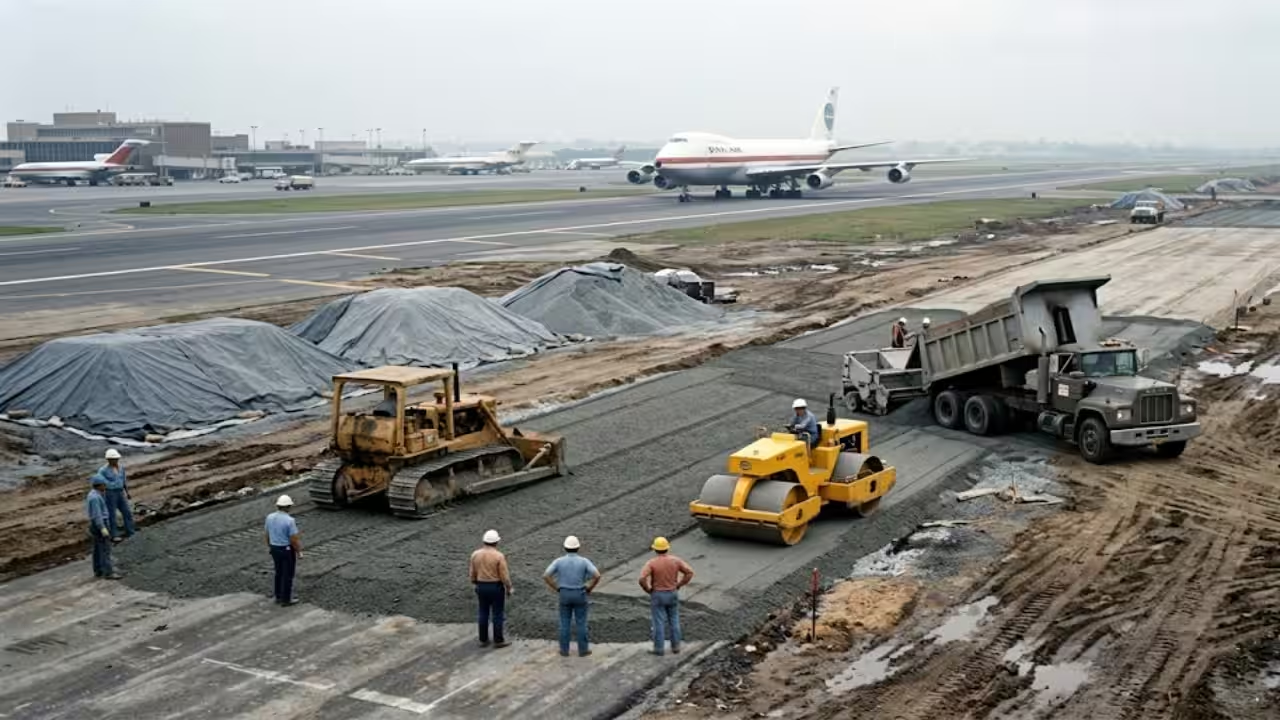
The pavement must withstand repeated loads without failing or deforming when airports construct runways for huge planes. Throughout the 1970s, Newark International Airport in New Jersey hosted one of the biggest US operations using coal fly ash in a stabilised pavement base. The stuff wasn't just thrown underground. To make a cementitious base for flexible pavement, engineers used fly ash, lime, Portland cement, and sand. After 20 years or more, the Federal Highway Administration reported that the stabilised parts were still operating satisfactorily. This project was notable because it showed that a material derived from the burning of coal could be made into a structural layer for a large airport. It also provided an early example of the use of an industrial byproduct in the construction of long-life infrastructure.How the airport used the ashIn the early to mid-1970s, construction began at Newark to build or expand runways, taxiways, and aircraft aprons for the jumbo jet era. Federal Highway Administration research on stabilised fly-ash bases indicates that the system was built as a flexible pavement with a stabilised base underneath. The basis was built in three levels with slightly varying mix compositions. Fly ash was 10 to 12% of the mix, and lime and Portland cement were roughly 3 to 4%. The completed stabilised base was 24 to 36 inches deep and provided a major structural layer beneath the asphalt surface of the runway system.The combination used a reaction between the fly ash and the activating ingredients. The reaction caused a cementitious matrix to form that linked the aggregate together, giving the base properties more akin to a layer of low-strength concrete than loose fill. This type of system is called a pozzolan-stabilized base by the FHWA, which is intended to offer load-bearing support under a flexible pavement.The design must also fulfil the requirements for heavier aircraft. The FHWA record shows one mixture with 4% lime and Portland cement reached ultimate strengths of roughly 2,000 to 2,600 pounds per square inch, suggesting the material was being employed as an engineered pavement component rather than as a simple waste-disposal approach.Extended field testWhat makes the Newark experiment especially interesting is that the material had to show itself throughout years of use, not simply in laboratory tests. The FHWA's later examination indicated that the stabilized-base pavement sections appeared to be functioning satisfactorily after more than 20 years of operation. That finding is part of a longer history of using fly ash in pavement bases. The FHWA said stabilized-base compositions containing fly ash have been utilised in the United States since the 1950s, when the material reacts with lime, Portland cement or other activators to generate a binding matrix.The FDA also warned that the system has a flaw: cracking. Stabilised bases may have shrinkage fractures that will eventually reflect through the asphalt surface and increase maintenance requirements. This scenario means that long-term performance depends not only on the mix strength but also on the design, curing, and placement of the base.FHWA's guidance says that the proper mix depends on the type of fly ash, the type of aggregate, the activator, and the moisture conditions. Thus, the Newark experience was not evidence that any coal ash could be easily replaced in a runway. It demonstrated that a carefully formulated blend could operate under challenging conditions.Importance of the Newark ExperimentCoal fly ash used to be considered primarily as a waste product that needed to be disposed of after coal was burnt. Alternatively, it may be used in stabilised pavement bases, putting part of that material into a regulated engineering use where its chemical qualities can add strength. That idea mattered economically as well. FHWA's study has shown that stabilised fly-ash bases usually have been more economical than other base materials in many places, however actual savings will depend on local resources, mix design and building conditions.The initiative also demonstrated the importance of linking material reuse to engineering and not simply substitution. Fly ash varies by source, and its behaviour depends on chemical composition and the activator used. The FHWA advice treats the material as part of a planned stabilized-base system with mix proportions, curing and strength development all influencing performance. That at Newark was particularly apparent, since the pavement was built to carry jumbo-jet loads. Even more than 20 years later, the government evaluation still said the stabilised pavement was performing satisfactorily.The lesson isn't that fly ash makes better runways automatically. It is that an industrial by-product can be turned into a valuable construction material if its chemistry, proportions and long-term behaviour are known. The runway base at Newark is one of the most obvious historic examples of that method in a major US airport project.You use AI every day. Now get your AI Quotient. Take the AIQ test.
Topics in this story
Gathered from external sources. Rights to this text belong to whoever originally published it.