In 1957, officials released one male and one female wild sheep on a remote Kerguelen island; 46 years later, their isolated population had higher genetic diversity
Rest of World News: A groundbreaking study reveals remarkable genetic diversity in the mouflon population on Haute Island, challenging traditional theories in population genetics and highlighting the impacts of natural selection and reproduction dynamics over nearly five decades.
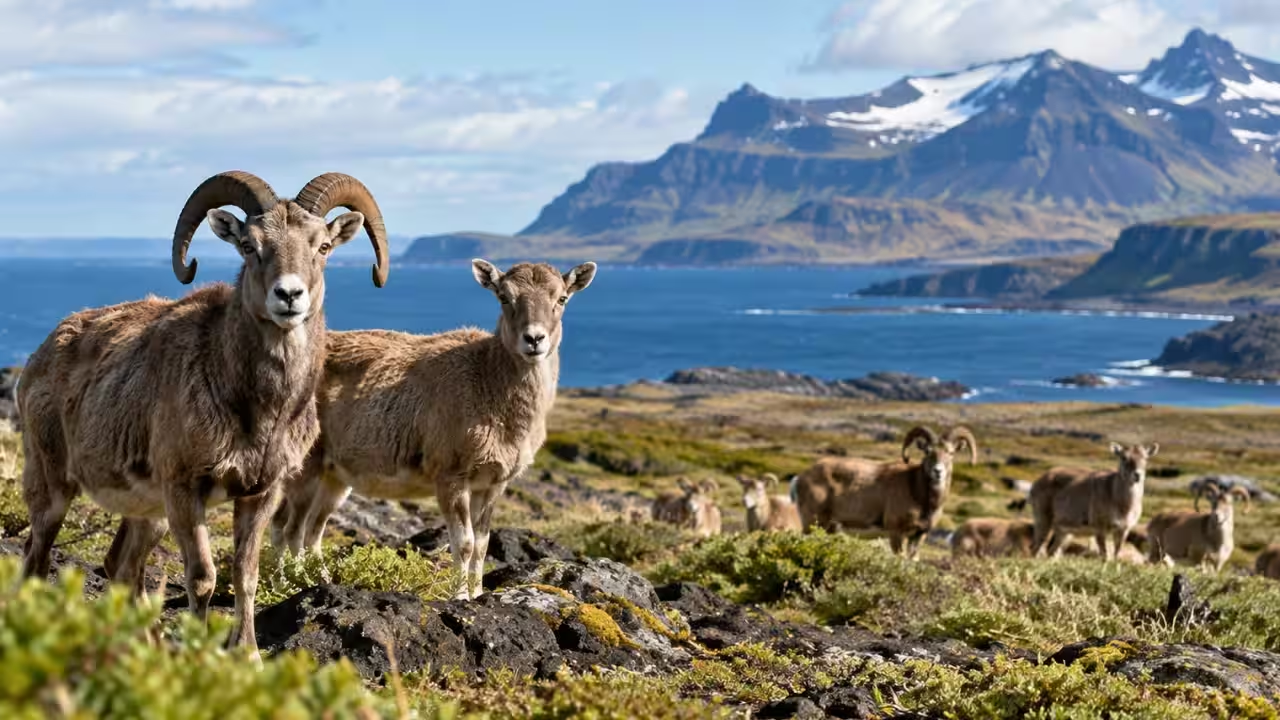
One male and one female yearling mouflon were released onto Haute Island of the Kerguelen archipelago in 1957, thus giving rise to the isolated population under study. To make that possible, a single yearling male and a single yearling female Corsican mouflon were brought from the Vincennes Zoo in Paris and released on Haute Island, a 6.5 square kilometre patch of land roughly 3,000 kilometres from Réunion, the departure point for supply ships serving the archipelago's research base at Port-aux-Français. No one involved at the time could have anticipated that this pair would later challenge a familiar assumption in population genetics.A single pair founds a population on one of the world's most isolated islandsHaute Island is located in the Kerguelen archipelago in the southern Indian Ocean and is an isolated French possession with a scientific station as its principal permanent facility. The mouflon population grew rapidly at first because there were no predators or migration, reaching an estimated 100 animals by the early 1970s and peaking at 700 in 1977. Cycles eventually occurred in the population, reaching peaks of more than 700 individuals followed by a sharp decline and further oscillations, with die-offs occurring every two to five years. By the time the biologists focused on this herd decades later, it had already become a wild herd consisting entirely of descendants of those two animals.Researchers trace genetic change across 46 yearsThis lengthy history meant that Haute Island was a unique biological laboratory for study purposes. Tissue samples taken from mouflon on Haute Island between 1957 and 2003 provided genetic data spanning 46 years from a population founded by very few animals. These samples were analyzed by Kaeuffer R., Coltman D.W., Chapuis J-L., Pontier D., and Réale D. in their article Unexpected heterozygosity in an island mouflon population founded by a single pair of individuals, in Proceedings of the Royal Society B: Biological Sciences. The researchers used 25 microsatellite markers to determine heterozygosity, which is a common measure of genetic diversity. According to the study, the founders of the population were only two individuals, a single male and female, in the year 1957; yet average heterozygosity levels were still very high, even surpassing Hardy-Weinberg expectations at some loci. By utilizing multilocus genotypes gathered between 1957 and 2003, the researchers propose that this is better explained by balancing selection or random retention, rather than genetic drift alone.Genetic diversity rises instead of falling, defying standard drift modelsThe predictions made by traditional population genetics were quite contrary to the results obtained by the researchers. Small founder groups should experience loss in genetic variability because each new generation receives only a random sample of the genes from the previous one. By contrast, the 2007 article showed that observed heterozygosity increased rather than decreased over the 46 years after introduction, and that it exceeded the levels predicted by neutral models and stochastic simulations. Selection was mentioned as one of the possible causes of such an observation, although some limitations were noted by the researchers in their models, such as generation overlap, population sizes and ascertainment bias.A follow-up study points to twinning and selectionA related study offered a possible clue to the unexpected genetic pattern. In Local effects of inbreeding on embryo number and consequences for genetic diversity in Kerguelen mouflon, published via the National Center for Biotechnology Information, Kaeuffer et al. examined the differences in the number of embryos among ewes of various degrees of multilocus heterozygosity. It has also been found that there is a very high twinning frequency of 33.8% in the Kerguelen mouflon, which is much higher than the frequency of 2.5-20.7% in European mouflons. Since such a high frequency existed even in the ancestral population, it seems likely that genes for twinning could have been present in the founder population.Unlike the traditional expectation that inbreeding could have a detrimental effect on reproductive success, the study showed that heterozygosity for three marker genes, namely, TEXAN4, DRBps and BM848, was significantly correlated with the number of embryos. However, the authors caution that the correlation does not mean a proportional increase in heterozygosity would produce a proportional increase in embryo number. The three SNPs TEXAN4, DRBps and BM848 were significantly linked to embryo count, even after correction for multiple tests, but the genes corresponding to the above association remain unknown. The authors suggested that twinning carries costs, including higher reproductive demands and increased mortality during the population's periodic declines. If the cost hypothesis is correct, selection could ultimately favor heterozygosity, or at least help maintain genetic diversity despite local genetic effects.Why a small island herd matters for conservation geneticsTaken together, the two studies suggest that genetic drift may not be the only evolutionary force shaping genetic diversity in this small isolated population, the researchers argue. Natural selection related to reproductive factors, and more specifically, twinning costs and benefits, might be offsetting some of the reduction in heterozygosity seen in neutral theory models. The longitudinal approach used in the Haute Island mouflon study is relatively uncommon in population genetics, where researchers often rely on comparisons among populations or sampling periods. In the case of the Kerguelen Archipelago, the founder effect alone does not determine a population's genetic future. Other factors also help maintain genetic diversity within a small population: generation overlap, uneven reproduction, population cycles, and natural selection.Catch the latest World News and Live updates. Download the TOI app.
Topics in this story
Gathered from external sources. Rights to this text belong to whoever originally published it.