In 1885, Italy forced every resident off Asinara Island and their donkeys were left behind; 131 years later, scientists traced the animals’ white coats to one recessive mutation
Rest of World News: In 1885, the forced evacuation of Asinara Island left behind wild donkeys that evolved a rare white coat due to a genetic mutation. Scientists have traced this transformation to a single gene mutation, revealing an intriguing link to albinism seen in humans. Explore the unique history and genetic heritage of these endangered donkeys.
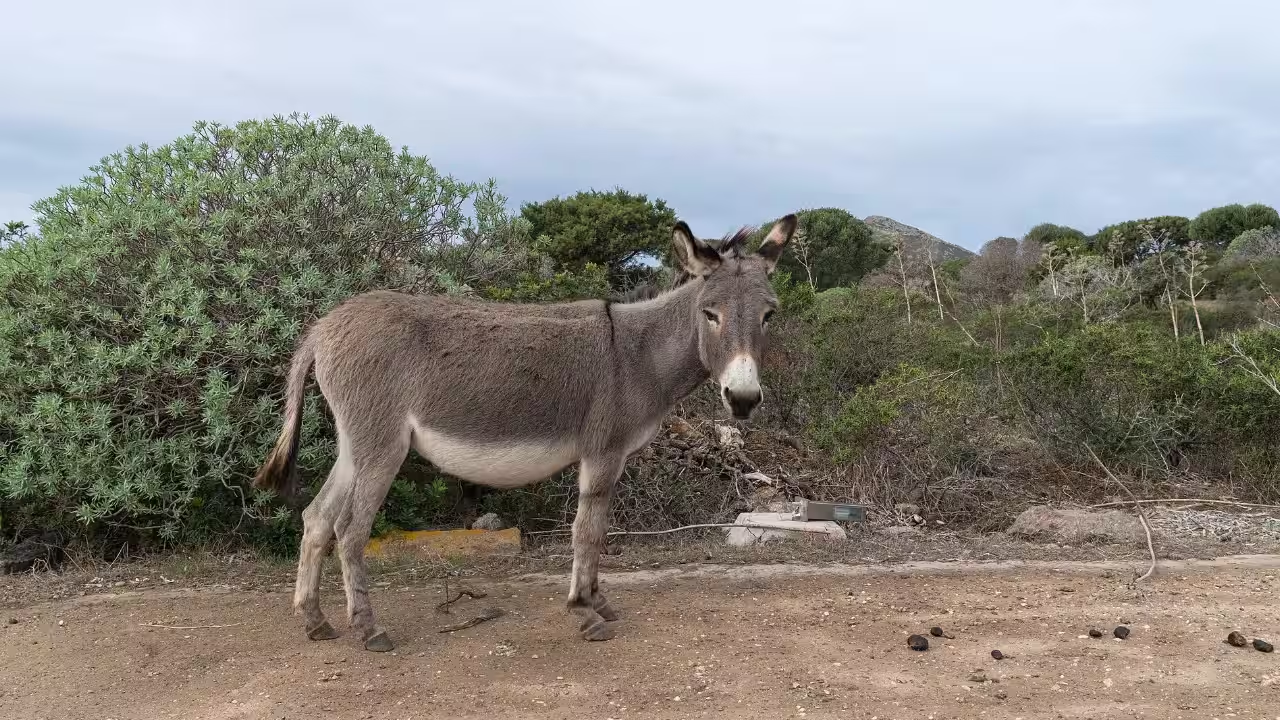
Off Sardinia's northwest coast lies Asinara, a small island whose human history was cut short more than a century ago, leaving behind an unusual population of donkeys that would later become one of the more striking case studies in animal genetics. The decree that depopulated the island was signed in 1885 by the Kingdom of Italy. Approximately 500 people, who lived on the territory in family units of 45 to 54 households, had to give up their houses and land because of the construction of a quarantine lazaretto and an agricultural penal colony on the island, as reported by ISPRA’s Quaderni Ricerca Marina. Most of the displaced families resettled on the Sardinian mainland, founding the village of Stintino. Left behind, however, were the Sardinian donkeys the shepherds had used as working animals; isolated on an island of approximately 50 square kilometers, the animals turned feral, a history documented by Utzeri and colleagues in their 2016 genetic study of the population.Isolation alone may not fully explain how the white coat took holdIsolation has frequently been cited as the sole reason for the existence of albinism among this population, but a specific genetic cause was later pinned down: the same 2016 study, published in Animal Genetics, traced the trait to a single mutation. According to some accounts, white donkeys may have been brought from Egypt in the nineteenth century by the Marquis of Mores, who held the title Duca dell'Asinara. Certainly, what can be concluded from this situation is that, since the allele was present, there were higher chances of producing albino offspring because the island had been isolated. It should be mentioned that the current population does not consist only of white donkeys; some grey heterozygous carriers still exist due to the recessivity of the phenotype.A 2016 study traced the coat colour to a single mutation in one geneRegardless of the actual origin, however, scientists were ultimately able to identify the biological reason for the condition in a particular genetic mutation. Utzeri and his colleagues at the University of Bologna looked at tyrosinase (TYR) genes in 13 donkeys, 7 white and 6 grey. This research, which appeared in Animal Genetics, found a missense mutation in a very well-conserved amino acid residue that causes damage to the copper-binding site that is necessary for the proper functioning of the tyrosinase enzyme. Two copies of the mutant allele were found in albino donkeys, while grey donkeys had either two copies of the normal allele or one normal and one mutant copy. An analysis on a larger sample of 82 donkeys was performed, and it revealed that the correlation between coat color and mutation was statistically significant to a degree that made it almost impossible to attribute it to coincidence. According to the authors, it was a single-base substitution in TYR, where the conserved histidine is substituted by arginine, which destroys a copper-binding site in tyrosinase.The albinism matches a form found in humans, and it shows up in the animals' blood tooMoreover, the mutation makes the Asinara donkeys comparable to certain rare human diseases. For instance, such tyrosinase mutations lead to the development of oculocutaneous albinism type 1, where the affected individuals experience the inability to produce melanin in the skin, hair, and eyes. In the article, "Albinism and Blood Cell Profile: The Peculiar Case of Asinara Donkeys," which appeared in Animals, Marco Cappai et al. analyzed blood samples of the Asinara donkeys against grey Sardo donkeys under identical environmental conditions.As seen in the above-mentioned research, it was found that the number of red blood cells in the Asinara donkey was considerably higher compared to that in grey donkeys, which was 5.19 and 3.80 trillion red blood cells per litre, respectively. They have small red blood cells with great variation in size, along with low hematocrit levels, which are still considered normal.A small, protected population remains genetically distinct todayHowever, the size of the population has varied greatly since the time of discovery of the mutation. It is estimated that there were about 120 animals living in Asinara during the 2000s. According to Cappai et al. 2024 in Animals, as of 2019, there were a total of 334 animals of this particular breed, including animals that belonged to the Porto Conte, Foresta Burgos, Tuscany, and Emilia Romagna areas, but excluding Asinara National Park. The Asinara white donkey is considered one of eight autochthonous donkey breeds in Italy and remains endangered because of its small population. The 1885 decision to clear the island for a prison and hospital created ideal conditions for a rare recessive mutation to persist.Catch the latest World News and Live updates. Download the TOI app.
Topics in this story
Gathered from external sources. Rights to this text belong to whoever originally published it.