Captain in UK's worst helicopter crash recalls 1986 tragedy
Pushp Vaid is one of only two survivors from the Chinook which crashed off Shetland in 1986.
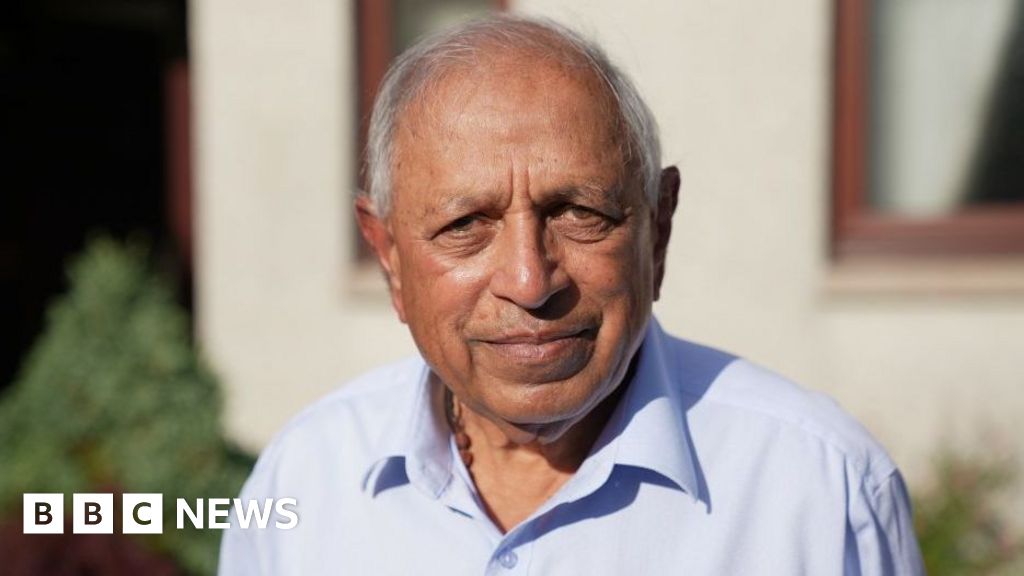
A man who captained a helicopter which crashed with the loss of dozens of lives 40 years ago has told how he could not comprehend he was one of only two survivors.
The Chinook carrying offshore workers crashed into the North Sea after a catastrophic gear box failure off the coast of Shetland on 6 November 1986.
Forty-three passengers and two crew members died, while one passenger survived alongside Captain Pushp Vaid. It remains the UK's worst helicopter accident.
Now 85, Vaid believes he was just "lucky" to escape: "I just could not grasp how 45 people couldn't make it, and two of us were able to come out of it," he said.
He has also now used artificial intelligence (AI) to recreate what happened to the helicopter.
The Chinook plunged into the water during its approach to Sumburgh.
The cause of the accident was subsequently discovered to be gear box failure.
Before the 1986 crash, the most deadly accident was in 1983, when 20 people died in the sea off the isles of Scilly.
The Chinook, built by Boeing in the US, had previously enjoyed a relatively good safety record. They first flew in 1961, and a military version was used by British forces during the 1982 Falklands War.
The Shetland accident highlighted concerns, voiced particularly by trades unions, about the safety of North Sea flights.
Vaid, of Westhill, Aberdeenshire, recalls 6 November 1986 being a "beautiful" day.
"The weather was very nice and calm in Sumburgh," he told BBC Scotland News.
The Chinook was returning from the Brent field with 47 people on board.
On the approach and as they started to descend, Vaid describes hearing a "whining" noise.
They assumed it was not serious, and was perhaps something such as a heater not switching off.
"Everything was okay, except this noise was coming," he said. "And it is getting louder, but it didn't sound dangerous. We couldn't figure out what it was."
"What had happened was the front gear had broken," he said. "And the noise that was coming was the gear breaking up.
"Once the gear was breaking up, the rotors were getting closer to each other. And the rotors hit each other."
He explained: "Once the rotors hit each other, the rear rotor parted from the helicopter and disappeared.
"So the helicopter, which is going along, suddenly is looking vertically up. So next thing I could see the sky in front of me. We were going at 100 knots, it became zero knots.
"The rotor was in front of me and it hit the windscreen as well. So part of the windscreen was flying in and hitting me."
More stories from North East Scotland, Orkney and Shetland
Listen to news from North East Scotland on BBC Sounds
"The cockpit did a flip and it broke from the main cabin, but the floor was still attached, so when it hit the water the rear part of the helicopter took the impact.
"I didn't feel going into the water at all. And then we went underwater.
"I swam through it and I reached the top. When I reached the top there was so much wreckage everywhere."
Vaid said that in the back of his mind he knew a rescue helicopter that was due to be out on a training exercise would come to his aid.
"So I wasn't worried that I was in the water," he recalled.
He and the other survivor were picked up by the rescue helicopter. They were treated in hospital in Lerwick before later being transferred to Aberdeen.
A special service will be held in Aberdeen to mark the 40th anniversary of the accident.
"I keep telling my story, but it's difficult to make people understand what I'm talking about and I thought I can make a visual story," Vaid said.
"When I saw some programmes made by AI that were so fantastic, I said there's no reason why I can't do it.
"That's one of the reasons I wanted to make the video - it's my way of paying my respect to the people who died."
He added: "The first year I used to feel guilty that I was alive and 45 people were not alive.
"But of course the fault was technical and the crew could have done nothing at all. It was very sad.
Trauma of surviving helicopter crash led to my son's death
Topics in this story
Gathered from external sources. Rights to this text belong to whoever originally published it.