Carney’s Euro trip inflames Trump tensions
The tension between President Trump and Canadian Prime Minister Mark Carney has only intensified amid the latter’s cozying up with the European Union (EU) on a high-profile trip this week. The relationship between the U.S. and Canada has been increasingly strained due to tit-for-tat tariffs on American and Canadian goods and Trump’s renaming of Lake…
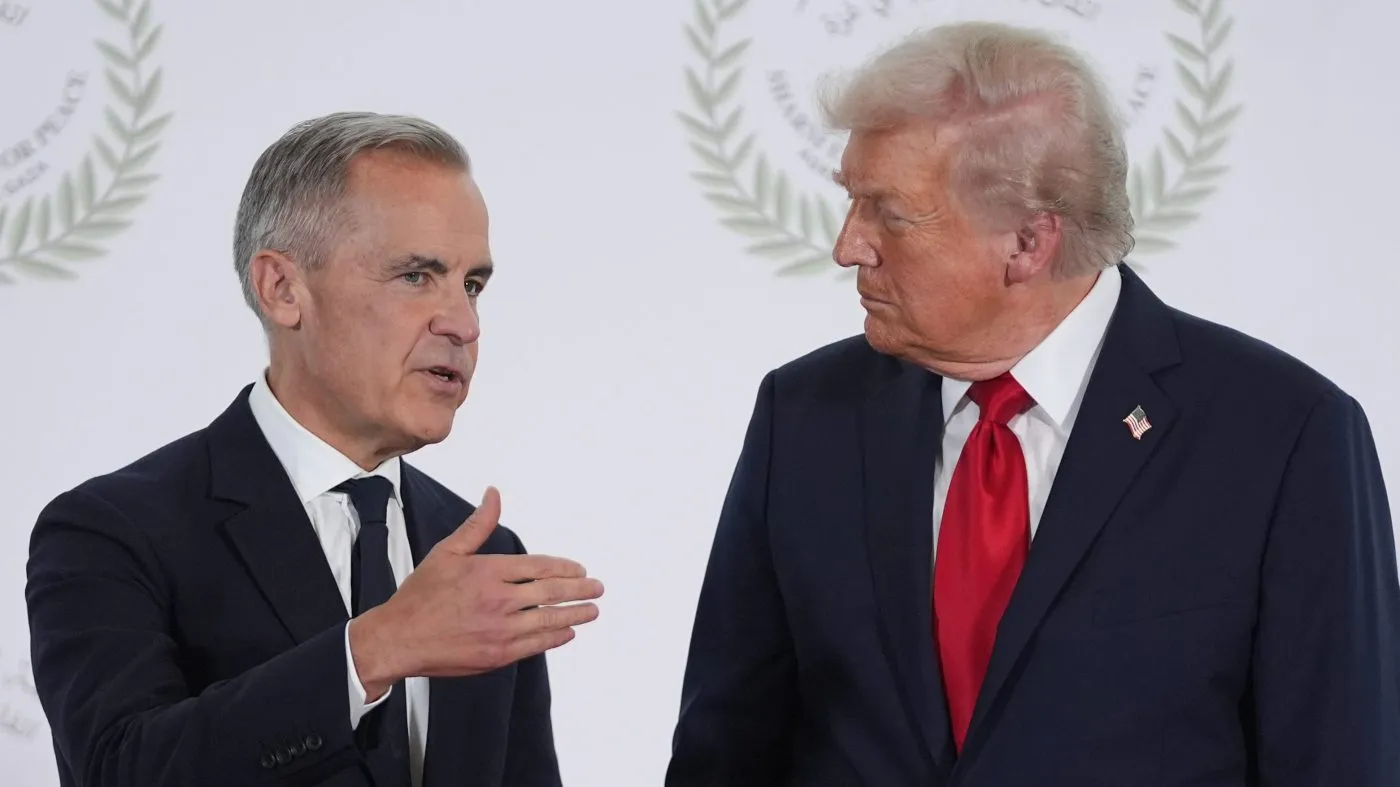
The tension between President Trump and Canadian Prime Minister Mark Carney has only intensified amid the latter’s cozying up with the European Union (EU) on a high-profile trip this week.
The relationship between the U.S. and Canada has been increasingly strained due to tit-for-tat tariffs on American and Canadian goods and Trump’s renaming of Lake Ontario to “Lake America,” along with his repeated remarks about making Canada the 51st state.
Trump lashed out Wednesday against a proposal to make Canada an associate member of the EU, telling reporters it could be considered a “hostile act” and threatening to slap tariffs or stop trading with Europe if it goes ahead.
The proposal, put forward by European Commission President Ursula Von der Leyen, would be a new status for the bloc and has yet to be clearly defined. Leaders from both sides will meet in Montreal at the end of October, where the proposal to take the Canada-EU relationship to a higher level will likely be discussed in more detail.
Carney welcomed the proposal in his appearance at the European Parliament on Thursday, although he specified he is not seeking full membership in the EU, but rather more integration in trade and defense to strengthen both Canada and the bloc.
“We do not seek power to dominate others,” he said. “On the contrary, we are pursuing resilience so that no one can control our open markets, impair our sovereignty, threaten our territorial integrity, or undermine our freedoms, our democracies, our rule of law.”
The deterioration in relations between the U.S. and Canada is without precedent in what has long been an ironclad alliance. While Carney has touted a geopolitical realignment, he regularly says America remains a crucial partner.
Still, the rift has already affected both countries, on an economic and social level, as Canadians rethink buying American products and visiting the US as tourists.
Imran Bayoumi, deputy director at the Atlantic Council, said the “volatility coming from the United States” and Canada’s desire to diversify partners explain the latest developments in Europe.
“I think the Trump driver is the main one, but I think there’s also a recognition that it’s a more dangerous geopolitical world,” Bayoumi said. “Canadian foreign policy is still rooted in a values-based approach and I’m not sure it can be said that the U.S. has that same outlook right now, so I think trying to meet the EU on that same plane is important to Canadians.”
Some senators said Thursday that they’re not surprised Canada is looking elsewhere for allies amid the tension with Trump, but that the U.S.-Canada relationship should be preserved.
“It’s understandable to me that the EU and Canada would look for ways that they can start to build relationships,” Sen. Tina Smith (D-Minn.) said. “You start to want to find new friends.”
Smith said her state is already seeing economic effects of fraying interchange with Canada, which is Minnesota’s largest export market.
Sen. Gary Peters (D-Mich.) said the same about his state.
“We had a lot of Canadians that come across the border to go to restaurants and shop, they don’t do that now,” Peters said. “They’re like, ‘I’m not going to go across to America.’ So, it’s really sad, and for us too to have to deal with that. So hopefully, we’ll get through it. I think it’s a good friendship. It’ll last, but it’s certainly being strained.”
Sen. Mike Rounds (R-S.D.) said the EU membership idea is just both countries entertaining a way to hit back at the U.S.
“They’re just trying to irritate the United States. They’re just sending a message that they know that Canada is not happy with us,” Rounds said of the EU. “I think it’s unfortunate that that happens, but it’s one more way in which Canada can express their hurt.”
Rounds, too, said the Canadian relationship was important and that the whole back-and-forth should have a goal.
“They’re our friends, they’re our allies, and I think the bottom line is, you need to get results at some point,” Rounds said of Canada. “Tariffs have a place, but the end result should be a better relationship when we’re all done.”
Trump told reporters Wednesday that Canada has “been a terrible trade partner” and that he doesn’t see them becoming an associate member of the EU.
“If they do that, if I think it’s at all a hostile act, I will put very serious tariffs or stop trading with Europe on many things,” he said. “So, if they do that, if Europe does that, with a bad intention — if it’s a good intention, that’s fine — if it’s bad intention, we’ll put very heavy tariffs on Europe, which is a possibility.”
Bayoumi said the U.S. “might not love it as a policy,” if Canada and the EU strike a deal.
“But at the same time, if that’s Washington’s position, there are actions that it could also take to start to repair the relationship with Canada,” he said.
Trade negotiations broke down last month between the U.S. and Canada after weeks-long negotiations. Both sides accused the other of adding stipulations last month that were nonstarters. The breakdown led to 50 percent tariffs on billions of dollars of Canadian goods, with Ottawa then announcing dollar-for-dollar counter tariffs on U.S. goods.
The standstill is likely to continue into the fall. While both Trump and Carney are attending the United Nations General Assembly next week, there are no confirmed plans for the two to meet.
Even if things thaw, Carney has said there’s no going back to the previous status quo.
Carney came into power on a wave of anti-American sentiment and has sought to realign Canada’s relationship to the world as a “middle power” that doesn’t need to rely on “hegemons,” as he described it in January.
“I think the relationship will be different regardless of who’s in power in 2028, regardless of what comes next,” Bayoumi said. “I think you’re going to have a Canada that’s more used to its autonomy, asserting itself, and hyper-focused on its national interest.”
“But I also think the bilateral relationship is going to endure,” he continued. “You can’t change geography, Canada, the U.S. share a land border, share a binational military command, they still have tons of shared interests, close economic ties and so those levels and areas of cooperation are going to persist regardless.”
Topics in this story
Gathered from external sources. Rights to this text belong to whoever originally published it.