In 2019, a Montana rancher found a rare dinosaur skeleton on her land; seven years later, the 70%-complete Nanotyrannus sold for $47.3 million at a New York auction, far above its $9 million top estimate
For decades, the Nanotyrannus occupied an uncertain place in the dinosaur world, caught between scientific classification and the shadow of its much more
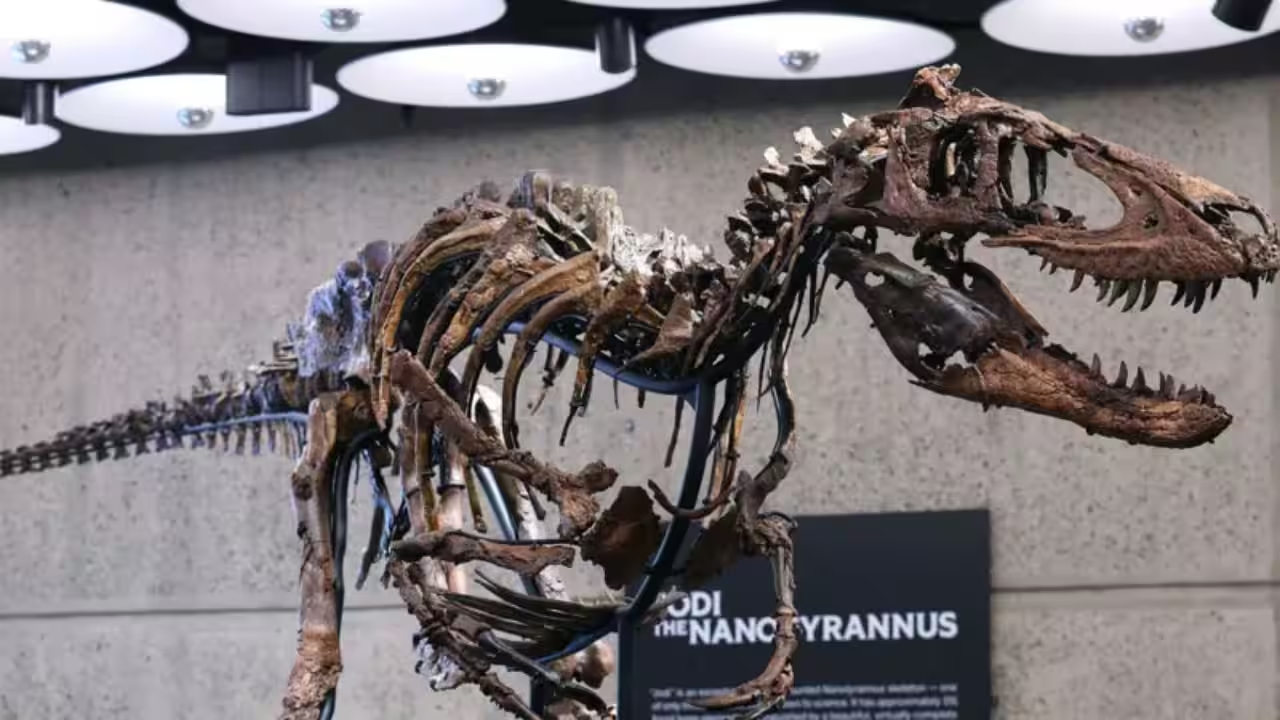
For decades, the Nanotyrannus occupied an uncertain place in the dinosaur world, caught between scientific classification and the shadow of its much more famous relative, Tyrannosaurus rex. Now, a remarkably preserved skeleton has given the disputed dinosaur a new kind of distinction: becoming one of the most valuable dinosaur fossils ever sold.Known as Jodi, the nearly 70%-complete skeleton fetched $47.3 million at a Sotheby’s auction in New York, dramatically surpassing its top estimate of $9 million. The sale, reported by The Associated Press, makes Jodi the second-most expensive dinosaur fossil ever sold, narrowly behind the $50.1 million record set by a Tyrannosaurus rex skeleton called Gus earlier this year.From Montana ranch to Manhattan auctionJodi’s journey began in 2019, when Montana rancher Jodi Pierson discovered the fossil on her property in the Hell Creek Formation, one of North America’s richest and most extensively studied dinosaur sites. The specimen was subsequently excavated by commercial palaeontologist Clayton Phipps.According to BBC, the skeleton was initially presented as a juvenile Tyrannosaurus rex. That classification reflected a debate that had persisted for decades: whether Nanotyrannus was genuinely a separate dinosaur or simply a younger form of T. rex.Research published last year helped settle the question in favour of Nanotyrannus being a distinct genus. The finding dramatically changed the significance of specimens such as Jodi, placing them among an extremely limited group of known Nanotyrannus skeletons.Jodi is one of only three relatively complete examples known to science. The mounted skeleton stands about 9 feet 6 inches tall and stretches nearly 20 feet from snout to tail.A smaller, sleeker tyrannosaurAlthough Nanotyrannus lived alongside Tyrannosaurus rex approximately 67 million years ago, it was considerably smaller. Jodi is roughly half the length of an adult T. rex, while its anatomy gives it a distinctly different appearance.The dinosaur had relatively longer forelimbs, larger hand claws and narrower, blade-like teeth. Its lighter, more slender build has helped distinguish it from the bulkier T. rex.According to CNN, Jodi consists of 191 fossil-bone elements and includes an exceptionally well-preserved skull. The specimen is considered an adult based on its size and bone development. Missing portions have been supplemented with custom 3D-printed and sculpted elements, allowing the skeleton to be displayed in a complete mounted form.Its rarity appears to have been central to the extraordinary auction result. With only a handful of known Nanotyrannus skeletons, the specimen offered collectors an opportunity to own an unusually complete example of a dinosaur whose scientific identity itself was only recently clarified.A fossil with a remarkable neighbourhoodJodi was not the only extraordinary discovery to emerge from the Hell Creek Formation. The same region has produced some of the most important Tyrannosaurus rex fossils ever found.Phipps also discovered the celebrated Dueling Dinosaurs in 2006, roughly eight miles from where Jodi was found. The fossil preserves the remains of a Triceratops and a smaller tyrannosaur apparently locked together, and it later became important to research supporting Nanotyrannus as a distinct genus.Another known Nanotyrannus skeleton, Jane, is housed at the Burpee Museum of Natural History in Illinois.The history of the region therefore adds another layer to Jodi’s importance. What began as a discovery on a working Montana ranch became part of a much larger scientific story about the diversity of tyrannosaurs during the Late Cretaceous period.Twelve minutes, millions of dollarsAt Sotheby’s, six prospective buyers competed for Jodi during a roughly 12-minute auction. The winning bidder, who participated online or by phone, has chosen to remain anonymous.The final price was more than five times the auction house’s lower estimate and substantially exceeded its $6 million to $9 million expected range. The result placed Jodi just behind Gus in the hierarchy of dinosaur fossil sales. The Stegosaurus known as Apex, which sold for $44.6 million in 2024, now ranks third, states BBC report.The price also highlights the extraordinary market that has developed around scientifically significant fossils, particularly exceptionally preserved dinosaur skeletons, adds CNN.The debate beyond the auction roomJodi’s sale has also revived a long-running debate over who should own important fossils and where they should ultimately be kept.Scientists have expressed concern that privately owned specimens can disappear from public view, limiting opportunities for researchers to study them and preventing museums, students and visitors from accessing them.BBC reported that palaeontologists have warned that increasingly high auction prices could encourage a new era of fossil collecting among ultra-wealthy buyers. The concern is particularly acute for rare specimens whose scientific importance may not yet be fully understood.At the same time, the debate is not entirely one-sided. The excavation of large fossils can require considerable expertise, labour, equipment and financial investment, particularly when specimens are located on privately owned land.For now, Jodi’s future remains uncertain. Its anonymous new owner has acquired a fossil that is not only exceptionally rare but also scientifically significant at a moment when Nanotyrannus has finally emerged from decades of classification controversy.Whether Jodi becomes part of a public exhibition or disappears into a private collection, its extraordinary sale has ensured that this once-mysterious dinosaur will remain at the centre of the palaeontology conversation.Images Courtesy: ReutersYou use AI every day. Now get your AI Quotient. Take the AIQ test.
Topics in this story
Gathered from external sources. Rights to this text belong to whoever originally published it.