“Read first, then watch TV”: Soha Ali Khan says sometimes you have to ‘bribe your children’, but warns against a common parenting mistake
Getting a child to pick up a book when there is a television, tablet or phone waiting nearby is hardly an easy parenting battle. Soha Ali Khan knows t.
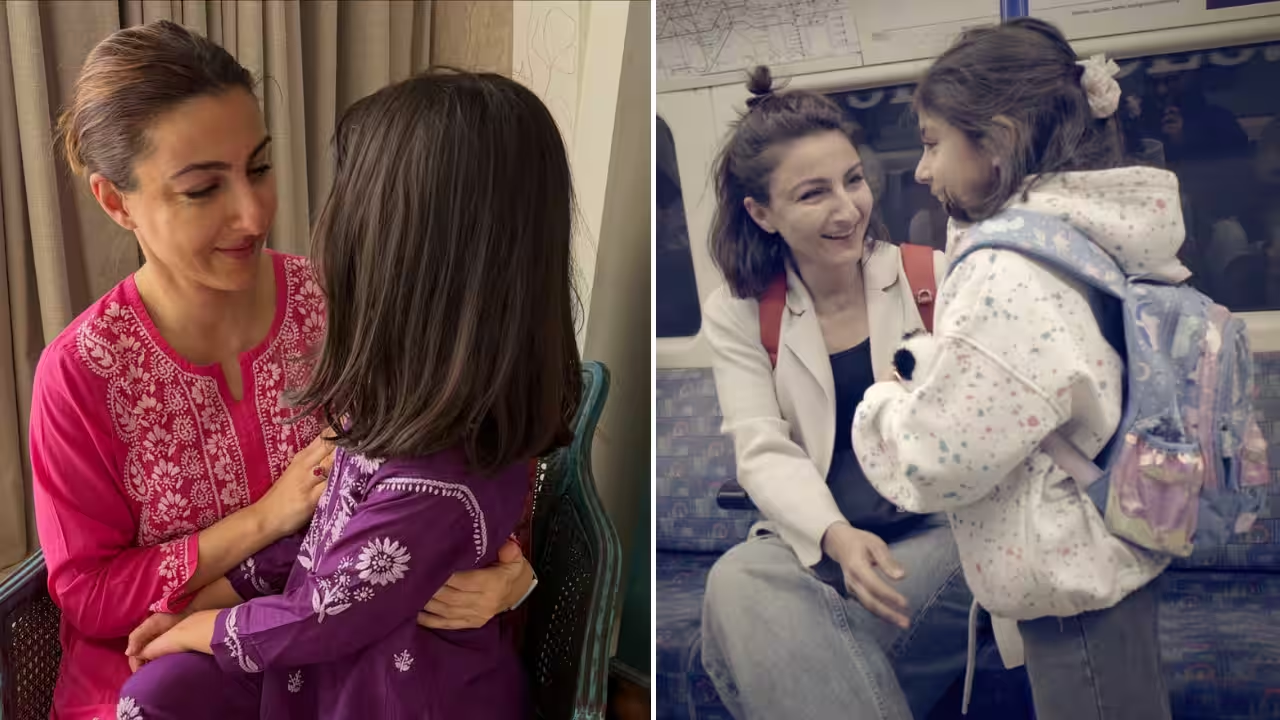
Getting a child to pick up a book when there is a television, tablet or phone waiting nearby is hardly an easy parenting battle. Soha Ali Khan knows this well. The actor and mother to daughter Inaaya Naumi Kemmu has admitted that sometimes, getting children to develop a habit they don't naturally enjoy requires a little negotiation- and even a little bribery.In an interview with Tweak India, Soha talked about her parenting approach and said she sometimes tells her daughter, “Inaaya, until you read this book, you can't watch TV.” And she is quite candid about the fact that this is not necessarily a perfect or foolproof strategy.“Sometimes you have to bribe your children, sometimes you have to incentivise them,” Soha said, acknowledging that not every child will automatically grow up loving books.‘Not all of them will be born readers’For Soha, one of the biggest parenting traps is comparing your child with another child who seems to be doing something effortlessly.She admitted that she has friends whose children are naturally enthusiastic readers and that, as a mother, she has also wondered why her daughter cannot be more like them.But telling a child to become like someone else, she pointed out, can have the opposite effect. “I have a lot of friends who have children who are readers and I'm like, my God, how do I tell Inaya, why can't you be more like X, Y and Z?” she said.And she knows exactly why that approach does not work. “Of course I do. Does it work? No, of course not,” Soha said, explaining that the moment children are compared with someone else, they can “completely rebel and revolt”.Instead of motivating them, the comparison can become another reason for them to resist the very behaviour parents are trying to encourage.Her bigger lesson: Children copy what they seeFor Soha, the more important question is not simply how to make a child read a book. It is what the child sees the adults doing every day. “You set an example by being a good role model,” she said.That means parents cannot spend the entire evening scrolling on their phones and then expect their children to happily put away their screens and read. Soha's own advice is simple: “You don't be on your phone all the time and then suggest they read a book.”Instead, she believes books need to become part of the child's surroundings. “You read books around them, you leave books around them,” she said. It is a small distinction, but an important one. Rather than presenting reading as yet another rule imposed by adults, parents can make it something children regularly see and experience at home.Soha does not pretend parenting always works perfectlyWhat makes Soha's approach relatable is that she does not present parenting as a perfectly executed formula. She openly acknowledges that incentives may sometimes be necessary and that even comparisons can creep into a parent's mind. But she also recognises when a strategy is likely to backfire.Her approach appears to be less about forcing Inaaya to become “a reader” overnight and more about creating an environment where reading has a place alongside television and other forms of entertainment.In fact, Soha's comments fit with the parenting philosophy she has spoken about elsewhere: she sets boundaries for her daughter, but also understands that consistency has to come from the adults at home. In a recent interview, she spoke about her non-negotiable 8 pm bedtime for Inaaya and said she tries to maintain a schedule because routine is important for a child.Perhaps the most interesting part of Soha's parenting lesson is that she does not suggest banning television altogether or assuming that every child will naturally love books. Instead, there can be room for both- with some boundaries.A child may need an incentive to pick up a book initially. But if reading is never seen at home, a lecture about its importance may have limited impact. Soha's message to parents is therefore less about finding the perfect reward and more about looking at their own habits. Because sometimes, the parenting lesson a child absorbs is not the one a parent says out loud- it is the one they watch every day.Looking for trusted parenting advice? Follow TOI Parenting Circle on Instagram for expert guidance, relatable stories, and practical tips delivered every day.
Topics in this story
Gathered from external sources. Rights to this text belong to whoever originally published it.