How an American teacher’s $5,000 donation helped turn a Chinese desert into a lush, green forest
HONG KONG — Ronald Sakolsky never thought his money would go this far.
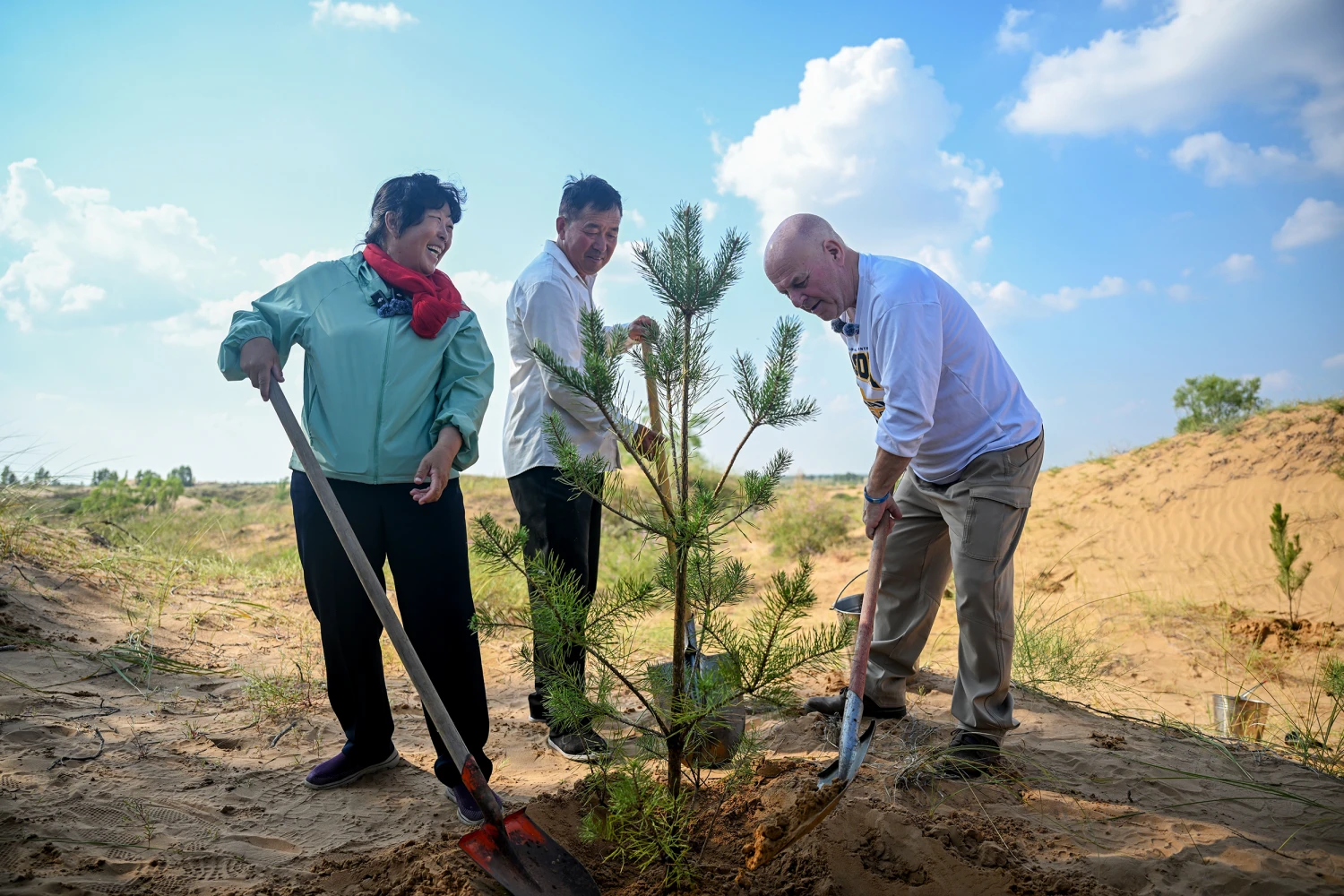
HONG KONG — Ronald Sakolsky never thought his money would go this far. What was once a vast, dry desert in northern China has transformed into a lush, green forest of 50,000 full-grown trees, thanks in part to a $5,000 donation he made more than a quarter century ago to a local farmer and “sand-control worker” named Yin Yuzhen. Sakolsky, 69, a retired teacher from Pennsylvania, was amazed to see the transformation in China’s Inner Mongolia region last month when he visited for the first time in 26 years. “Seeing it with my own eyes, that was the biggest surprise,” he told Chinese state media. “I saw pictures, I was told all about it, but until you see it is when you realize that it’s real.” Sakolsky and Yin’s reunion last month has been held up by Chinese authorities as an example of how China and the United States, the world’s two biggest greenhouse gas emitters, can work together on global issues such as climate change. Chinese leader Xi Jinping, in Washington this week for a summit with President Donald Trump, mentioned Sakolsky’s story in his toast at a state dinner on Thursday, saying it “touches the hearts of many Chinese people and stands as a shining example of the friendly exchanges between our two peoples.” Sakolsky was teaching English on exchange in China’s central Henan province in 1999 when he saw a TV news report about Yin. More than a decade earlier, the newly married Yin had started planting trees as a way to feel less isolated in her new home in the Mu Us Desert, also known as the Maowusu Desert (“bad water” in Mongolian). Moved by her story, Sakolsky raised $5,000, which was many times Yin’s annual income, so she could plant even more. They met in person in 2000, when Yin promised Sakolsky that she and her family would take good care of the saplings. Earlier this year, Yin launched an online campaign to track down Sakolsky, and last month he made a 10-day visit to China that included an emotional reunion with Yin in her forest, where the trees now stand more than 30 feet high and the government has named a grove after him. The two of them planted a friendship tree, and Sakolsky collected a jar of sand to take home to Pennsylvania. Yin also gave him a cross-stitch with the words “One Earth, One Dream.” “I want him to know that I kept my word, and that Chinese people keep our promises,” she said. Yin called Sakolsky her “brother” and said the sapling they planted together would be standing tall in another 26 years. Reports on Sakolsky’s visit have been heavily promoted by Chinese authorities and widely viewed on Chinese social media, where commenters described him as “a real friend of Chinese people.” Tree-planting efforts are part of a decadeslong government campaign sometimes referred to as China’s “Great Green Wall,” which was launched in 1978 as a 73-year effort intended to reduce sandstorms and help stave off desertification associated with global climate change. Away from emotional stories like Yin’s, the campaign has had mixed success. While the Great Green Wall is a “great initiative in principle,” the Chinese government tends to emphasize “top-down, technocratic solutions to environmental problems” and focus on targets more than quality, said Judith Shapiro, who teaches at American University in the department of environment, development and health. The loss of open land for nomadic herding as a result of the initiative “remains a serious blow to some ethnic minority nationalities,” she said. In the program’s early years, deserts were lined with “fast-growing but water-hungry” trees such as poplars that depleted water tables, though more suitable and biodiverse species are now being planted. “Overall, the Chinese government has done a good job instilling the idea that trees are a great benefit to society,” Shapiro said. The climate connection Days after Sakolsky met with Yin in China’s arid north, a likely impact of the changing climate was felt when a devastating flood struck 2,000 miles away along the Nepal-China border. More than 1,400 people have been confirmed dead and thousands remain missing across Nepal and China’s Tibet region after the Aug. 26 disaster, which experts say was linked to warming temperatures in the Himalayas. “I am very, very sad for the people in Nepal and people in China,” Sakolsky said at a news conference in Beijing on Aug. 31. “I know now the world is alive, and if I keep throwing paper on the ground or if I keep letting trees die, I am killing the life of the world, which means I am actually killing mankind.” The Tibet flood was one of several disasters this summer in China, where flooding triggered by Tropical Storm Maysak in early July killed at least 159 people in the southern region of Guangxi. At least 16 people in Jiangxi province were killed in a Sept. 5 mudslide set off by torrential rain linked to Typhoon Saudel. Researchers said last year that climate change is making such storms in Asia more frequent and severe. China says it plans to reach peak carbon emissions before 2030 and achieve carbon neutrality by 2060. Its carbon emissions have been “flat or falling” since 2024 and are on track to fall in 2026 for the second year in a row, according to an analysis for Carbon Brief this month by the Centre for Research on Energy and Clean Air. While its coal emissions are still rising, China is seeking to fill a void in global climate leadership left by the U.S., the world’s largest carbon emitter historically, which withdrew from the Paris climate agreement during Trump’s first days back in office last year. Critics say China’s goals are too cautious and will leave it unable to meet its Paris Agreement pledge to cut emissions by 65% from 2005 to 2030. Trump and Xi were not expected to have any meaningful discussion about climate change at their summit this week. Sakolsky said last month that both countries have common interests, including combating climate change. “You want the best for your children because you know they are tomorrow,” he said. “You want the best for your country, but it does not mean you have to sacrifice your children.” Sakolsky called on anyone inspired by his friendship with Yin to “go out and plant one tree.” “If everybody plants one tree in their backyard or in their park after watching this,” he said, “can you imagine how many trees we would have in the world?” Jennifer Jett reported from Hong Kong, and Erin Tan and Fred Dufour from Beijing.
Topics in this story
Gathered from external sources. Rights to this text belong to whoever originally published it.