Tony Hawk founded a nonprofit in 2002 to expand access to free public skateparks; it has since helped fund nearly 700 parks across all 50 US states
For young skateboarders, finding a safe, legal place to practise is not always easy.
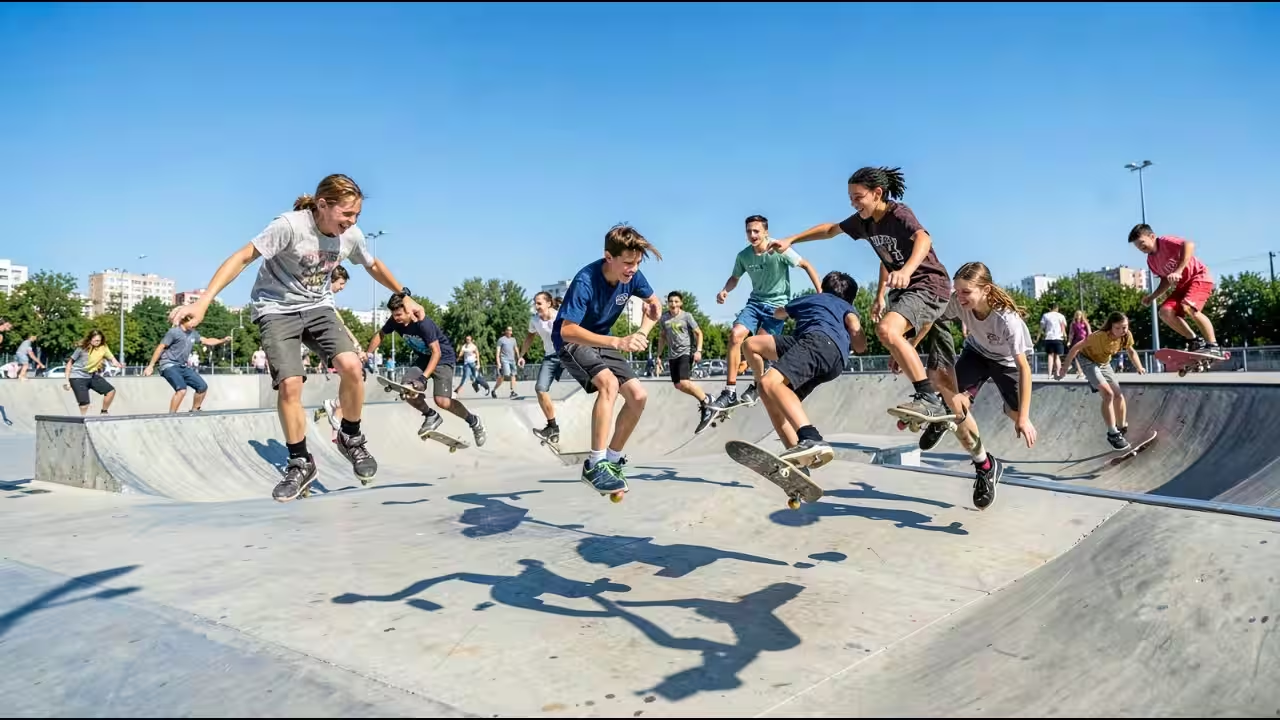
For young skateboarders, finding a safe, legal place to practise is not always easy. Since 2002, a nonprofit founded by professional skateboarder Tony Hawk has helped communities develop public skateparks, particularly in areas with limited recreational facilities. Formerly known as the Tony Hawk Foundation, the organisation became The Skatepark Project in 2020 to put its mission at the centre of its identity. It provides grants, technical assistance and other resources to communities seeking to create free public skating spaces. The organisation says it has helped fund nearly 700 skateparks across all 50 US states. A February 2026 Los Angeles City Council report separately documents its involvement in a skateboarding facility at the West Los Angeles Municipal Complex. Its work includes permanent community parks and temporary facilities developed with municipal authorities. Examples from Augusta, Kansas, and Los Angeles show how nonprofit support can help expand access to public recreation.The Skatepark Project: how Tony Hawk’s foundation began in 2002Hawk established the nonprofit to address the shortage of public places where young people could skateboard legally. According to The Skatepark Project’s account, Hawk used the $125,000 he won on Who Wants to Be a Millionaire in 2001 to help launch the organisation. It was formally founded in 2002 as the Tony Hawk Foundation. The foundation focused on helping communities secure funding and other resources for public skateparks, especially in underserved areas. Rather than limiting its work to financial assistance, it developed a community-oriented approach involving local advocates, public authorities and skatepark users.In 2020, the foundation adopted the name The Skatepark Project. A 2020 announcement about the rebranding reported that the organisation had helped fund more than 600 public skateparks across all 50 states. Its current programmes include grants of up to $25,000 for eligible projects, as well as technical assistance and support for youth activities. The organisation’s grant guidelines specify that projects must provide permanent, public concrete skateparks in underserved communities, remain free to use and involve local users in planning, fundraising and design. The organisation’s grant guidelines also set requirements for community support and project funding.Free skateparks in underserved communities: how grants and local funding workThe emphasis on free access is central to the organisation’s mission. A public skatepark does not require users to pay an entry fee or purchase a membership, although skaters may still need their own equipment. The Skatepark Project’s support is intended to help communities create facilities where young people can participate without the cost of private recreational venues. One of its regional initiatives is Built to Play, a partnership with the Ralph C. Wilson, Jr. Foundation. The Built to Play initiative, a partnership with the Ralph C. Wilson, Jr. Foundation, aimed to support up to 20 public skateparks across 16 counties in Southeast Michigan and Western New York. A separate example comes from Augusta, Kansas. In an announcement about a $15,000 grant from The Skatepark Project, the city said the funding would help address potential construction-cost increases for its community skatepark. The city also described plans to pursue additional funding and continue local fundraising.The Augusta project subsequently opened to the public on 5 November 2023, according to the city’s skatepark opening announcement. The example illustrates the wider role of municipal planning and community investment in establishing public recreational facilities. The Built to Play initiative and Augusta’s grant are separate examples of the organisation’s work, rather than parts of the same programme. The organisation’s reported national reach should be distinguished from estimates of park usage. Published figures for annual visits vary, and the available material does not establish whether they use comparable dates or counting methods. These estimates should therefore not be presented as a verified count of unique visitors.Los Angeles skate plaza: a $70,000 donation accepted in 2026The organisation’s work also includes temporary facilities developed with local authorities. In Los Angeles, the City Council considered a donation valued at approximately $70,000 for skateboarding features at the West Los Angeles Municipal Complex. The city’s official council record confirms that the council adopted the Government Operations Committee report on 3 February 2026, with all recorded votes in favour. The donation comprised labour, materials and equipment for four skate obstacles, handrails, ledges, a wedge spine, signage and replicas of courthouse monuments.Under the proposal, the Skatepark Project would oversee the design and construction with professional builders and cover the associated costs. The improvements were intended to provide a temporary skating facility while the complex remained subject to redevelopment plans. A local report described new features and murals being unveiled at the site on 3 February 2026, the same day the City Council adopted the committee report. The Los Angeles example shows that the organisation’s role can extend beyond conventional grants. It can contribute equipment, construction resources and project oversight to help create skating opportunities at existing public sites.Across its programmes, The Skatepark Project combines grant funding, technical assistance and partnerships with communities and public agencies. Its reported national reach provides a measure of the scale of its work, while local examples show how individual facilities depend on planning, funding and construction. The number of parks alone cannot establish how much access has improved in every community, but the projects demonstrate a sustained effort to make public skateboarding spaces available without entry fees.You use AI every day. Now get your AI Quotient. Take the AIQ test.
Topics in this story
Gathered from external sources. Rights to this text belong to whoever originally published it.