Stanford professors Sebastian Thrun and Peter Norvig opened their artificial intelligence course to the world for free in 2011; 160,000 students from 190 countries enrolled
Discover how Stanford's groundbreaking artificial intelligence course opened its doors to 160,000 students worldwide, revolutionizing online education in 2011.
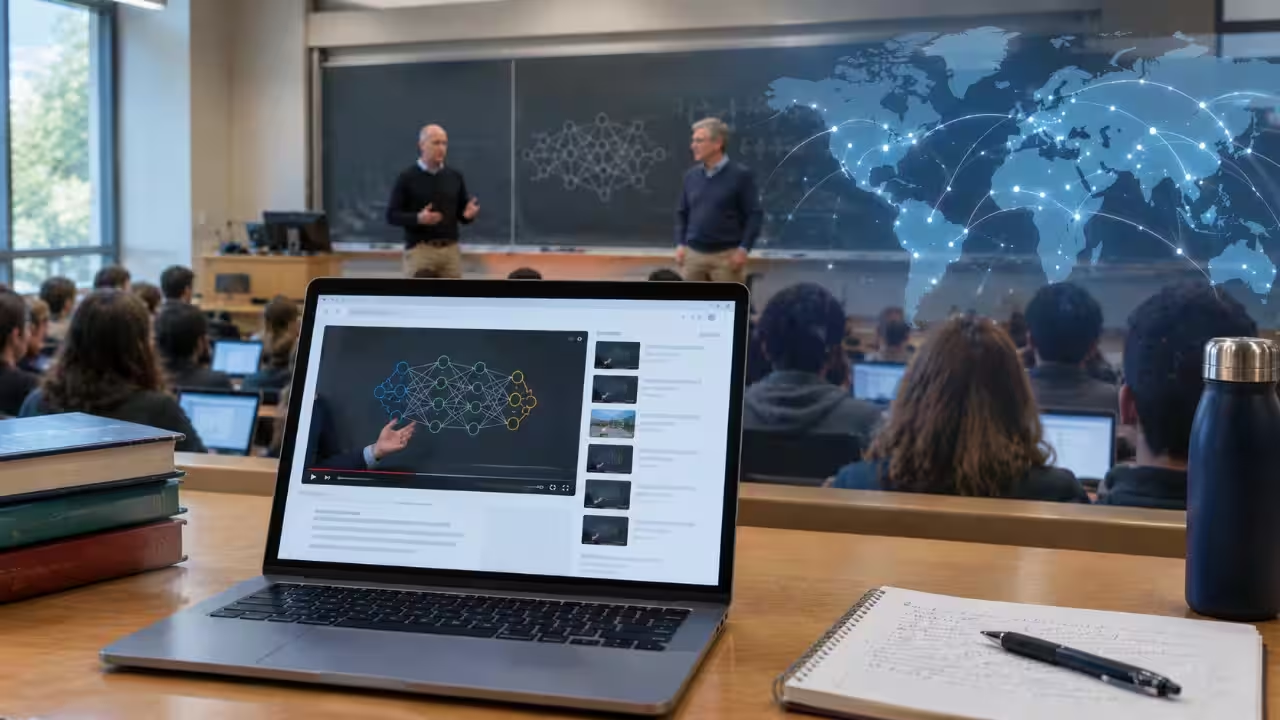
In October 2011, professors from Stanford University made their introduction to Artificial Intelligence as a free course and open to anyone with internet access. Taught jointly by Stanford research professor Sebastian Thrun and Google research director Peter Norvig, who expected few sign-ups, the course exceeded their expectations when 160,000 enrolments came from more than 190 countries. According to Stanford Engineering, the course started on 10 October and ran until 18 December, forming part of a wider experiment that involved three online computer science courses offered by the university. Along with the artificial intelligence course, students enrolled in Introduction to Databases, which was taught by Jennifer Widom, and Machine Learning under Andrew Ng.A university course with assignments, tests, and international participationUnlike a typical online setting where students can learn through online lectures, the classes were structured like a course of study. According to Stanford Engineering, the course was designed to offer students more than the scope of university lectures, wherein they could work through recorded mini-lectures, complete exercises, and take examinationsIntended to run for ten weeks, the syllabus covered the tenets of artificial intelligence through models of robotics, autonomous vehicles, and software that recommends music. Students were able to go through each week’s lessons at their own pace because the teaching materials were released weekly, while mid-term and final examinations were automatically assessed. To make the video lectures more interactive, quizzes were incorporated into the system. For students wanting to test their practical skills, programming exercises were in place to assess their knowledge. However, it would be remiss not to mention that those who completed the course requirements were awarded a statement of accomplishment, but participation did not confer Stanford University academic credit.Moreover, the design of the assessments was made in a way that allowed for repeated attempts. The one responsible for this interface was Stanford computer science professor emeritus, Jeffrey Ullman. Ullman had conceptualised a testing method that relied on a pool of possible answers rather than just the visible options on a single question. As a result, the system generated different question sets for each iterative attempt a student made on a given assessment.Furthermore, the system allowed an online discussion forum, much like the setting of a classroom where the floor is opened for questions. There, students could pose questions, answer the lingering doubts of their colleagues, and vote answers up or down based on their satisfaction. Jennifer Widom, who taught the databases course, reported that this was instrumental for teachers since they couldn’t cater to all the students at once; she said, "I can see that students are answering each other's questions and that answers from the top students are going to bubble up."International participation and the implications for higher education The impact of this artificial intelligence course was felt beyond the figures it had registered; Stanford Engineering reported that students had accessed the course database more than 7,500 times per second. About 40% of the total registrants across the three courses were from the United States, and India accounted for the second-largest group.Participation wasn't just limited to the formal teaching platform, as volunteers lent a helping hand and translated the artificial intelligence course into more than 40 languages, while local study groups were formed in different places to discuss the material in person. For instructors and teachers alike, the experiment provided an opportunity to understand how students learn and thereby improve their teaching methods. With tens of thousands of participants exposed to different testing arrangements, this exercise would have been otherwise difficult to conduct with a conventional class of 50 or 60 students.Ultimately, the course’s significance lies in establishing artificial intelligence as a barrier breaker and strengthening the groundwork of teaching methodology. Up until this initiative, institutions would publish lecture recordings for remote audiences. The Stanford experiment showed the possibility of combining video instruction with structured coursework and assessment on a much larger scale.You use AI every day. Now get your AI Quotient. Take the AIQ test.
Topics in this story
Gathered from external sources. Rights to this text belong to whoever originally published it.