From 200 km to 500 km: How long-range missiles are rewriting the rules of air combat
International News: A decade ago, the notion of striking an airborne target at 200 kilometres was considered a rare feat, more a matter of chance than certainty. Today, t.
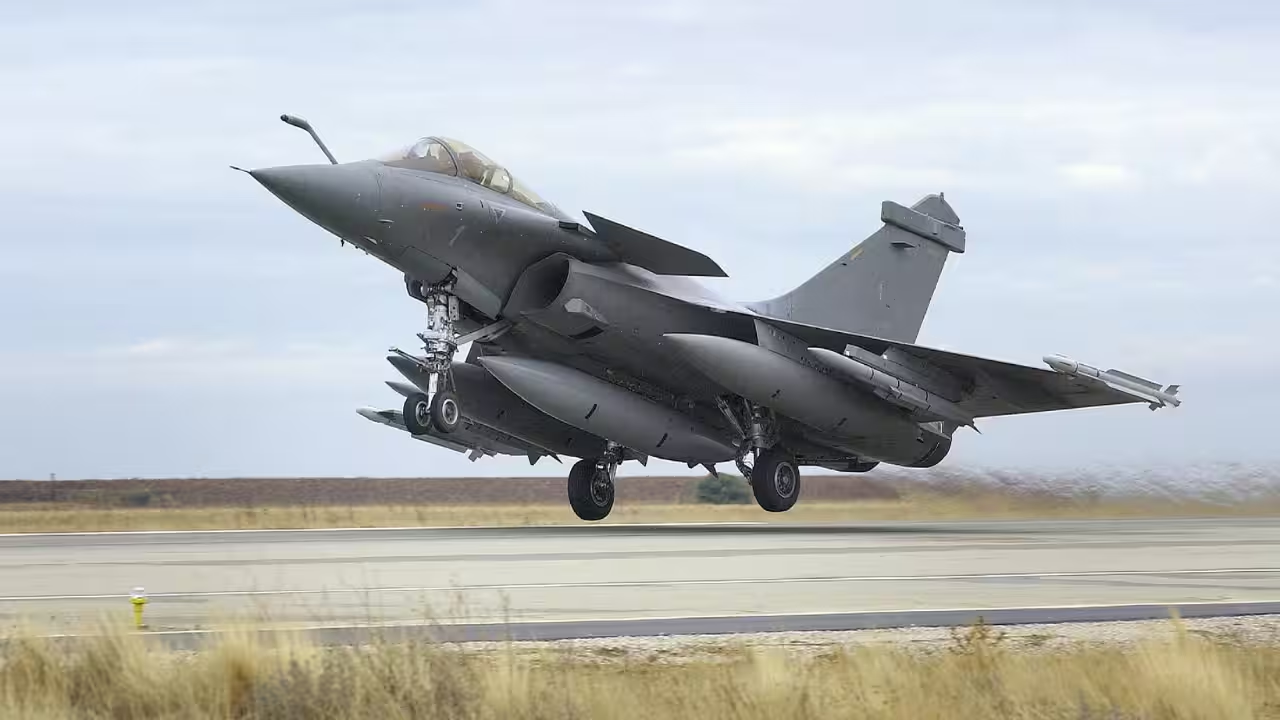
A decade ago, the notion of striking an airborne target at 200 kilometres was considered a rare feat, more a matter of chance than certainty. Today, the envelope of air-to-air missile engagements has expanded dramatically, with systems now promising ranges of 400 to 500 kilometres, and in some cases even more. This transformation is reshaping aerial warfare, shifting the emphasis from close-in dogfights to long-range denial of critical enablers such as airborne early warning aircraft, tankers and electronic warfare platforms.China’s PL-17, designed to neutralise high-value assets, is reported to reach nearly 400 kilometres, while Russia’s R-37M, capable of Mach 6 speeds, has been deployed on MiG-31 and Su-35 fighters with ranges around 300 kilometres. Europe’s Meteor, powered by a throttleable ramjet, sustains flight well beyond 150 kilometres, giving partner air forces a decisive edge in beyond-visual-range combat. India’s Astra programme, initially fielded with ranges of 110 to 160 kilometres, is now being expanded into longer-range variants, with reports suggesting capabilities approaching 300 kilometres. For the Indian Air Force, the integration of such systems into future platforms like the AMCA will be critical to maintaining parity with peer competitors.The United States has now unveiled its most ambitious programme yet, one that could redraw the rules of aerial combat for decades. Announced at a naval aviation symposium, the AIM-424 Long Range Air-to-Air Missile, also referred to as Malice, is being developed to ensure American forces retain the edge in what planners describe as first look, first shot, first kill engagements. Manufactured by Raytheon, Malice stretches 13.5 feet, weighs 680 kilograms, and employs a two-stage solid-propellant rocket motor to achieve a stated range exceeding 250 nautical miles, or roughly 463 kilometres. It is designed to arm both current and future fighters, from the F/A-18E/F Super Hornet and F-35C to the sixth-generation F/A-XX, giving naval aviators a weapon tailored for today’s air wings and tomorrow’s. Where Malice fits alongside the AIM-174B, adapted from the Navy’s ship-launched SM-6 interceptor, remains to be seen, but the Pentagon’s ambition is clear: to eventually field air-to-air weapons capable of reaching nearly a thousand miles, a capability seen as essential to counter adversary anti-access systems and to dominate extended kill chains.From the era of 200 kilometre “lucky shots” to today’s 500 kilometre sightlines, air combat has become a contest of reach, precision and denial. The trajectory points towards even greater ranges in the coming decade, demanding not only advances in propulsion but also robust sensor networks and data links to cue missiles accurately at extreme distances. The decisive battles of the future may well be fought long before opposing fighters ever come within visual range.
Topics in this story
Gathered from external sources. Rights to this text belong to whoever originally published it.