By 2020, an eastern Washington historian had spent more than 30 years building his own Monticello; the replica was about 90% complete and he was still working
Explore how historian Dan Sisson dedicated over 30 years to construct Monticello West in Washington using 22,186 salvaged bricks, inspired by Thomas Jefferson's Monticello.
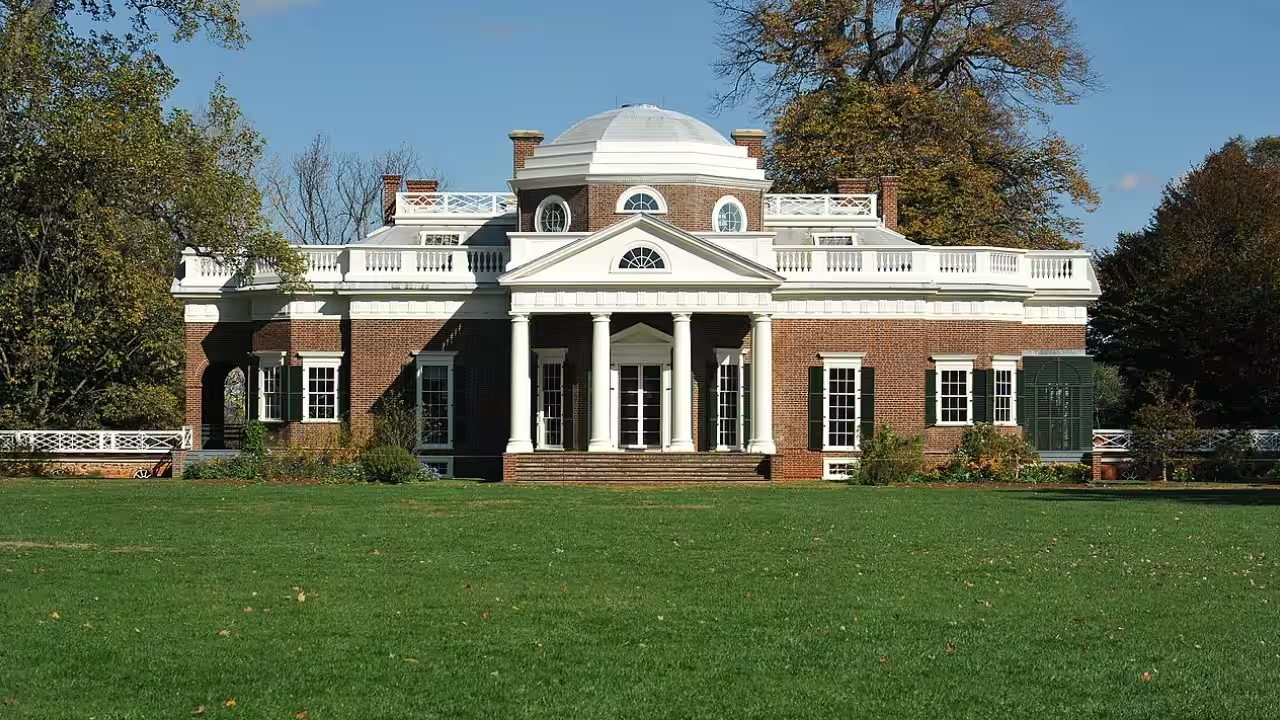
The house stands south of Ford, a small community in Stevens County, Washington, on land between state property and the Spokane Indian Reservation. Its brick walls and front elevation follow Thomas Jefferson’s Monticello in Virginia, though it was built with scavenged materials rather than a contractor’s budget. The builder is Dan Sisson, a historian, author, and longtime Eastern Washington University professor. He calls the house Monticello West. Though largely complete, the house remains a work in progress. The Spokesman-Review and the Los Angeles Times both covered Sisson’s project, and InsideHook later summarized the Times profile. Together, the reports describe a project that would normally take a construction crew, which Sisson took on with help from family, friends, and some hired workers, using mostly salvaged and secondhand materials.From Jefferson scholar to congressional candidate in 1976According to his biographical note, Sisson was born in Washington, D.C. He holds a master’s degree and a PhD. The note adds that he ran for Congress in 1976. A summary of that profile says he visited Monticello as a child with his father, who said that any building he made should resemble it.Digging the foundation at 61 and still working at 82A Los Angeles Times profile reports that Sisson dug the foundation with a shovel and pickaxe at 61 and was 82 when the profile was published. The profile also reports that he designed Monticello West in the mid-1980s, bought the land near Ford in 1998, and moved in during 2002.The Los Angeles Times article “How do you build a replica of Monticello? Brick by scavenged brick” reported that the replica, known as Monticello West, was about 90% complete by April 2020. Over two years, Sisson collected about 30,000 used bricks from a Spokane redevelopment zone, making roughly 120 trips in a pickup that could carry up to 250 bricks at a time. Stevens County withheld permission for the project until Sisson showed his plans to the planning director.Scavenged wood, flooring and marble, and thousands of straightened nailsMaterials were the project’s biggest challenge. Contemporary reports say he scavenged wood, flooring, and marble, much of it free or cheap, and straightened thousands of old nails for reuse. His wife and son helped, as did other people drawn to the idea of a Monticello northwest of Spokane.Jefferson’s plan in 1792 to reuse about 60,000 bricksReusing brick is not a new habit at Monticello. In a letter from Thomas Jefferson to Stephen Willis, 12 November 1792, Jefferson wrote that he expected the demolition of old walls and an antechamber to yield about 60,000 bricks. The Thomas Jefferson Foundation’s Monticello Encyclopedia records that Stephen Willis, a brick mason, arrived at Monticello around 1770 to help build the South Pavilion and continued working there through 1778. In effect, Jefferson reused materials from one project to build another, much as Sisson did with salvaged bricks.Jefferson’s 13 May 1822 brick estimate for six West Portico columnsJefferson also worked out his brick needs on paper. In Thomas Jefferson’s Notes on Bricks Needed for Monticello Columns and Cisterns, dated 13 May 1822, he tallied headers and stretchers course by course for six Doric column shafts. The editors identify those shafts as belonging to the West Portico. Monticello Magazine reports that the West Portico columns were restored in 2013 to their original look during Jefferson’s time by stripping away the layers of white paint and restoring the original render with period-appropriate materials. The restored columns are built of molded brick finished with a render, a cheaper approach than solid stone. Both builders, separated by two centuries, solved the column problem by choosing a cheaper material and shaping it to fit.Jefferson’s construction timeline and Sisson’s approach Sisson himself draws the comparison. Sisson himself draws the comparison, telling the Spokesman-Review that Jefferson spent 43 years building his house, a span he offers as a parallel to his own long schedule. The earlier-mentioned letter from 1792 indicates the pace at which Jefferson was proceeding. In 1792, Jefferson planned the next phase of construction at Monticello, including digging the cellars in early April.You use AI every day. Now get your AI Quotient. Take the AIQ test.
Topics in this story
Gathered from external sources. Rights to this text belong to whoever originally published it.