In 2020, Edwin Wiek spent four days in a chimp’s former cage; by day four, donors had given €20,855 toward a Thai rescue centre caring for 780 animals
Edwin Wiek spent four days in a chimp's old cage to raise funds for Wildlife Friends Foundation Thailand during the pandemic, highlighting the plight of wildlife rescue centers.
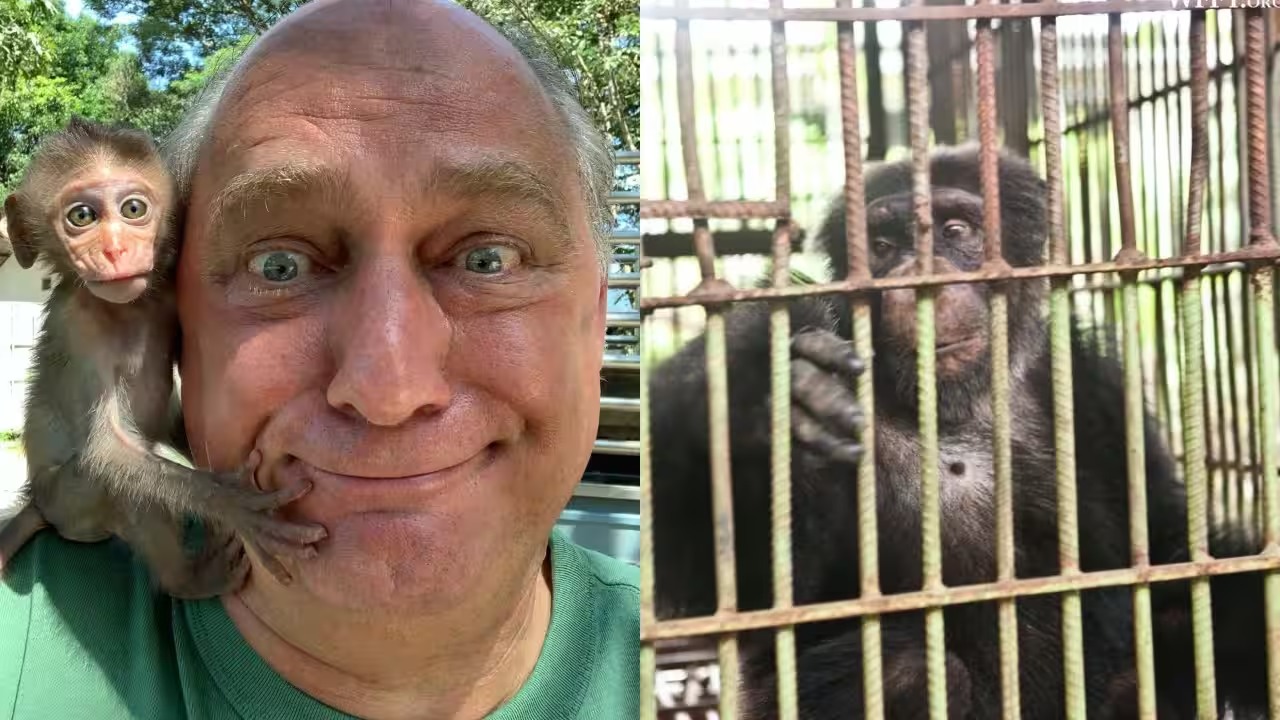
The media rarely cover wildlife rescue centres until an incident occurs. The majority of them survive on a consistent supply of volunteers, visitors, and small donations. But that support dried up quickly when Thailand’s tourism industry was hit by the pandemic in 2020. Edwin Wiek responded in July 2020 by spending four days in a cage in Bangkok where a chimpanzee named Canoe had previously been kept for more than 20 years, according to a 2015 report from the Wildlife Friends Foundation Thailand. Despite this, the animals continued to require daily sustenance. The rescue centre he established in Phetchaburi province, in which he was then caring for 780 animals, had received €20,855 in donations by the fourth day of his stay.Wildlife Friends Foundation Thailand is managed by Wiek, who was 54 years old at the time and is of Dutch descent. The rules, as outlined by WFFT, were stringent when he entered the cage at noon on Friday, July 10, 2020. He could only leave for the toilet six times a day, and he was prohibited from leaving for more than ten minutes at a time. The foundation's objective was to raise funds to nourish the wild animals under its care and to raise awareness of the millions of wild animals that are kept in cages as pets or tourist attractions.Life in the cageThe cage was small by any measure. Khaosod English reported that the cage measured 1.4 metres by 2.3 metres, with a ceiling just under two metres. "The mosquitoes, the ants and the snakes, I don't mind so much, but the lack of space does, and by the fourth day it was getting to me," Wiek told the paper. He also said that the chimpanzee that used to live there stayed in the same space for many days, putting his own time there in perspective.The fundraising process resembled a reality show. Viewers could pay to make Wiek's stay easier or more difficult while he was live-streamed on Facebook and YouTube. A 10-minute shower cost $200, while snacks and soft drinks started at $25. On the unfriendly side, it cost $250 to be hosed down, $300 to be poked with a bamboo stick, and $200 to have noise blasted at the cage for 15 minutes. Anyone willing to pay $5,000 could effectively throw away the key. According to Wiek, the majority of the donations came from Australia, the United States, and Europe. One challenge, wearing Thai-style clothing and a wig, was cut short to an hour because of the heat, according to Smart Local Thailand.The chimp who resided thereThe chimp was named Canoe. VICE World News reported that Canoe had already been moved to the rescue centre earlier in 2020, before Wiek's fundraising stay in the chimpanzee's former cage. His stay in Bangkok had been long and grim. WFFT reported in February 2015 that he had lived in a cage of roughly five square metres at a school in Bangkok for more than 20 years. On February 18 that year, Wiek sent a petition with 25,000 signatures to the head of Thailand’s Department of National Parks and Wildlife.Two days later, officials arrived with a court order and found the chimpanzee, a gibbon and a macaque kept under improper conditions. The gibbon and the macaque had ownership documents. Canoe didn’t, and the owner said he had kept him before Thailand’s wildlife laws came into effect. The foundation also pointed out that chimpanzees are a protected species under CITES, raising the question of how he had ever gotten into the country in the first place. Authorities instead recommended giving the animals to a rescue facility, and the owners were given 90 days to improve conditions to international standards.Where the money wentThe goal was $25,000. Different reports quote it in dollars and in euros, but they agree on the number. Khaosod English reported that donations had reached €20,855 by Monday, July 13, the fourth day of the fundraiser. Later coverage put the final total at between $25,000 and $30,000, enough to keep the centre operating for about a month, according to VICE World News.That sounds small until you see what the foundation was up against. In interviews during the pandemic, Wiek described a sharp fall in revenue after tourism and visitor numbers collapsed. He warned that the centre’s savings could run out within six to eight weeks and that facilities without income were beginning to consider giving their animals away. He warned the savings would be used up in six to eight weeks, and zoos and animal attractions with no income were beginning to think about giving their animals away. Wiek also warned that zoo closures and the loss of tourism revenue were putting additional pressure on animal facilities. By late 2020, the centre’s animal count had reportedly risen from 780 to roughly 850.The residents included gibbons, macaques, orangutans, chimpanzees, elephants and a bear. The Wildlife Friends Foundation says its rescue centre has taken in thousands of animals since it opened, many of them rescued from the pet trade, tourist photo props and entertainment attractions. Animals that cannot be released back into the wild remain in the centre’s care.Wiek later said he would undertake the fundraising stunt again, linking the pandemic to the wildlife exploitation his foundation had been fighting for 19 years. The campaign drew attention to the pressures facing rescue centres when tourism and visitor revenue disappear. Such facilities rely on donations as well as visitor income, and Wiek used his four days in Canoe’s former cage to highlight the consequences of keeping wild animals confined.You use AI every day. Now get your AI Quotient. Take the AIQ test.
Topics in this story
Gathered from external sources. Rights to this text belong to whoever originally published it.