Scientists planted 150,650 native koa trees on Hawaii’s abandoned pasture, but 20 years later endangered birds were moving into the young forest
US News: For decades, cattle had grazed across large areas of what is now Hakalau Forest National Wildlife Refuge on Hawaii's Big Island, leaving thousands of .
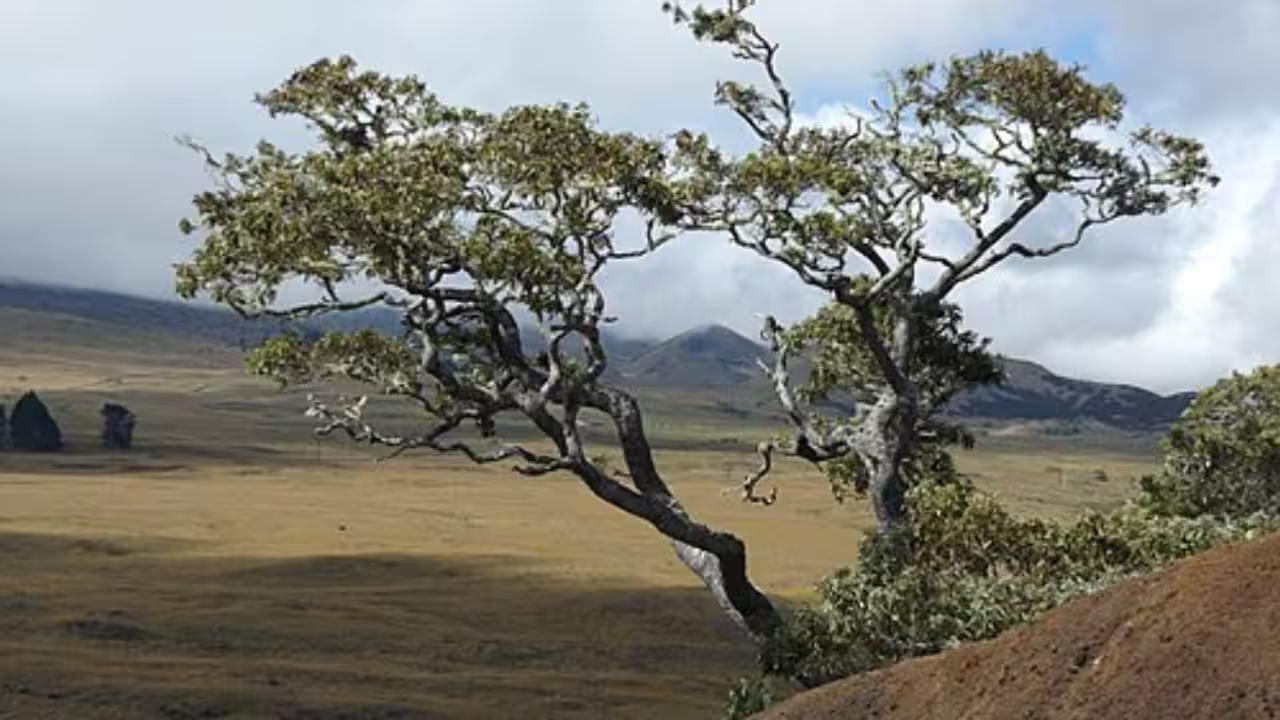
For decades, cattle had grazed across large areas of what is now Hakalau Forest National Wildlife Refuge on Hawaii's Big Island, leaving thousands of acres dominated by pasture grasses instead of native forest. Then, beginning in the 1990s, conservationists began rebuilding the forest one tree at a time. Between 1992 and 1996, American Forests supported the planting of 150,650 native koa trees across degraded pasture at Hakalau. The aim was not simply to put trees back on the landscape. The young forest was intended to create habitat and nesting areas for some of Hawaii's rarest birds.Two decades later, researchers found that the strategy was working. Birds that depended on native forest were moving into the restored areas, with several species increasing as the planted trees matured. A later study using more than 20 years of observations described the Hakalau project as one of the largest ongoing reforestation efforts in Hawaii and found that time since restoration and proximity to intact forest strongly influenced how quickly birds colonised the new woodland.American Forests planted 150,650 koa trees across abandoned pastureHakalau Forest National Wildlife Refuge covers roughly 34,000 acres on the slopes of Mauna Kea and contains some of the last extensive montane rainforest habitat in Hawaii. But much of the landscape had been transformed by cattle ranching. American Forests says that thousands of acres inside the refuge had become abandoned pasture, with invasive weeds and grasses replacing the native vegetation. From 1992 to 1996, the organisation supported the planting of 150,650 koa trees, a native Hawaiian tree considered a keystone species in these forests.The project built on earlier restoration work that began in the refuge in the 1980s. The idea was to establish strips and corridors of native trees through the open pasture, creating a bridge between surviving forest and areas where native vegetation had disappeared. Koa was particularly useful because it could grow relatively quickly on degraded land while providing structure and resources that could eventually support other native plants and animals.The 2003 paper ‘Tree Planting at Hakalau Forest National Wildlife Refuge, the Right Tool for the Right Stock Type,’ published in Native Plants Journal, was written by Jack Jeffrey and Baron Horiuchi. The researchers described koa and ‘ōhi‘a lehua as important species for restoring degraded parts of Hakalau and explained how different planting tools were used for different types of seedlings.The young forest was designed to bring endangered Hawaiian birds backThe trees were never the only goal. Hakalau was established in 1985 specifically to provide habitat for rare and endangered native forest birds. But much of the upper refuge had already been heavily altered by ranching, leaving large areas of open pasture where forest birds could no longer find the food, shelter and nesting habitat they needed.The restoration corridors were therefore intended to do more than replace missing trees. They were designed to create foraging cover, nesting sites and food resources while helping native forest gradually expand into former pasture. Koa also had an important ecological advantage. Its canopy could eventually shade out some of the aggressive pasture grasses while creating a more forest-like environment beneath the trees. That could make conditions more suitable for the return of native understory plants.American Forests says endangered birds including the ‘i‘iwi, or scarlet honeycreeper, and the ‘akiapōlā‘au began returning to areas that had once been largely barren. The organisation describes the project as one of the world's notable examples of native forest restoration. The restoration was therefore conceived as a long-term ecological transition: plant native trees first, allow the canopy to develop, then create the conditions in which a more complex native forest community could return.After more than 20 years, birds began colonising the planted forestThe strongest evidence of what happened next came from researchers who examined the bird community over a much longer period. In the study ‘Predicting effects of large-scale reforestation on native and exotic birds,’ published in Diversity and Distributions, Liba Pejchar, Travis Gallo, Mevin Hooten and Gretchen C. Daily examined a reforestation project at Hakalau that was already more than 20 years old. Their research asked how quickly a landscape converted from pasture to young native forest could begin supporting forest birds.The researchers surveyed birds in several types of habitat, including corridors of young planted trees, remnants of mature forest and mature forest itself. They found that time since restoration and distance from intact forest were important predictors of bird abundance and colonisation. That meant the young forest was not immediately equivalent to old-growth forest. Birds did not all arrive at the same speed, and species farther from existing forest generally took longer to colonise the restored areas. But the direction was clear: as the planted forest developed, native birds increasingly used it.A separate long-term study, 'Rapid colonization of a Hawaiian restoration forest by a diverse avian community,' analysed 26 years of bird-count data at Hakalau. The researchers found that most species in the diverse forest-bird community increased significantly in the restoration forest, although different species colonised at different rates.Endangered birds were using trees planted on former cattle pastureThe results were particularly significant because Hawaii has lost much of its original forest and many of its endemic birds are found nowhere else on Earth. The long-term Hakalau research showed that restoration could provide useful habitat even before a planted forest had reached the structure of mature native woodland. Forest cover and the diversity of vegetation beneath the trees also helped explain bird densities.Some species responded relatively quickly, while others took much longer to appear. The ‘akiapōlā‘au, an endangered Hawaiian honeycreeper, was among the species recorded in the restoration forest and showed an increasing trend over the study period. That gradual colonisation matters because Hawaiian forest birds face threats beyond habitat loss. Introduced mosquitoes and avian malaria have devastated many native species, while invasive plants and animals continue to alter their remaining habitat.Hakalau's restoration therefore offers more than a simple tree-planting success story. The young forest provides an expanding refuge at higher elevations, where conservationists hope native birds can find enough habitat to persist as environmental conditions change. American Forests is now involved in another stage of that effort. Its Kanakaleonui Bird Corridor project aims to connect Hakalau with higher-elevation forests on Mauna Kea, potentially giving vulnerable birds access to cooler habitat as climate change pushes mosquitoes and avian malaria into areas that were once relatively safe.The story of Hakalau began with a landscape altered by more than a century of cattle grazing. In the 1990s, conservationists planted 150,650 native trees across part of that abandoned pasture. More than 20 years later, researchers were documenting forest birds moving through the young woodland. The trees did not recreate an ancient forest overnight. Instead, they provided the first structure from which a new forest could grow, and, with it, a route back for some of Hawaii's most threatened birds.Catch the latest World News and Live updates. Download the TOI app.
Topics in this story
Gathered from external sources. Rights to this text belong to whoever originally published it.