‘Wake up’: Iran releases 25-page letter urging US voters to reject Trump ahead of midterms
Iran’s Islamic Revolutionary Guard Corps (IRGC) has made a direct appeal to American voters, urging them to reject President Donald Trump’s policies and
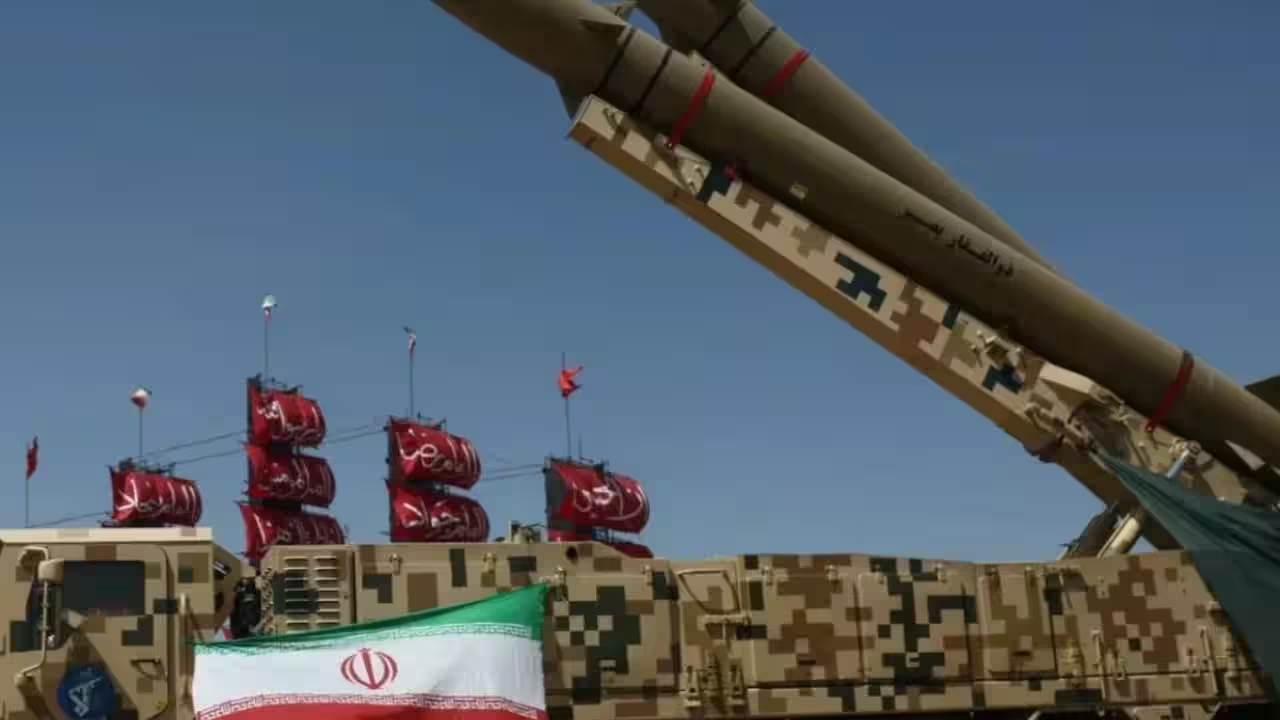
Iran’s Islamic Revolutionary Guard Corps (IRGC) has made a direct appeal to American voters, urging them to reject President Donald Trump’s policies and “wrest control back from corrupt politicians” as the US heads towards its midterm elections. In a lengthy open letter addressed to the American public, the powerful Iranian military force argued that Washington’s war against Iran had failed to achieve its objectives and called for a change in US policy towards Tehran.The 25-page letter, released seven months after the US-Israel war against Iran began, seeks to draw a distinction between the American people and their government. The IRGC argues that ordinary Iranians and Americans share common interests and grievances, portraying both as victims of political leaders pursuing costly wars. It also urges Americans to oppose US support for Israel and foreign military interventions, while presenting peaceful coexistence between Washington and Tehran as possible if US policy changes.IRGC spokesman Gen Hossein Mohebbi reinforced the message at a news conference in Tehran on Tuesday, saying the only way for the conflict to end was for Washington to acknowledge defeat and withdraw. He urged Americans to reconsider their leadership and put pressure on the Trump administration, arguing that many US citizens remained unaware of what he described as the “harms” caused by its policies.The timing of the letter is significant. The letter was released about five weeks before the US midterm elections, with the IRGC describing the current period as a moment when the American political system is at its weakest. Mohebbi said he did not necessarily expect the letter to change the US administration’s behaviour, but hoped American voters would hear its message.‘Wake up’: Iran takes message to US votersThe letter repeatedly attacks Trump’s justification for the war, particularly his claim that Iran’s nuclear programme posed a threat that required military action. Tehran has consistently denied seeking nuclear weapons and maintains that its uranium enrichment programme has civilian purposes.“The enemy [US] knows that Iran is not after nuclear weapons,” Mohebbi said, echoing the letter’s argument that Washington has used the nuclear issue as a pretext to pursue wider strategic and economic goals.The IRGC also claims that the US and Israel failed to achieve their stated objectives in the war. According to the letter, the targets shifted repeatedly after earlier goals, including regime change and partition of Iran, were not achieved. It lists objectives ranging from forcing Iran’s unconditional surrender and destroying its nuclear and missile programmes to taking control of the Strait of Hormuz.The letter declares Iran the victor, claiming that thousands of US and Israeli strikes damaged Iranian infrastructure but failed to accomplish their stated aims. It further claims that Iranian forces inflicted major losses on US military assets and severely damaged American bases across the region. These assertions are presented by the IRGC as evidence of a broader strategic defeat for Washington.The Strait of Hormuz features prominently in the letter and Mohebbi’s remarks. He rejected US claims that Iran had lost its leverage over the vital waterway, arguing that the movement of a limited number of vessels did not mean the strait was fully open. Oil exports through the waterway, however, have recovered substantially from the levels seen earlier in the conflict, according to figures cited in the supplied material. ‘Death to America’ explained as attack on rulersThe IRGC letter also attempts to explain one of the most recognisable slogans associated with Iran’s political system: “Death to America”. It argues that the phrase is directed at the US political establishment rather than the American population.“‘Death to America’ is a prayer for the eradication of the diabolical ruling elite whose seat of power is the White House,” the letter says.The document repeatedly contrasts the American public with Washington’s political leadership, claiming that taxpayers ultimately bear the financial burden of US wars. It asks Americans to question why their government continues to pursue military confrontation and warns of what it describes as the consequences of an ongoing conflict.The IRGC’s approach echoes Cold War-era efforts to reach an adversary’s population directly. During the Vietnam War, Vietnamese broadcaster Trinh Thi Ngo, widely known as “Hanoi Hannah”, used English-language broadcasts to target American troops, urging them to question their government and the war. Her programmes highlighted US casualties, anti-war protests and reports critical of the conflict while presenting the Vietnamese side’s narrative.Iran has similarly sought to communicate directly with Western audiences since the latest war began, using Iran-linked media and online networks, including English-language AI-generated videos, memes and short-form content.The IRGC letter now represents a much more formal version of that strategy: an attempt to speak past Washington and directly to American voters.For Tehran, the central message is that the war is not simply a military confrontation between two states, but a political choice that Americans themselves can challenge. Mohebbi urged them to put pressure on their government, while the letter concluded with a broader argument that Iran’s resistance had demonstrated the limits of American military power.Meanwhile, Iran’s economic pressures remain severe. The rial fell to a new record low on Tuesday, with traders in Tehran reportedly exchanging more than 2.5 million rials for one US dollar. The currency has repeatedly hit new lows since the war began.You use AI every day. Now get your AI Quotient. Take the AIQ test.
Topics in this story
Gathered from external sources. Rights to this text belong to whoever originally published it.