South West birdwatchers describe thrill of starling murmations
Photographers and artists are encouraging people to watch winter starling gatherings.
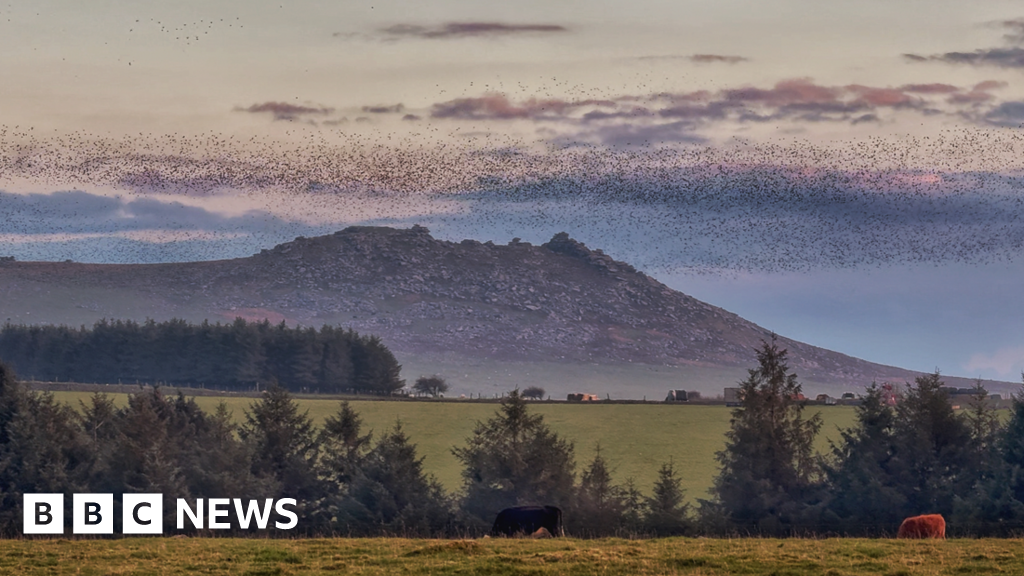
Birdwatchers have described their joy at seeing starling murmations as a survey seeks to build a picture of their numbers.
Researchers from the University of Gloucester are updating a survey conducted a decade ago which examined the behaviour of the birds to find out what has changed.
Murmurations are lauded as one of "nature's winter wonders" as they involve masses of starlings swooping and diving in a pattern before roosting.
Encouraging people to participate in the survey, Devon artist Mike Langman said the dances were "just absolutely stunning", while Cornwall photographer Peter Glaser described murmations as "hair-raising".
The study hopes to find out if murmurations happen in the same places, if bird numbers have stayed the same and whether birds of prey are still around.
The 2014-16 study found there was an average of 30,000 birds in a murmuration, while some of the larger ones had more than 750,000 birds, based on sightings from 23 countries.
As part of the original study, researchers backed the idea that murmurations are primarily to protect birds against predators such as peregrine falcons and sparrowhawks.
Langman, who leads guided bird tours, encouraged citizen scientists to join in "for the experience as much as anything else".
He nominated his best spots for murmations in Devon as Countess Wear, near Topsham, and Thurlestone and Slapton Ley in the South Hams.
"Not only do you see them, you hear them as well and sometimes you even smell them," he said.
He said the sounds could be "remarkable" as tens of thousands of birds twist and turn before roosting when they fall silent.
"It's just like someone has switched off a light switch," he said.
Photographer Peter Glaser, who has captured many murmurations at Roughtor on Bodmin Moor, said they were "absolutely enthralling" to see.
He noted numbers this year "seem to be quite a marked improvement" on previous years.
"The expressions of delight [from others], the hairs on the back of your head rising, it is incredible," he said.
Wadebridge-based photographer Adrian Langdon said starlings often gathered at Penzance rail and bus station and Marazion Marsh.
"It's one of the spectacles of the natural world... it's pretty special," he said.
Prof Adam Hart from the University of Gloucester, who is leading the survey, asked people to provide accurate estimates of the number of starlings in the group as well as recording any birds of prey.
"We may see fewer birds, we may see fewer murmurations. We don't really know and that's the point of doing the survey," he said.
Follow BBC Cornwall on X , Facebook and Instagram . Follow BBC Devon on X , Facebook and Instagram . Send your story ideas to spotlight@bbc.co.uk .
Help needed to solve mystery of starling murmurations
Falcon attack on starling murmuration 'incredible'
Amazing pre-murmuration display captured on film
Topics in this story
Gathered from external sources. Rights to this text belong to whoever originally published it.