African Parks spent 20 years testing conservation in Malawi; its new model now covers 1.37 million hectares across three African parks
For more than two decades, African Parks has been working to restore and manage wildlife landscapes in Malawi, beginning with Majete Wildlife Reserve in
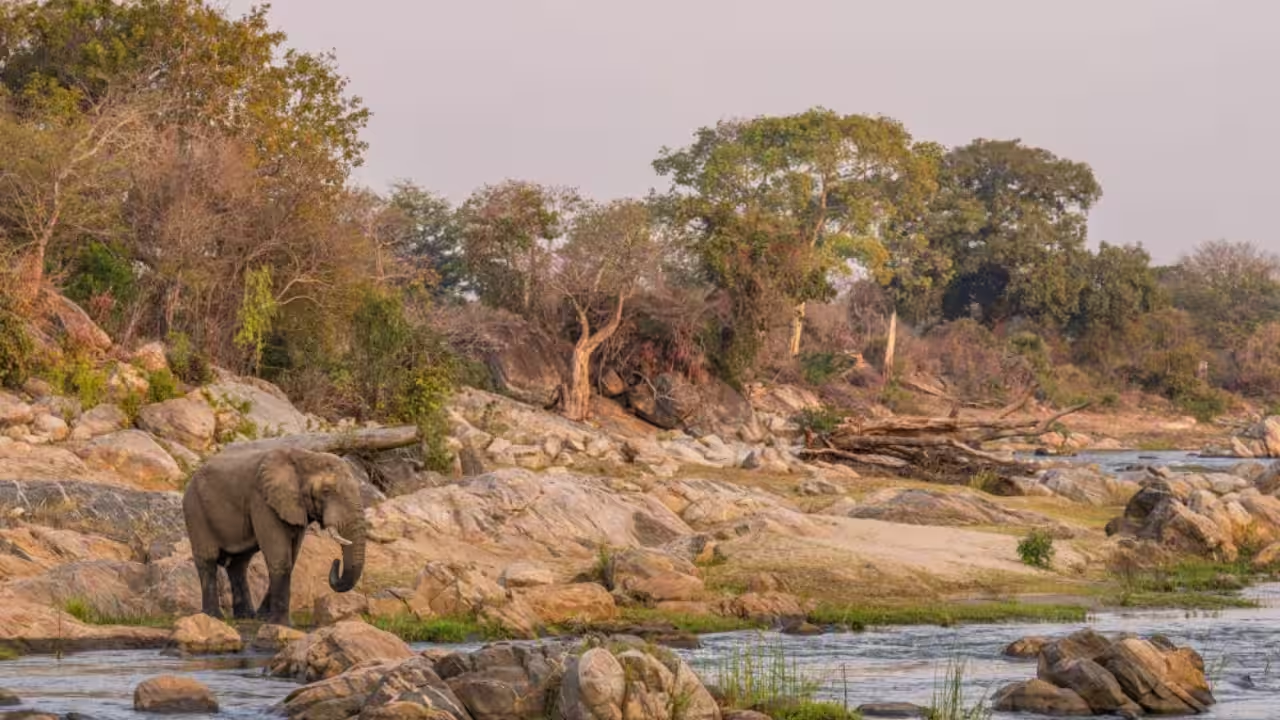
For more than two decades, African Parks has been working to restore and manage wildlife landscapes in Malawi, beginning with Majete Wildlife Reserve in 2003. That long-running conservation work has now become the testing ground for a different question, how can the ecological health of protected areas be measured in a way that also helps attract long-term funding? The organisation developed the Verifiable Nature Unit (VNU) with The Landbanking Group as an outcomes-based system for measuring, reporting and verifying changes in nature. The African Parks Organisation says the first VNU pilot was launched at Majete Wildlife Reserve, Malawi, after more than 20 years of conservation management. The model has since expanded beyond Malawi, with VNU projects in three large African parks covering a combined 1.37 million hectares.Majete became the testing ground for the new conservation modelAfrican Parks signed its first management mandate for Majete Wildlife Reserve with the Malawian government in 2003. The reserve covers some parts of south-western Malawi and underwent extensive restoration, including the reintroduction of wildlife species that had been depleted from the area.Over the following two decades, African Parks says more than 3,000 animals representing 17 species were reintroduced at Majete. Rhino reintroductions began in 2003, followed by elephants in 2006, lions in 2012, giraffes in 2018, cheetahs in 2019 and African wild dogs in 2021. The organisation also developed infrastructure and worked with communities surrounding the reserve.That long period of management gave African Parks what it describes as an ideal proof of concept for the VNU. The first VNU pilot was launched at Majete, where 711 VNUs were issued in 2024 and reissued in 2025.Each VNU represents a square kilometre of natureThe VNU is designed to turn ecological outcomes into a standardised unit that can be measured over time. African Parks defines each VNU as one square kilometre of land whose ecological integrity has been maintained or improved over a specified period.Rather than simply measuring how much land exists inside a protected area, the system looks at whether the condition of that land is being maintained or improved. African Parks says each VNU is assessed annually using two principal indicators are habitat intactness and indicator species.Habitat intactness tracks changes caused by pressures such as settlement expansion, deforestation and agricultural conversion. Indicator species are monitored for their presence and abundance as a measure of broader ecosystem health. The system also uses observation, machine learning, third-party verification and a digital system for issuing and reporting VNUs.The model expanded to 1.37 million hectaresAfter the Majete pilot, African Parks began testing VNUs in three additional national parks, Odzala-Kokoua in the Republic of the Congo, Garamba in the Democratic Republic of the Congo, and Zakouma in Chad.According to African Parks, VNUs issued for these three parks in 2025 and again in 2026 cover a combined 1.37 million hectares, or 13,700 square kilometres. The expansion takes the system from its original Malawi proof of concept into several much larger and ecologically different landscapes.The VNU is not itself a biodiversity credit. African Parks describes it as an independently verified measurement of ecosystem integrity that can underpin different funding mechanisms, including outcomes-based grants, nature or biodiversity credits, nature-linked financial instruments and payments for ecosystem services. During the pilot phase, VNUs are being used through bilateral agreements with funders rather than as tradeable units.African Parks wants conservation outcomes to become measurableThe organisation's broader aim is to connect funding to measurable conservation results. Instead of funding being based only on activities carried out in a park, the VNU framework is intended to show whether ecological integrity is actually being maintained or improved.African Parks says the next stage will involve expanding the methodology into community-managed landscapes surrounding the pilot parks. The organisation plans to test whether verified conservation outcomes can also help support community development and provide incentives for protecting natural areas outside formally protected parks.For African Parks, Majete therefore serves two roles, it is a long-running example of conservation management in Malawi and the first testing ground for a system designed to measure the ecological results of that work. The approach has now moved beyond the reserve, with VNU projects spanning 1.37 million hectares across Odzala-Kokoua, Garamba and Zakouma.You use AI every day. Now get your AI Quotient. Take the AIQ test.
Topics in this story
Gathered from external sources. Rights to this text belong to whoever originally published it.