In 1974, two siblings released their cattle before leaving a Scottish island; 50 years later, the herd showed wild deer-like social behaviour and defeated bulls lived on a separate headland
Rest of World News: Discover the fascinating story of how a herd of cattle on Swona Island adapted to life without human intervention, evolving into a distinct breed over 50 years.
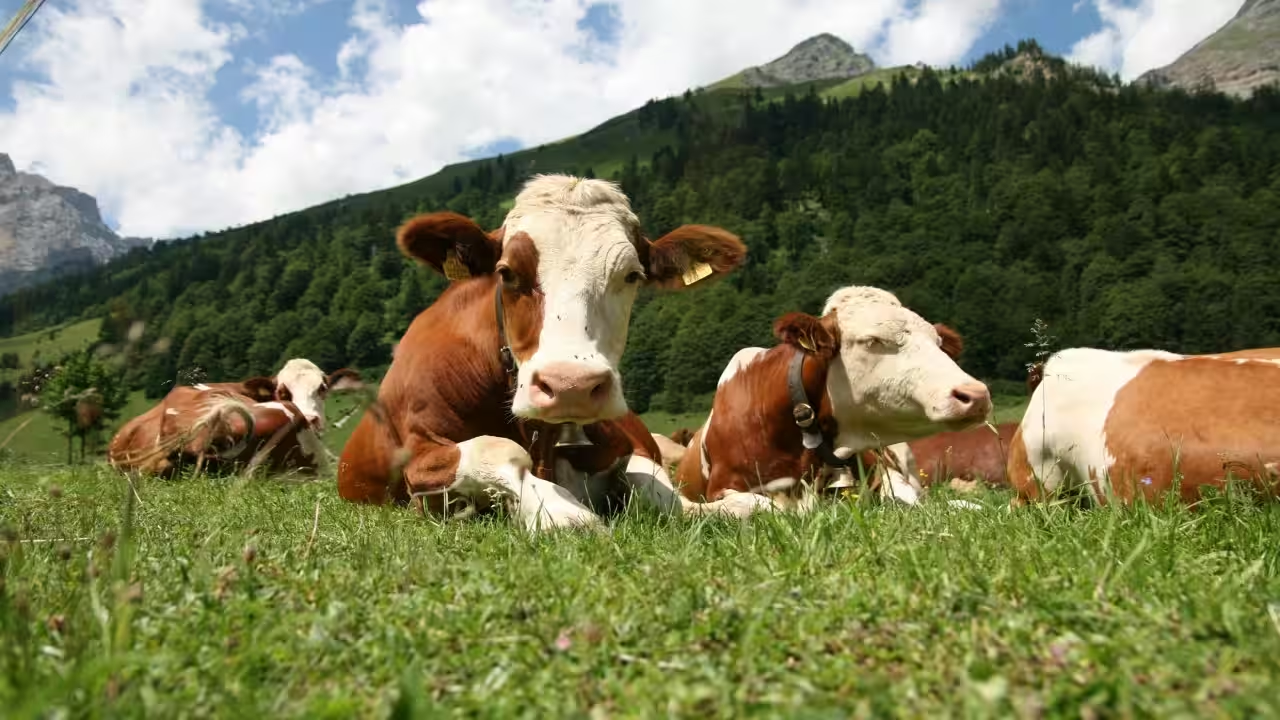
Swona was once home to a small farming and fishing community that gradually disappeared as its residents grew older and left the island. After their owners departed, only a few of the remaining animals managed to survive on their own. However, a small herd of cattle on a little island in the Pentland Firth did just that and has been flourishing for more than 50 years, mostly unaffected by human activity. The island, known as Swona, lies in the Pentland Firth between Orkney and mainland Scotland. Since its last inhabitants departed in 1974, Swona has become a case study for scientists interested in the behaviour of domestic animals when they are completely released from human control.In a rush, left behindBy the early 1970s, Swona's population had been declining for decades, and by 1974, just two people lived there: an old brother and sister named James and Violet Rosie. The Swona Heritage notes that intensive husbandry ended when the Rosies left the island in 1974. One stormy night in March James felt dangerously ill, and Violet sent for the lifeboat. She urged the crew to assist her and let free the tiny herd when they were leaving, not knowing whether they would ever return, rather than leaving the animals shut in with no one to feed them. The herd consisted of eight cows and one bull, with the cattle derived from Shorthorn and Aberdeen Angus stock.The following year, an attempt was made to bring the cattle back to the mainland, but Swona had no good harbour, just a rocky landing that was unsuitable in poor weather. The roundup went horribly. A couple of animals broke their legs during handling and were euthanised afterwards. Then no one tried again. The herd was left on the island with no regular husbandry, but additional hay was supplied for a few years, with the last winter feeding recorded in 1977.A herd that followed its own rulesWhat happened next startled practically everyone who looked at it. Thus isolated from any outside breeding stock, the cattle developed a closed, self-sustaining community and increased steadily, from nine to more than thirty animals in a decade or so. In difficult times they would eat seaweed, and when the winter storms came round Orkney, they would take shelter in the damaged crofts.Their social behaviour was also modified. Unlike the loose grazing pattern typical of a farmed herd, the Swona cattle started to impose a more wild ungulate-like organisation on themselves, like red deer. Bulls fight for control within the group, and the loser is forced to a different headland at the north end of the island, living apart from the main herd until it can fight its way back in or simply living out its remaining years in solitude. Cows, however, seem to stay with the herd for life and seem to raise their calves communally rather than in separate family groups. After decades without controlled breeding, the Swona herd has developed distinctive characteristics and is listed as a distinct breed in the World Dictionary of Livestock Breeds.Why scientists continue to observeThe Swona herd is one of only a few truly feral groups of Bos taurus, the domestic cow species, anywhere in the globe. Its rarity gives it value to researchers examining how quickly a domesticated animal reverts to wild patterns of behaviour when human supervision is completely removed. Research has studied the herd's population, its social structure and even how individual animals age and die without medical care as far back as the 1980s. It is a protected-status island, yet the cattle are pretty much left to their own devices. Swona is privately owned and hard to reach, which has helped preserve the herd's seclusion.Half a century after the Rosies left, the island is an unintentional experiment in what happens when farm animals are just left to be something else. No one had gone to Swona to breed a new breed of cattle. It happened because two old islanders had little choice but to open a gate and let the animals take it from there.Catch the latest World News and Live updates. Download the TOI app.
Topics in this story
Gathered from external sources. Rights to this text belong to whoever originally published it.