In 2004, Little Barrier Island removed invasive Pacific rats; one year later, Cook's petrel breeding success at its hardest-hit sites jumped from 5% to 53%
In a groundbreaking conservation effort, the removal of invasive Pacific rats from Little Barrier Island has led to a remarkable increase in the breeding success of Cook's petrels, from just 5% to 53%. This article explores the impact of predator control on New Zealand's native seabird populations.
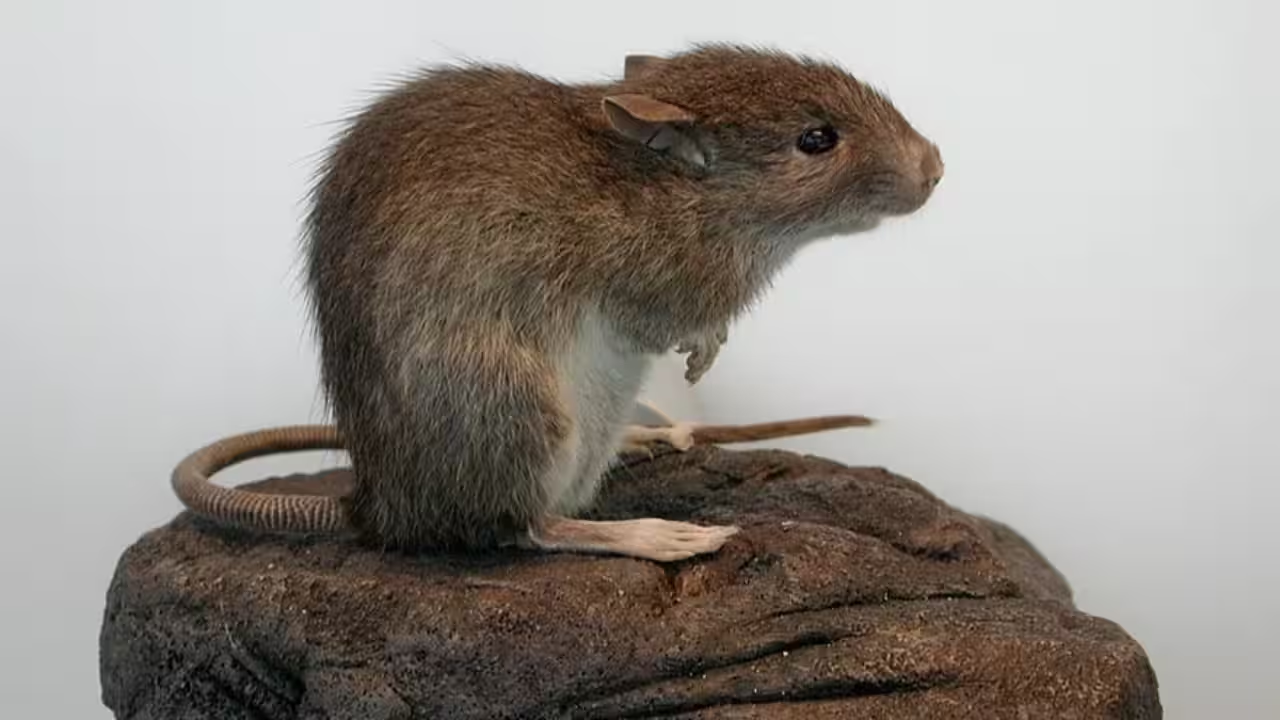
On Little Barrier Island, also known as Hauturu, in New Zealand’s Hauraki Gulf, the removal of an introduced predator produced a striking change in the breeding fortunes of a native seabird. Pacific rats, known locally as kiore, had been eating the eggs and chicks of Cook’s petrels, a small burrowing seabird that nests on the island. According to PNAS, the 2004 eradication of Pacific rats was followed by a sharp increase in breeding success at two high-altitude Cook’s petrel sites, from about 5% before the eradication to 53% in 2005. The result provided evidence that rat predation had been an important factor behind the earlier breeding failures.The change was especially notable because another introduced predator had been removed decades earlier. Cats were eradicated from Little Barrier Island in 1980, but their removal allowed Pacific rats to become a more important predator of petrel nests. The later rat eradication therefore allowed researchers to see what happened when the remaining introduced mammalian predator was removed.A predator problem hidden in the island ecosystemCook’s petrel (Pterodroma cookii) uses Little Barrier Island as an important nesting site. Cook’s petrels nest in holes where their eggs and chicks become targets for predation. Introduced Pacific rats that had lived on the island for many years ate all kinds of food, including seabird eggs and chicks. Cats that had been introduced at a later time also attacked Cook’s petrels.Research in PNAS also notes that the cats were eradicated in 1980 after a three-year campaign involving traps, dogs and poison. The outcome for the petrels was not entirely straightforward. In two high-altitude research areas, the rate of breeding declined in the years when there were no other mammals besides the Pacific rats. From 1972 to 1979, when cats and rats coexisted, about 32 per cent of the monitored burrows produced chicks. In 1982-2004, when cats had disappeared but rats persisted, the percentage declined to 9 per cent.This pattern fits what ecologists call "mesopredator release". When a larger predator disappears, a smaller predator that it previously suppressed can have a greater impact. In this case, removing cats appears to have left Pacific rats with less predation pressure, while the rats continued to prey on petrel eggs and chicks.The 2004 rat eradicationThen, in 2004, conservation authorities carried out aerial poisoning of Pacific rats with brodifacoum. Subsequent monitoring revealed that the island was now free of introduced mammals. Cook’s petrel responded quickly. Prior to the rat eradication, nesting success in the highland colonies stood at only 5% on average in 2003 and 2004. The following year, which was the first breeding season without the rats, saw nesting success increase to 53%, and for the period 2005 to 2007, it stood at an average of 59%.The Department of Conservation also reported the dramatic change in the early monitoring results. Its 2005 annual report said that around 70% of monitored Cook’s petrel chicks fledged that season, compared with years when as few as 5% survived. The department attributed the improvement to the kiore eradication, while noting that the island still needed continued monitoring before it could be confirmed rat-free. The change was not identical everywhere on the island. At a lower-altitude study site, breeding success remained broadly similar before and after rat removal. Researchers recorded about 66% success in 2003 and 2004 and about 59% after the eradication. This difference showed that the effect of rats varied according to location rather than producing a uniform island-wide response.A recovery that followed the removal of pressureAccording to Emu, Little Barrier Island had been affected by logging, burning, grazing and introduced mammals, but the removal of cats and rats reduced some of the major pressures on its native wildlife. The findings showed that Cook’s petrels living at high altitudes were especially vulnerable to rat predation because their eggs can be left unprotected while incubating, allowing rats to enter burrows and consume eggs or chicks.Little Barrier Island is currently known as an important refuge for Cook’s petrels. Population estimates for 2007, according to New Zealand Birds Online, state that Little Barrier Island is home to 286,000 breeding pairs of Cook’s petrel, the largest population of the species anywhere. In addition, there are other native species that have benefited from the eradication of introduced mammals on the island. The case of Little Barrier Island shows how removing one invasive species can trigger complex ecological changes.You use AI every day. Now get your AI Quotient. Take the AIQ test.
Topics in this story
Gathered from external sources. Rights to this text belong to whoever originally published it.