An American elm has stood for more than 150 years and witnessed 33 US presidents despite the disease that wiped out millions of these trees
A historic American elm on the grounds of the Smithsonian National Museum of Natural History in Washington, D.C., has survived for more than 150 years,
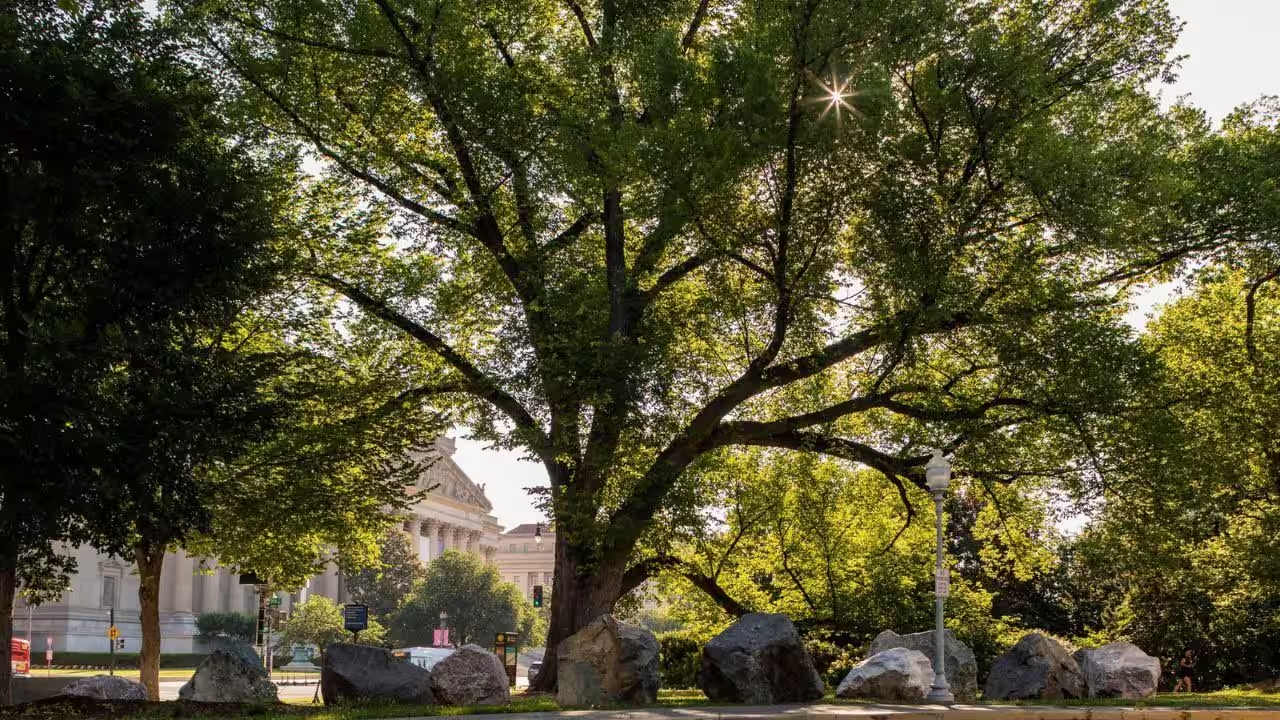
A historic American elm on the grounds of the Smithsonian National Museum of Natural History in Washington, D.C., has survived for more than 150 years, quietly witnessing generations of American history. Planted around 1850, the Smithsonian Witness Elm was already established decades before the museum opened in 1910. Since then, it has seen 33 US presidents, major national events and sweeping changes to the city around it. Its survival is especially remarkable because Dutch elm disease later killed millions of American elms across the country, leaving this tree as a living reminder of a once-common part of the American landscape.How the historic American elm witnessed 33 US presidentsThe Smithsonian Witness Elm stands near the corner of Constitution Avenue and Ninth Street, in the grounds of the National Museum of Natural History. According to the Smithsonian Magazine the tree is estimated to be more than 150 years old and has existed through the administrations of 33 presidents.The tree predates the museum beside it by roughly 60 years. When it was planted around 1850, Washington, D.C., looked very different. The surrounding landscape would gradually change as the National Mall developed and the city expanded, while the elm continued to grow in place.The Smithsonian Gardens Witness Tree information sheet, identifies it as an American elm, or Ulmus americana, and describes it as one of the oldest and most majestic trees on the Smithsonian grounds. Its position also gave it a remarkable view of events taking place between the White House and the US Capitol.Importance of American elms to WashingtonAmerican elms once played a major role in American cities. The Smithsonian Gardens document explains that the species is native to eastern North America and was widely planted throughout the United States during the 1700s and 1800s.Washington was particularly associated with the trees. According to Smithsonian Magazine, American elms became a defining part of the city's landscape, including the National Mall. Their graceful shape, shade and ability to tolerate urban conditions made them a popular choice.The Smithsonian Gardens document notes that elm trees were part of the earliest plans for the National Mall, where they helped connect parks, avenues and monument grounds. The resulting landscape created the broad avenue of trees that became such a familiar feature of central Washington.The Dutch elm disease changed that landscapeThe survival of the Witness Elm becomes more remarkable when set against the history of Dutch elm disease. The Smithsonian Gardens document states that the fungus was introduced to the United States around 1930 and went on to kill millions of American elms throughout the country.Smithsonian Magazine provides more detail on the disease's impact. Dutch elm disease was first identified in the Netherlands in 1919 and detected in the United States in 1930. It is caused by a fungus that is commonly spread by European elm bark beetles. Once inside a tree, the fungus blocks the tissues that carry water and nutrients, causing leaves and branches to die.The disease reached Washington, D.C., in 1947. By the 1970s, the US Forest Service estimated that tens of millions of American elms had been killed. The loss was especially significant because cities had planted so many elms.How the old tree continues to surviveThe Smithsonian Witness Elm is not believed to possess the strong resistance to Dutch elm disease found in some other American elms. Smithsonian arborist Jake Hendee explained to Smithsonian Magazine that many large, old elms that remain today may simply have survived through a combination of chance and careful management.That management is extensive. The tree is about 85 feet tall and more than five feet in diameter, according to the Smithsonian Magazine. Its size means that staff must pay attention not only to disease but also to the physical weight and structure of its branches.Large metal cables are used on some trees to provide support, while structural pruning can reduce the weight placed on vulnerable parts. Specialists also use sonic tomography to look inside the tree and identify weak areas without drilling into its wood.The Witness Elm also receives preventative treatment. Smithsonian Magazine reports that the tree is injected with fungicide every three years to help protect it from Dutch elm disease.What the Witness Elm reveals about long-term tree careThe Smithsonian Gardens document says the elm is carefully maintained by staff and was the first tree catalogued in the Smithsonian Gardens Tree Collection, a living collection containing thousands of trees.Its physical scale helps explain why it has attracted attention. The Smithsonian Gardens information sheet records a trunk circumference of 17.75 feet, a crown spread of 116.5 feet and a height of 80 feet. The Smithsonian Magazine article gives a later measurement of about 85 feet in height, showing the tree's continuing growth and the variation that can occur between measurements.Smithsonian arborists emphasise that relying heavily on one species can leave an entire landscape exposed to disease. A mixture of species and varieties gives city forests a better chance of withstanding possible threats.Today, its branches form a living link between the Washington of the nineteenth century and the city of the present.You use AI every day. Now get your AI Quotient. Take the AIQ test.
Topics in this story
Gathered from external sources. Rights to this text belong to whoever originally published it.