In 1954, an Alabama farmer found a piece of a meteorite on a dirt road; he sold it for enough to buy a farm and a car, but the exact price was never reported
In 1954, an Alabama farmer found a meteorite on a dirt road, selling it for enough to buy a house and a car. Explore the puzzling stories of two meteorite discoveries linked to the famous Sylacauga fall.
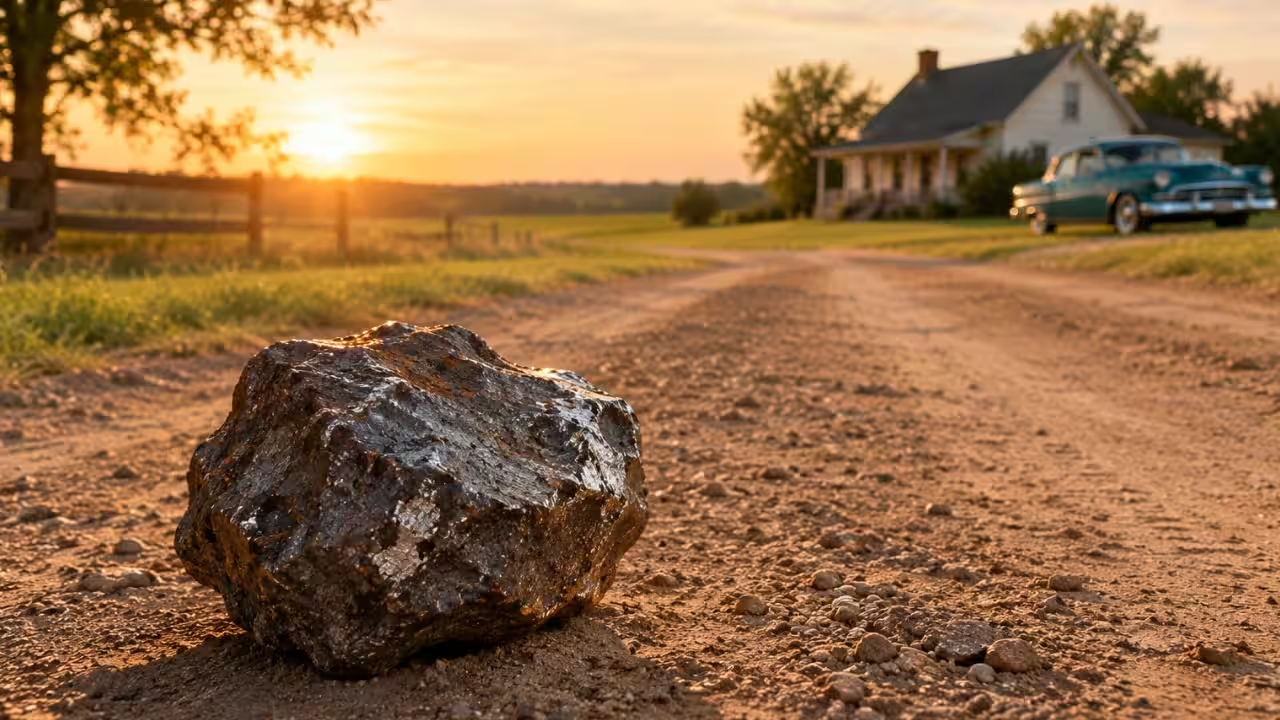
Most stony meteorites give little warning beyond a bright fireball and a series of sonic booms. In the following minutes, questions will start arising about what landed and where. Once such a meteoroid starts breaking down in the upper atmosphere, the resulting chunks do not stay together and scatter all around, landing on rooftops, in fields and even in the middle of the road. It all depends on the finder and their ability to determine the significance of the find. Such instances were recorded twice in the famous fall in the Southern United States and it is also the same case where there is not a single piece of financial information revealed.The Hodges stone and the fireball over Oak Grove The Encyclopedia of Alabama records that a meteorite crashed through the roof of a home near Sylacauga, in Talladega County, on November 30, 1954 and struck resident Ann E. Hodges. The rock reportedly weighed about eight and a half pounds and is now on display at the Alabama Museum of Natural History in Tuscaloosa. The minerals database Mindat suggests that the rock first hit a radio console and then struck Mrs. Hodges. Mindat gives the stone’s weight as 3.86 kilograms, while the combined weight of the two stones is reported as 5.54 kilograms. It categorizes it as a chondrite of the H4 type. Mindat lists the fall time as 12:46 hours on November 30, 1954. The ownership of the meteorite was a point of conflict as well. While the encyclopedia claims that it was only after the intervention of the congressman, Kenneth Roberts, that the stone was returned to the state, Alabama Living magazine claims that the landlady of the Hodges returned it to the Hodges family in 1955 for $500.Julius Kempis McKinney and the second stone The second stone was discovered by Julius Kempis McKinney, a local farmer who, the Encyclopedia of Alabama says, found it on a dirt road on December 1, 1954, when his mules refused to move because of the black rock. He sold the piece through a lawyer and it went to the Smithsonian Institution, for enough money to buy a small farm and a used car.There are different stories of the discovery. One of them says that he brought the stone to the postman, who was the only government representative he trusted. Another story states that he put the stone aside and came back home in the evening, having heard about the stone of the Hodges. Mindat lists the McKinney stone’s weight as 1.68 kilograms. The postman and McKinney concluded that there must be a connection between the rock and the Hodges stone and it could be valuable. The information can be found on the Weekly Recess website.A sale to the Smithsonian whose price was never reportedAlabama Living reports that the sum was never revealed and the Weekly Recess and Bizzarro Bazar websites likewise give no figure for the amount. The Encyclopedia of Alabama describes McKinney as probably the only major figure in the story to claim a satisfactory ending. Smithsonian magazine reports that McKinney’s stone is in the collections of the Smithsonian’s National Museum of Natural History, where it is on view. Hodges donated her stone to the Alabama Museum of Natural History in 1956, after the ownership dispute left her unable to find a buyer, according to Sky at Night Magazine.What a 2019 NASA analysis says about meteorite strikes on people and buildingsThe NASA analysis, Kinetic Damage from Meteorites, presented as a poster at the 2019 Planetary Defense Conference, describes the Sylacauga stone as a 4-kilogram meteorite that indirectly hit Hodges. In addition, a 4-gram stone falling onto a young boy is recorded for the 1992 Mbale fall; neither incident caused death. The poster adds that fragments on the order of 0.1 kilograms may be enough to cause serious human injury or death and it cites Halliday et al.’s 1985 estimate that a person is struck by a meteorite roughly once a decade, most likely by a gram-sized piece. A second study,The fall, recovery, classification, and initial characterization of the Hamburg, Michigan H4 chondrite, published in Meteoritics & Planetary Science, examined a stone from the 2018 Michigan fall that belongs to the same H4 group as the Sylacauga stones.Why the two Sylacauga stones ended so differentlyThe same NASA poster also lists 48 meteorites found in North America between 1962 and 2016, of which 23 fell on roofs or buildings and three on cars. In other words, a meteorite striking a building is not unusual, but one striking a person, as happened to Hodges, remains extremely rare. McKinney’s good fortune lay in recognizing that the rock might be valuable and acting on it.You use AI every day. Now get your AI Quotient. Take the AIQ test.
Topics in this story
Gathered from external sources. Rights to this text belong to whoever originally published it.