Stabbed, bleeding, still fighting: How hero Indian pilot helped stop another 9/11-type attack
This week, we are tracking: The 30-second plunge: How hero Indian pilot helped stop another 9/11-type attack From MAD to AI: Are Altman and Amodei the new
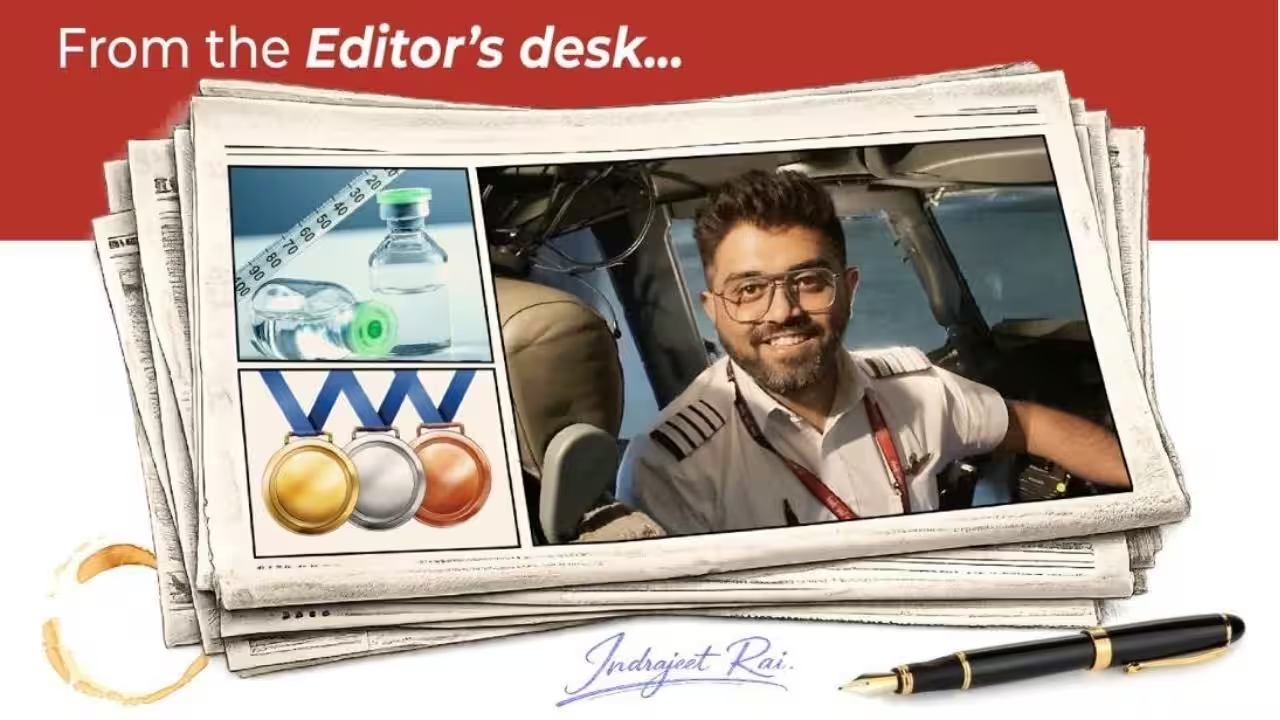
This week, we are tracking:The 30-second plunge: How hero Indian pilot helped stop another 9/11-type attackFrom MAD to AI: Are Altman and Amodei the new keepers of Doomsday?MRP mystery: Who gets the money between factory and patient?Asian Games: A medal in many sports, a gold in too fewStabbed, bleeding, still fighting: How hero Indian pilot helped stop another 9/11-type attackAt about 34,000 feet over Saudi Arabia, flydubai flight FZ1073 was a routine Dubai-to-Tel Aviv service carrying 174 people on board. Then there was sudden mid-air action. The co-pilot stabbed the captain and tried to crash the aircraft.The Boeing 737 Max 8 dropped more than 14,000 feet in about 30 seconds, according to Flightradar24 data. A passenger, Naama Bershadski, said she closed her eyes, convinced “We are going to die”.In the cockpit, Captain Smit Machchhar, an Indian national, was badly wounded and lying on the floor. Israeli officials say he gathered what strength he had left to hit the door release.That gave passengers and crew a way in. They overpowered the co-pilot. Two other pilots, who were on board to operate the next flight, took control of the aircraft. The flight diverted to Tabuk in Saudi Arabia, where it landed safely.A heroPraise for Machchhar came quickly. PM Modi called him a hero and said his courage saved hundreds of lives. “In the face of the gravest danger... he showed immense courage and an unwavering resolve to protect the lives of others,” PM Modi wrote on X.Israeli PM Benjamin Netanyahu credited him with preventing a "catastrophic midair disaster."“The pilot, in bad shape, had the sense to open the door. In a way he was a hero,” US President Donald Trump said.‘Kill me, kill me’Netanyahu said that the co-pilot had undergone “Islamist radical indoctrination”. He told Fox news that when restrained, the co-pilot cried “kill me, kill me”. The co-pilot, reported to be an Omani national, has not been named publicly yet.Read more:'I was reciting Hanuman Chalisa': flydubai 'hero' Captain Smit Machchhar tells PM Modi about cockpit orde'Consider for Ashoka Chakra': Milind Deora writes to PM Modi seeking honour for pilot Smit MachchharAirlines wake up to ‘insider threat’ after flydubai attackPM Modi speaks to 'hero' flydubai pilot Smit Machchaar, hears his account of the ordealThe world's Smit-ten: PM to Trump, praise pours in for braveheart pilotForget Trump and Xi. Altman and Amodei could decide humanity’s fateThe world thinks its future rests on Trump and Xi. It may come down to whether Sam Altman and Dario Amodei can stop hating each other.Since the US and erstwhile Soviet Union acquired nuclear weapons, humanity has lived with the possibility of annihilation: Mutually assured destruction, or MAD.Now, it’s the US and China. Donald Trump and Xi Jinping can escalate or ease a trade war, restrict or exchange technology, and decide whether the US and China cooperate on the risks of artificial intelligence.But the more consequential rivalry may be unfolding below the level of presidents. It is between Sam Altman of OpenAI and Dario Amodei of Anthropic.The pace is set by a personal feud. Amodei left OpenAI in 2020 convinced that Altman was a manipulator who could not be trusted with AGI. As Kevin Roose recounts in the Atlantic, Amodei has written in internal messages that Altman and OpenAI are "evil". However, some at OpenAI regard Amodei as a power-hungry virtue-signaller.The danger in the Altman-Amodei rivalry is not that they are reckless by temperament. It is that the feud has turned caution into a competitive liability.The worst scenario is a mutual misread. One lab, convinced its rival is about to leap ahead, releases early or trims a safety test. The other sees this and does the same. Nobody planned for catastrophe, and everybody can explain their own step as defensive. A hotline between Washington and Beijing won't help if the trigger is pulled in San Francisco, because by the time a model misbehaves in the wild, the decisions that mattered were already made.Read more:Less than a week after Chinese President Xi Jinping's visit, the US government rules out working with China on AI; the American President says: Do not want ...As AI fears ‘spread’, Donald Trump to meet CEOs of Meta, Google, Nvidia, Anthropic and other tech companies$1tn at stake & unbridled power: Amodei, Altman & Musk fear AI could doom humanity but Trump & China can’t seem to stop race - why?Bombs without brakes? Why the US-China AI race may be harder to control than the nuclear one'Let's race, not wrestle': 5 takeaways as Trump-Xi navigate trade, Taiwan and AIRs 2,700 to Rs 27,000: Inside the strange economics of India's medicine pricesOn September 22, the Supreme Court asked why an essential cancer drug that retailers buy for about Rs 2,700 can carry an MRP of Rs 27,000. A week later, a bench of Justices Vikram Nath and Sandeep Mehta called the tenfold markup "carnage" and asked why the 16% retail margin used in price-control rules could not cap MRP over the price to retailer.The SC also noted that inflated MRPs can also end up being reimbursed under government-funded health schemes. In that situation, the margin is not merely being paid by a desperate patient. It is being paid by the taxpayer.The Centre acknowledged that excessive pricing was a problem and said it would consult officials to find a solution. The case returns on October 12.The MRP questionWho keeps the difference between the price the pharmacy pays and the price printed on the strip. A pharmacy’s purchase price is not the factory’s manufacturing cost, which is rarely public. The printed MRP is a maximum selling price. The manufacturer, marketer and distributors earn their shares before the strip reaches the pharmacy.Why simply capping MRP may not solve everythingIf regulators merely cut the printed MRP but leave incentives throughout the chain untouched, manufacturers, distributors, hospitals and retailers can reorganise margins elsewhere.The question is no longer merely how cheaply India can make a medicine.It is why an inexpensive medicine can become so expensive by the time a sick Indian is asked to pay for it.Read more:Kerala High Court expands Union government’s power to intervene in pricing of patented drugs'Broad daylight dacoity': SC questions overpricing of essential cancer drugsIndia accounts for 20% of world’s childhood cancers: JipmerIndia's Asian Games: Plenty of medals, not enough goldIndia's medal count at the Aichi-Nagoya Asian Games is healthy, but the gold count is a worry.Through October 2, India has 75 medals (15 gold, 25 silver, 35 bronze), good for fifth place.Gold problemIndia finished fourth at Hangzhou with a record 107 medals, including 28 gold. Of those golds, 20 have already slipped away.What’s nextA strong finish would make this a better campaign. But the broader assessment is already coming into focus: We can win medals in many sports, but we need more athletes and teams to take the final step to gold.Read more:Sujeet Kalkal wins India's first wrestling gold at Asian Games 2026Three golds in a day! Ankush Panghal completes Indian boxing hat-trick at Asian GameParveen Hooda holds her nerve to clinch Asian Games boxing gold in 3-2 thrillerAsian Games 2026 India medal winners: Full list of athletes and medals till October 2Asian Games 2026: India add sepaktakraw bronze as medal tally swells to 72Editor’s picks - Some of our most and must-read articles:Kill webs, drones and less guesswork: How India's armed forces are using AI in combatWhy Tamil Nadu’s men are dying youngerSmoking just 1 cigarette a day: Is there a safe number for your heart?Jail, isolation, crackdown: Why Pakistan’s establishment has failed to break Imran KhanSIR, 'vote chori' row: Is it time for Congress and INDIA bloc to take a leaf out of CJP's playbook?Disclaimer: Views expressed above are the author's own.
Topics in this story
Gathered from external sources. Rights to this text belong to whoever originally published it.